





More In Safety: The Car Seat and the Company Car: Why Your Fleet Needs A Child Safety Seat Policy
Daytime Running Lights: Benefits, Limitations, and Fleet Driver Responsibilities
How Daytime Running Lights strengthen safety on the road.
January 27, 2026
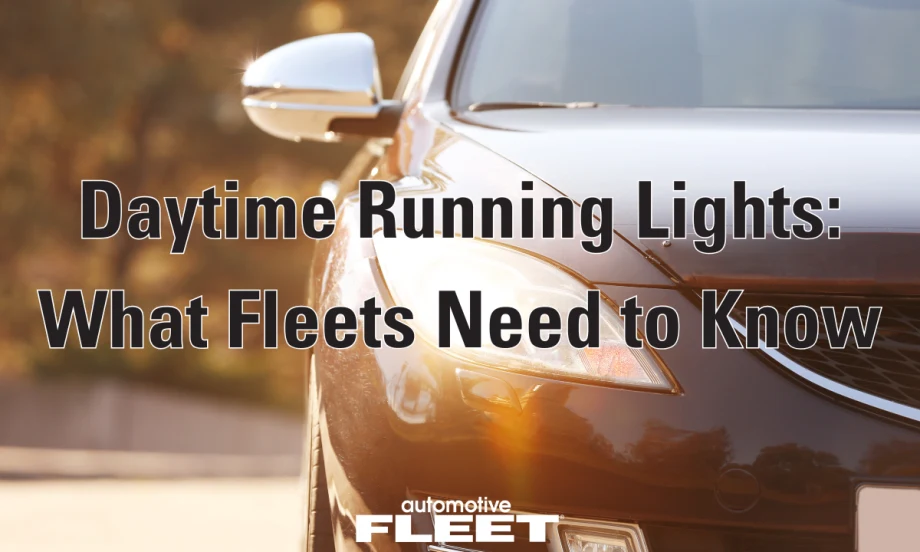
Daytime running lights offer safety benefits, but their limitations highlight the need for clear fleet policies and driver training around proper vehicle lighting.
Credit: Automotive Fleet
3 min to read
Daytime driving often creates a false sense of safety for fleet drivers. While nighttime hours carry heightened risk, nearly half of multi-vehicle crashes occur during daylight hours due to traffic volume, congestion, and reduced vehicle conspicuity. One technology designed to address this challenge is Daytime Running Lights (DRLs), but understanding how they work and where they fall short is critical for fleet safety.
The Benefit of Daytime Running Lights
DRLs are forward-facing lights that automatically illuminate when a vehicle is in operation. Their primary purpose is visibility, helping other road users detect approaching vehicles sooner, particularly in oncoming traffic, intersections, and visually complex driving environments. Studies have shown that vehicles equipped with DRLs experience fewer daytime multi-vehicle crashes, making them a valuable safety enhancement for fleet operations.
The Limitations Fleet Drivers Must Understand
A common misconception is that placing headlights in the “AUTO” position ensures full vehicle visibility at all times. In most vehicles, DRLs illuminate only the front of the vehicle. Rear lights and brake lights are typically not activated during daylight operation unless headlights are manually turned on. While some newer vehicle models and enhanced lighting systems do activate rear lighting with DRLs, this is not universal. Fleet drivers should never assume their vehicle is fully illuminated simply because the lights appear to be on. DRLs also do not replace headlights in adverse conditions. Automatic headlight systems rely on light sensors, which may not activate properly in rain, fog, snow, dawn, dusk, or heavy overcast.
Headlight Safety Features Fleet Drivers Must Actively Manage
To reduce risk, fleet drivers should be trained to evaluate and manage their vehicles’ lighting systems rather than rely solely on automation.
Key safety considerations include:
Daytime Running Lights (DRLs) – Benefits and Limitations: Drivers should know whether their assigned vehicle is equipped with DRLs and understand that while they improve forward visibility, they do not guarantee full vehicle illumination or activate rear lights.
Manual Headlight Activation During Daylight: If a vehicle is not equipped with DRLs or if visibility is reduced due to glare, shadows, or traffic conditions, drivers should manually activate headlights to improve vehicle conspicuity.
Inclement Weather Activation: Headlights should be manually turned on in rain, fog, snow, sleet, or anytime windshield wipers are in use. This ensures both front and rear lights are illuminated, improving visibility for surrounding traffic.
Fleet Driver Responsibilities
Fleet safety depends on informed driver behavior, not technology alone. Drivers should:
Understand how lighting systems function in their assigned vehicles · Avoid assuming “AUTO” settings provide full visibility
Manually activate headlights when conditions change
Follow company policy regarding headlight use in daylight and inclement weather
The Bottom Line for Fleet Safety
Daytime Running Lights are a valuable safety enhancement, but they are not a complete visibility solution. Fleet drivers who assume “auto equals protected” may unknowingly reduce their visibility to others, particularly from the rear. DRLs should be viewed as an added safety layer, not a substitute for active driver decision-making. A strong fleet safety culture reinforces:
Manual intervention when conditions change
Policy clarity on lighting requirements
Ongoing education as vehicle technology evolves
Visibility saves time, reduces crashes, and protects lives, but only when drivers understand both the capabilities and limitations of the technology they rely on. If your lights are on, are you sure your vehicle is visible? Daytime Running Lights don’t always activate rear lights, and assumptions can increase risk.
Subscribe to Our Newsletter
More Safety

What’s Next for Fleet? Safety, AI & Industry Recognition | AF News Recap
Could your company's culture be encouraging distracted driving? This week, we're exploring how workplace expectations affect driver safety, what AI, EVs, and autonomous vehicles could mean for the future of fleet management, and how fleet professionals can strengthen their award nominations.
Read More →
Does Your Fleet's Culture Encourage Distracted Driving?
What happens when the people responsible for enforcing safety rules are the ones setting the wrong example? The answer may reveal why some of the biggest risks to fleet drivers have little to do with what's written in the employee handbook.
Read More →
Sponsored•October 1, 2026
Fleet Manager’s Ultimate Playbook: Navigating the New Standard in OEM Connectivity
Rising operating costs, driver safety concerns, and unplanned downtime are putting unprecedented pressure on modern fleets. Discover how fleet managers use embedded OEM connectivity and real-time vehicle data to cut TCO, prevent downtime, and protect drivers without aftermarket telematics hardware.
Read More →
From Driver Well-Being to EV Charging | AF News Recap
Mental health belongs in the fleet safety conversation. This week, we’re looking at five ways fleets can support employee well-being before a crisis, plus Holman’s expansion in Mexico, new one-day Fleet Forward passes, and why EV charging demand is outpacing infrastructure growth.
Read More →
Nexar-Nauto Merger Aims to Give Fleets Better Safety Intelligence Through Larger Driving Dataset
Stefan Heck tells Automotive Fleet that combining more than 10 billion miles of driving history with Nexar's AI models will give fleets deeper insights into driver risk and roadway conditions than either company could provide independently.
Read More →
Don't Wait for a Crisis: 5 Ways to Build Mental Health Into Your Fleet Safety Program
For Suicide Prevention Month, fleet and safety leaders have an opportunity to put mental health where it belongs: at the center of workplace safety.
Read More →
How Camera Data Can Strengthen a Fleet’s Insurance Renewal
Insights from a commercial insurance carrier and a broker show how fleets can turn video telematic data, driver coaching, and improved claims results into a stronger case at insurance renewal.
Read More →
The Safest Fleets Aren’t the Ones with the Most Technology
You’ve made the telematics investment. Here’s how to capture the other half of its value and build the safest fleet on the road.
Read More →
Sponsored•August 7, 2026
Hidden in Plain Sight: Fleet Compliance Risks
Fleet compliance isn't just about having policies — it's about consistently enforcing them. This practical guide reveals six hidden compliance risks common in public sector and shared fleet operations and outlines proven strategies to improve visibility, accountability, and audit readiness
Read More →
NETS Sets 2026 Fleet Safety Benchmark Conference for Indianapolis
The Sept. 15–17 program will feature fleet benchmarking data, case studies, emerging technologies, and implementation strategies while running alongside the NSC Safety Congress & Expo.
Read More →