




Collision Management Programs that Work
Regular program reviews, benchmarking, gathering metrics, and holding your provider accountable for results are important to cost-effectively manage fleet vehicle accidents.
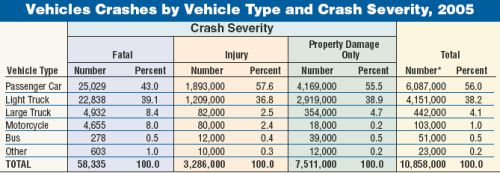
In 2005, on average, a person was injured in a police-reported motor vehilce crash every 12 seconds and someone was killed every 12 minutes.
What area of fleet management causes many fleet managers in corporate America — typically a highly pragmatic and solidly grounded group — to erect psychological barriers? If you said “accident or collision management,” you’d be absolutely right. The fact is that, all too often, the concept of vehicle collisions tends to create an attitude that might be described as acceptance. You know full well that accidents will occur, and you accept the fact that you’ll have to budget for accident management. But, the concept is so distasteful that, in too many instances, there is a tendency to simply wish it would disappear — to avoid benchmarking and gathering metrics and holding your provider accountable for results.
However, those same metrics, with other best practices, can make your accident management program more cost-effective and efficient than many fleet managers consider. So, at mid-year, when the number of drivers on the road increases due to vacations, long weekends, and the lure of good weather, it is an appropriate time to review an organization’s collision program and determine what can be done to optimize results.
Automatic Repair Authorization —When to Step In
The first thing to consider is the timing of a fleet manager’s direct involvement in the vehicle repair decision. For many enterprises, repairs up to about $2,000 are automatically authorized. In the past few years, however, the severity of accidents and corresponding repair requirements, have been on the rise for organizations throughout North America. Factors such as an overall increase in prices for vehicle parts and electronic components have been responsible for this upward trend. Working closely with your fleet management firm may help to offset these rising costs. Wheels Inc., for example, has maintained a relatively low repair rate and still recommends a threshold of $2,000.
Setting a repair authorization ceiling offers two major benefits. First, the fleetmanager saves time to focus on more strategic issues. Secondly, since fewer repairs need approval, the time a driver spends in a rental car can be significantly reduced.
However, despite these benefits, it sometimes makes sense to step in to review repair situations. If, for example, the vehicle is close to the end of its replacement cycle, the fleet manager may want to make the call on whether to authorize repairs even if the estimate is under the $2,000 ceiling.
To Repair or Not to Repair?
The decision to authorize or forego repairs obviously significantly impacts a collision management program’s overall effectiveness. Several factors must be considered. The first, of course, involves assessing what percentage of the total repair cost is tied to required safety-related repairs.
Corporate image is another consideration. For example, a vehicle is close to replacement. A minor scrape that costs more to repair than its potential impact on resale value might still be repaired if the vehicle’s business purpose is tied to the company’s image. However, if the vehicle is purely for business transportation, this type of cosmetic bodywork might be foregone.
The potential for hidden damage is another critical factor in the repair decision. A technical review of the accident photos by a collision repair specialist, the nature of the crash, and the vehicle’s model-specific history should all play into the final repair decision.
What Makes a Collision Expert?
A collision specialist’s expertise plays an all-important role in determining the success of an accident management program. Not surprisingly, the number of years the expert has spent in collision repair is one key factor. Also critical is the level of formal training and certification that underlie that experience.
The Inter-Industry Conference on AutoCollision Repair (I-CAR) is a leading organization offering training and certification programs for collision repair in North America. I-CAR provides several certification levels for individuals and companies. For a well-run fleet, it is strongly recommended that individuals managing the organization’s repairs hold the I-CAR platinum designation and that the fleet management firm or third-party accident management services provider by which those experts are employed is recognized at the gold level.
Fleet managers should also be aware of a lesser-known, but important, organization — the National Association of Subrogation Professionals (NASP). This group is the only association in the country that offers a professional designation for subrogation specialists. Given the many variables and regulations that impact the art and science of subrogation, a high level of independently certified expertise can be critical to successful accident — and cost — management.
Another area to examine is the integration between the accident repair team and those involved with recommending the most appropriate fleet vehicles. To ensure smooth communication and knowledge transfer, these groups should work together very closely. Ideally, both groups are services offered by a single supplier.
Indepth knowledge of the resale market is also essential for successful accident management. It’s an extremely complex market and trending to become even more so. As a result, the expertise required to assess market value, identify the appropriate time to replace a vehicle, and target the best resale channel depends on a laser focus in this specialized market sector. Since few organizations have a fleet large enough to build and justify sustainable resale expertise in-house, this activity is generally outsourced.
In any case, resale expertise comes from working with large volumes of vehicles on a continual basis. Wheels, for example, is involved in the resale market for about 60,000 vehicles annually compared to third-party providers that typically salvage perhaps 4 percent of the vehicles they manage.
Lastly, the level of knowledge individuals making repair decisions have of your organization’s resale plans plays an important role in making appropriate repair / forego / salvage decisions for each vehicle.
The Right Body Shop: Independents or Multi-Shop Networks
Traditional body shops tend to be independently run and fairly small with a few vehicle repair bays. However, a new type of body shop is rapidly emerging, and its business model offers considerable benefits for corporate fleets. The new body shop is part of a local or regional multi-shop network managed by a single owner. These networks — sometimes referred to as consolidators — are taking repair results to new levels by gaining economies of scale through a single back-office and business process infrastructure that applies to all locations.
The multi-shop networks offer a variety of benefits for cost-effective and highly efficient fleet accident management. First, these networks generally perform repairs at a lower cost than individual competitors because they can purchase parts in bulk at a lower price, have a lower overhead-to-repair bay ratio, and handle division of labor in the same way as in manufacturing — by specialization. Rather than tying up a repair bay with a single vehicle for several days or more, the vehicle is moved from station to station as repairs are completed. And, if a repair must be held while waiting for a part on order, the vehicle is moved to a temporary hold area.
In addition to optimizing the repair flow process, networks typically offer highly trained technicians and utilize the latest technology. As a result, the networks also deliver shorter repair time and decreased vehicle rental cost.
Taking advantage of these multishop network benefits is not currently an option in some metropolitan areas. Additionally, when accident management is handled at the company’s local branch level, negotiating a better repair deal may be possible with a smaller independent eager for the business. However, as networks continue to open in new locations, they are definitely worth investigating because of the significant benefits they can deliver.
Measuring Collision Management Program Success
Whether comparing your collision management program to that of another organization or simply evaluating your own company’s performance, several metrics are useful in determining the program’s level of success.
The most common measure of repair costs is “average dollars per repair.” Another metric some fleets use is the “average repair turnaround time.” This latter metric is generally used by service fleets in which the vehicle is fundamental to the work and rental or other replacement vehicles are unavailable.
In fleets where the driver and a rental car can carry out the organization’s business, a useful measure is the “average rental days per collision claim.” Here, the rental time — not the repair time — drives costs. We still see the general benchmark of approximately five to six rental days per $1,000 of repair as a useful rule-of-thumb to measure effectiveness in managing the repair time.
Also helpful is tracking metrics that benchmark subrogation — the recovery damages from the at-fault party. In addition to claim recovery success percentage, “average dollars recovered per claim” and the “percentage of claims pursued” are often used in subrogation situations.
Many organizations choose to measure the success rate, i.e., the “percentage of dollars recovered” versus the “percentage of dollars sought” in subrogation. However, this metric can be misleadingly high if the company is conservative in choosing which claims are pursued via subrogation. For this reason, evaluating the number of dollars actually recovered per claim may be more helpful. And, keep in mind, damage recovery may be limited by state or by province regulations. These limits may reduce the potential for damage recovery, depending on the locations where vehicles are concentrated. In these scenarios, the fleet management firm can work with you to improve the end result. Wheels pursues all costs including diminished vehicle value and loss of use, a practice more accident management providers are following.
Additional metrics to help evaluate programs include driver satisfaction with the process, compliance with loss reporting requirements, and the level of integration between the collision program and the overall fleet program. Close integration increases the chances of making the right repair decision because information such as vehicle warranty details or a one-off change to a vehicle’s replacement date is less likely to be lost or overlooked.
The most appropriate metrics for each organization depend on the fleet’s business purpose and vehicle applications. Working with a supplier who knows every detail of your program will ensure building a collision program flexible enough to accommodate changing needs and capable of delivering measurable success.
About the Author:
Stratford Dick is director of marketing for Wheels Inc., a fleet management company headquartered in Des Plaines, Ill.
More Operations

Here's When You Should Make an Exception to Fleet Policy
Fleet policies are designed to create consistency, but not every driver or situation fits neatly within standard rules.
Read More →
AI-Native or AI-Acquired: What Should Fleet Managers Look for in an AI Platform?
Six questions can help fleet managers look beyond AI marketing claims to evaluate integration, data access, and real-world operational performance.
Read More →
A buyer's guide to fleet management software in 2027
Buying fleet management software in 2027 means looking beyond features and price. As fleet operations, technology and expectations evolve, this guide explores what today’s fleet professionals should consider when choosing a system that can deliver value now and adapt to what comes next.
Read More →

What Will Shape the Next Era of Fleet Management?
EVs, AI, and autonomous vehicles are reshaping fleet management. Discover what’s ahead—and how fleet leaders can prepare for the next era.
Read More →
How Fleets Can Recruit and Train Veterans for Technician Roles
Here's how the technician shortage has affected uptime for fleets, and what to do about it.
Read More →
Avis Budget Group Deploys Neology Toll Management Technology Across Major Brands
Neology’s neoFleet platform will manage toll transactions and toll-authority operations for vehicles across Avis, Budget, Payless, Budget Truck and Zipcar.
Read More →
Fleet Personal-Use Charges Edge Higher in 2026
Nearly eight in 10 surveyed fleets allow personal use of company vehicles, while just over half of respondents report charging employees for the privilege.
Read More →
The Future of Fleet + What’s Changing Right Now | AF News Recap
Could developments overseas offer a preview of what’s coming for U.S. fleets? This week, we’re looking at the future of AI, autonomy, and electrification, plus Ford Pro’s new certified pre-owned program, smarter vehicle offboarding, and a new way for fleets to manage toll expenses.
Read More →
How to Handle Vehicle Offboarding
What do fleet managers need to do when a driver leaves?
Read More →
Fleet Manager’s Ultimate Playbook: Navigating the New Standard in OEM Connectivity
Rising operating costs, driver safety concerns, and unplanned downtime are putting unprecedented pressure on modern fleets. Discover how fleet managers use embedded OEM connectivity and real-time vehicle data to cut TCO, prevent downtime, and protect drivers without aftermarket telematics hardware.
Read More →