




Coca-Cola Bottler Finds It's Easy Being Green
Coca-Cola Bottling Company Consolidated bought Toyota Prius models to cut fuel costs. However, the company not only saved fuel expense, but also reduced vehicle operating costs and tailpipe emissions.
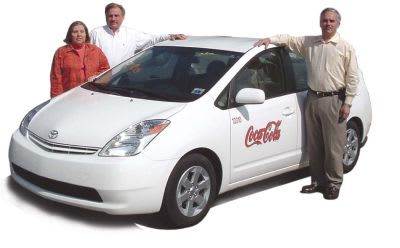
CCBCC fleet team members (L-R: Hope Barnhardt, fleet admin. mgr.; Gerry Beattie, dir. fleet ops.; and Bo Calloway, dir. fleet assets and process).
Coca-Cola Bottling Company Consolidated (CCBCC) found going “green” not only has provided significant economic benefits, but also earned the company public recognition for helping the environment. Headquartered in Charlotte, N.C., CCBCC is the second-largest bottling company in the nation. Serving a growing base of customers throughout the Southeast for over 100 years, the company operates a fleet of 2,500 light-duty vehicles that travel approximately 40 million miles annually.
Reducing Emissions a Company Goal
One company goal has been to reduce emissions on the manufacturing side of the business. It made good sense to expand this effort to fleet vehicles and to be a good corporate citizen. Five years ago, Robbie Snipes (retired), VP, fleet and transportation operations at CCBCC began an internal investigation into fuel expense and potential sources for savings. Snipes had witnessed a significant increase
in overall company fuel costs and was researching all opportunities to
reduce fuel expense. Part of his initial research led him to the potential offered by hybrid-vehicle technology. Snipes sought out his Toyota representative to gain information about the Prius, its technology, availability, estimated residual value, and expected maintenance costs.
Over the next several months, Snipes examined many different scenarios and concluded the Toyota Prius would provide significant fuel savings and could be a highly viable alternative to the company’s lightduty fleet vehicles. He recommended to management changing the majority of the light-duty fleet to the Toyota Prius. Executive management agreed with the assessment study and in 2004, CCBCC ordered its first group of Toyota Prius.
Today, the company operates 400 Prius vehicles, with an additional 150 on order for the balance of 2007. Company officials intended to purchase the hybrid vehicle exclusively; however, product availability limited vehicle acquisition during the replacement cycle.
$8,000 in Bottom-Line Savings Realized over 100,000 Miles
The switch to a hybrid vehicle produced definitive fuel cost savings. Bo Calloway, director of fleet assets, calculated about $4,000 in fuel costs at 100,000 miles for the Toyota Prius versus
more than $10,000 for the previous vehicles used in the same fleet application. That equates to $6,000 in fuel savings over the expected 100,000-mile use period. This saving was calculated at a gas pump cost of $2 per gallon (the first of several conservative predictions).
CCBCC also has discovered substantially reduced vehicle maintenance costs in using the Prius. When Snipes retired, Rich Clark was named to the position. He has been collecting maintenance expense data for the Prius over a three-year operating period, comparing this cost against a similarly sized group of vehicles in operation at CCBCC.
Based on 75,000 miles of use so far, the hybrid Prius has a running cost per mile of about $0.025 — two-and-a-half cents per mile. The company’s other fleet vehicle records $0.045 per mile. At
a projected 100,000-mile cycle, the cost per mile total is expected to provide another $2,000 per-unit saving, bringing Coca-Cola Consolidated’s bottom-line savings to $8,000 per unit.
Residual Values Estimated Conservatively
During initial lifecycle estimates,Snipes and CCBCC estimated a conservative
projected Prius residual value. No data existed at that time for used hybrid-vehicle values, especially at 100,000 miles. The company based
an estimated residual on a 4-5-year old Prius at less than a Toyota Corolla of similar age and mileage. Hard data on Prius values for high
mileage is still limited; however, it is becoming clear that the study’s estimated Prius residual was substantially low.
CCBCC expects to sell a few of Prius vehicles in 2008 to obtain a realistic net dereciation value. The balance of the hybrids in operation will be kept in service until they begin to see a significant increase in vehicle maintenance expense. Overall, Clark, Calloway, and Coca-Cola Bottling Consolidated are experiencing a total cost of ownership substantially less for the Toyota Prius than for any other light-duty car in their fleet.
Hybrid Brought Rewards Beyond Ownership Cost Savings
Adding hybrid vehicles to the fleet has earned rewards beyond reduced cost of ownership. The Environmental Protection Agency has rated the Toyota Prius rated a super ultra-low emission vehicle (SULEV). As such, this hybrid has the cleanest tailpipe emission of any vehicle on
the road with the exception of a zero-emission vehicle (ZEV).
Calloway estimated the carbon dioxide (CO2) emission for the Prius versus the company’s other common fleet vehicle. During the expected 100,000-mile use period, the Prius will emit just 35,250 lbs. of CO2. The other CCBCC fleet vehicle would emit 105,700 lbs. of CO2 during the same period, based on EPA estimates. The reduction of more than 70,000 lbs. represents a 67-percent decrease in emission of this primary greenhouse gas.
CCBCC originally bought Toyota Prius models to save fuel costs. However, the company received the first annual North Carolina Mobile Clean Air Renewable Energy (CARE) Award, demonstrating that a company can enhance its bottom line, save fuel expense, and reduce overall vehicle operating costs, while at the same time reducing tailpipe emissions and helping the environment.
The CARE Awards were created through the efforts of three N.C. state agencies with overlapping interests in air quality and energy. These agencies joined forces to identify and recognize individuals and organizations making a significant contribution to reducing emissions and energy use. According to Calloway, “Being green is saving gold!”
With apologies to Kermit the Frog, it is easy being green after all..
More Operations

Avis Budget Group Deploys Neology Toll Management Technology Across Major Brands
Neology’s neoFleet platform will manage toll transactions and toll-authority operations for vehicles across Avis, Budget, Payless, Budget Truck and Zipcar.
Read More →
Fleet Personal-Use Charges Edge Higher in 2026
Nearly eight in 10 surveyed fleets allow personal use of company vehicles, while just over half of respondents report charging employees for the privilege.
Read More →
The Future of Fleet + What’s Changing Right Now | AF News Recap
Could developments overseas offer a preview of what’s coming for U.S. fleets? This week, we’re looking at the future of AI, autonomy, and electrification, plus Ford Pro’s new certified pre-owned program, smarter vehicle offboarding, and a new way for fleets to manage toll expenses.
Read More →
How to Handle Vehicle Offboarding
What do fleet managers need to do when a driver leaves?
Read More →
Fleet Manager’s Ultimate Playbook: Navigating the New Standard in OEM Connectivity
Rising operating costs, driver safety concerns, and unplanned downtime are putting unprecedented pressure on modern fleets. Discover how fleet managers use embedded OEM connectivity and real-time vehicle data to cut TCO, prevent downtime, and protect drivers without aftermarket telematics hardware.
Read More →
U.S. Bank Adds Verra Mobility Toll Management to Voyager Fleet Platform
The integration allows U.S. Bank Voyager fleet customers to manage toll payments and violations alongside fuel, EV charging and maintenance expenses.
Read More →
ADAS Prevents Crashes. But Repairs Cost More | AF News Recap
ADAS-equipped vehicles may crash less often, but they can cost more when they do. This week, we’re breaking down what that tradeoff means for fleets, plus Subaru’s first Forester Wilderness Hybrid, Nissan’s new e-POWER Rogue, and why Calstart has become Catalyst Mobility.
Read More →
Moventum Fleet Management Names Mark Iorillo Head of Sales
Iorillo brings nearly 20 years of fleet management and sales experience to the role, including previous positions at Element Fleet Management, CEI, Donlen and Ryder.
Read More →
Fleet Has a Talent Pipeline Problem. What Comes Next? | AF News Recap
Where will fleet’s next generation of leaders come from? This week, we’re looking at the industry’s talent pipeline, what certification can add to a fleet career, how to build an award-worthy track record, and the return of Automotive Fleet’s Personal Use Survey.
Read More →
Smith System Launches Driver Risk Management Program
Fleets have more driver data than ever, but identifying risky behavior doesn't necessarily correct it. Smith System's new Driver Risk Management program combines monitoring, training, and follow-up coaching to help fleets connect risk signals with driver intervention.
Read More →