




Cellular Phone Use Is Growing
Cell phones allow businessmen to conduct business while they're driving. They can make and cancel appointments, return messages, contact their secretaries, and provide customer with important information without having to go to the zone office or hunt down a pay phone.
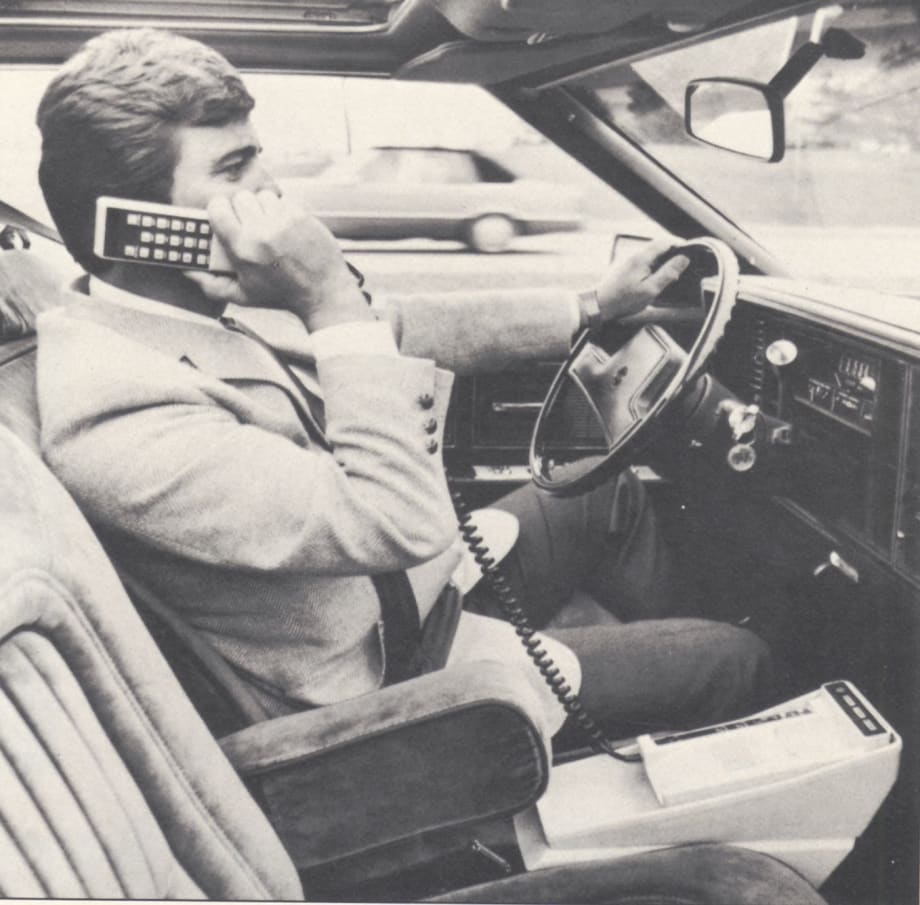
Driver uses the dial-in-handset control unit from AT&T.
Three months ago, Harry Hammond of the central Chevrolet fleet office oversaw the placement of briefcase-mounted cellular telephones with several of his 48 regional salespeople. The phones, each weighing some 25 pounds and representing the latest in cellular technology, were assigned for a 'field evaluation' to Chevy fleet representatives in Dallas, San Francisco, Los Angeles, Chicago, Detroit, Atlanta, and Miami.
Driver uses the dial-in-handset control unit from AT&T.
So far, at least, the GM division's assistant manger for fleet field operations likes what he's overseen.
"Our people wish they could have had these phones years ago," Hammond says. "The phones allow them to conduct business while they're driving. They can make and cancel appointments, return messages, contact their secretaries, and provide customer with important information without having to go to the zone office or hunt down a pay phone."
Hammond is so pleased with cellular phones, in fact, that he predicts their eventual widespread acceptance by rental, commercial, and leasing fleets. And he adds that Chevy itself may eventually "pre-wire" some cars for cellular phones -thus introducing the technology to high-volume applications for the first time.
Nearly 55 years after the Detroit police department because the first major user of radio phones in vehicles, Chevrolet seems to have discovered the newest wave of advanced telecommunications technology. Surprisingly, it's a technology that's only been in use in the U.S. since 1983, when the first cellular system went on-line in Chicago. Since then, though, more than 40 systems have gone up in such major markets as Milwaukee, Los Angeles, Atlanta, Boston, Philadelphia, and Dallas.
Statistics show that there are now some 100,000 people with cellular car-phones in this country, and there could be more then a million in 1990. By the end of the century, it's predicted that one out of every four or five vehicles in major American cities will be equipped with cellular phones.
But what in the heck are cellular phones? And what do they many for fleets?
To understand how cellular works, it's helpful to start with an explanation of the conventional "improved mobile telephone system" (IMTS), the kind of per-cellular car phone system found in most areas. Under IMTS, a powerful, two-way transmitting system fed directly into a large antennae located near the center of a city. The car phone's signal was transmitted between the car's antennae and the large antennae, working within a radius of 25 to 35 miles from the tower. But because only one car phone could use a single frequency at any one time-and only 12 to 24 channels were allocated to each urban area by the Federal Communications Commission- a driver could wait forever to get a dial tone.
By contrast, a cellular system divides the city into a honeycomb of small segments (or "cells"), each with its own antenna, each spaced throughout the city so that the signals overlap slightly. As a car whose driver is making a cellular call moves from cell to cell, the conversation is automatically switched off by computer from one antenna to the next. The individual cells can use the same frequencies, thus permitting simultaneous conversations. And because your car is never far from a cell transmitter, the sound quality is as good as that of the ordinary office phone.
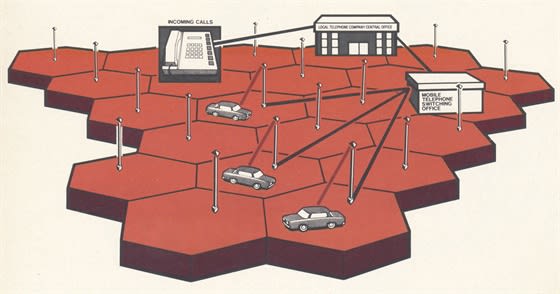
Cellular operates by dividing a city into cells, each served by its own radio transmitter. Cell sites are connected to the Mobile Telephone Switching Office (MTSO), which is linked to the landline network through the local phone company central office. As the caller drives across the service area, the call is passed from one transmitter to another. This illustration is courtesy of Southwestern Bell Mobile Systems.
In 1982, the FCC approved the division of cellular franchises into many shares, limited the ownership of large telephone operating companies, and supported a policy of two competing systems per each metropolitan area in the 90 biggest U.S. markets. One of these systems in very big city will be the local phone company's while the other will be that of a "non-wireline" competitor such as Ameritech, Metro-media, or Western Union.
To foster competition, the FCC also allows the "resale" of cellular service, whereby firms install cellular equipment, provide phone numbers, and accomplish the billing. Among the first resellers have been such rent-a-car companies as Hertz, Avis, Budget, and National. Each charges customers a premium for the privilege of driving a car with a cellular phone; the phone bill is then added to the car bill when the vehicle is turned in.
Some auto dealers such as Potamkin Cadillac in New York are also offering mobile phones as optional extras. And so too are GM's Buick division and Ford's Lincoln-Mercury division, on luxury models.
Meanwhile, the manufacturers of some cellular phones have launched aggressive campaigns to attract fleet business. A release from one such manufacturer, for example, recounts a recent magazine article documenting the way mobile phones can improve the personal productive of your most important drivers.
"(The driver) makes four pay-phone calls a day, each lasting about five minutes," the article supposes. "Over a five-day week that's one and a half hours spent on a pay phone. However, each call also requires five to 10 minutes of looking for a pay phone, plus the five minutes of lost driving time to make the call. So one five-minute call actually costs you 10 to 15 minutes of driving time.
"The one and a half hours of time on the pay phone now becomes three to four, or more, hours of time that could be put to much more productive use. If you made the same calls from your car phone, let's assume a cost per minute of 40 cents times 90 minutes, or $36. Add the prorated cost of the service, plus the cost of the phone, and the cost of using your car phone comes to about $50 to $60 a week.
"By contrast, if you estimate the worth of your time at $1.58 per minute, or $94.80 an hour (the total value of a key employee's time), the three to four hours of looking for and using pay phones would cost you and your company an incredible $284.40 to $379.20 per week."
As scenarios like that are increasingly accepted, some experts are warning that cellular car phones pose new safety risks for fleet drivers. At the recent convention of the National Association of Fleet Administrators, for instance, Merrell Dow fleet manager Steven Schultz said that mobile phones may be "as common as air conditioning" within five years. However, Schultz cautioned, drivers should always pull off to the side of the road to conduct phone conversations. The mental aspect of phone calls could be dangerously distracting, Schultz warned, as when "a sales manger chews (a driver) out on the phone," upsetting the driver emotionally.
Charles Butler of the American Automobile Association concurred with Schultz, adding that voice actuated equipment not requiring the receiver to be held might be less of a problem. But Butler agreed that any conversation should be held only after stopping by the side of the road.
Already, a "hands-free" cellular model allowing a caller to operate the phone without removing the handset has been introduced by AT & T, the communications conglomerate whose Bell Laboratories invented cellular technology back in the 1940s. One of the biggest of many suppliers in the U.S. market, AT & T also offers at least two other sophisticated models featuring easy-to-read LED displays lighted status indicators (they limit the phone user to pre-designated service providers). Additionally, the firm has plans to test a new voice-activated cellular technology that would allow a caller to touch a button, say 'Call Joe Smith,' and then simply wait as the car-phone dials Smith's number.
Meanwhile, AT&T cellular phones have found their way into Harry Hammond's fleet-sales cars, and into the small-fleet operation of Leonard Robin, an advertising executive in Los Angeles. Robin has installed the AT&T "hands-free" model in his four personal cars, as well as in vehicles operated by several of his 35 employees.
"Cellular phones have increased my efficiency by 100 to 150 percent," Robin says enthusiastically. "They're probably the single best business tool I've ever more across."
Like Chevrolet's Hammond and Schultz of Merrell Dow, Robin believes that phones in business cars are here to stay.
More Operations

Fleet Has a Talent Pipeline Problem. What Comes Next? | AF News Recap
Where will fleet’s next generation of leaders come from? This week, we’re looking at the industry’s talent pipeline, what certification can add to a fleet career, how to build an award-worthy track record, and the return of Automotive Fleet’s Personal Use Survey.
Read More →
Smith System Launches Driver Risk Management Program
Fleets have more driver data than ever, but identifying risky behavior doesn't necessarily correct it. Smith System's new Driver Risk Management program combines monitoring, training, and follow-up coaching to help fleets connect risk signals with driver intervention.
Read More →
Automotive Fleet Opens 2026 Personal Use Survey for Commercial Fleet Managers
Less than two weeks left! Commercial and corporate fleet managers are invited to share how their organizations handle company vehicle personal-use policies, charges, and driver eligibility.
Read More →
From AI Prompts to AI-Generated Safety Songs | AF News Recap
Can better prompts make AI more useful for fleet managers? This week, we’re breaking down smarter fleet analysis, an AI-assisted experiment that turned safety training into music, and what happened to fuel prices in August.
Read More →
How to Write Better AI Prompts for Fleet Analysis
Include these six elements in your fleet prompts to generate more relevant analysis and accurate answers.
Read More →
Fleet Meets: Eric Kilgore
This edition of the Fleet Meets series features one of the industry's best leaders driving multi-market and national operations.
Read More →
Why Reactive Fleet Management Is Becoming Too Expensive to Sustain
Research highlights a growing need for proactive management strategies to address rising costs in fleet operations effectively.
Read More →
What Your Fleet KPIs Aren’t Telling You
Tracking fleet metrics is only useful when the data leads to better decisions. This guide helps fleet leaders assess cost, utilization, and downtime more accurately, identify performance gaps, and prioritize the actions that can improve operational results.
Read More →
Hidden in Plain Sight: Fleet Compliance Risks
Fleet compliance isn't just about having policies — it's about consistently enforcing them. This practical guide reveals six hidden compliance risks common in public sector and shared fleet operations and outlines proven strategies to improve visibility, accountability, and audit readiness
Read More →
Turning Fleet Payment Data into Executive Insights
Does data alone drive results in operations?
Read More →