




Cell-Phone Bans Help Reduce Distracted Driving
Using mobile phones while driving is one of the top causes of distracted driving incidents. Reduce potential liability issues with a comprehensive fleet policy.
Some drivers continue to hold the belief that business calls while driving increases productivity rates, and as a result, fleet managers, often at the direction of senior management, are creating mobile-phone policies to curb this dangerous practice. According to John Ulczycki, VP at the National Safety Council (NSC), driving collisions nationwide have seen a large decrease; however, because commercial fleets are a smaller group to review, driving collisions have not seen the same positive results of decreased collision rates.
Research conducted by traffic organizations such as the NSC, the National Highway Traffic Safety Administration (NHTSA), and the Federal Motor Carrier Safety Administration (FMCSA) show that crashing is four times as likely when using a handheld cell phone. In response, these organizations are publicizing their belief that all commercial fleets should implement total- ban policies. They add that several businesses have said productivity increased after implementing a total-ban policy.
Multi-Tasking Versus Distracted Driving
Even though many companies insist that their employees possess multi-tasking skills, the NSC reported in 2012 that multi-tasking has its limitations.
The human brain does not multi-task, it switches attention — shifts its focus. According to the NSC report, while listening and responding to information, a driver’s vision is reduced, response time lessens, and lane keeping wanes.
After examining a collective sample of 521,000 fleet vehicles and 9.8 billion miles traveled, NETS found that traffic collisions remain the No. 1 cause of workplace death and injury, costing employers in excess of $60 billion annually.
And, according to Ulczycki, the No. 1 factor in distracted driving and vehicle collisions is the time spent using a cell phone while driving.
Distractions occur in three ways: visually, manually, and cognitively. Or, as executive director for NETS Jack Hanley explained, this is the equivalent of “taking your eyes off the road, your mind off the road, and your hands off the wheel.” Because text messaging requires visual, manual, and cognitive attention from the driver, it causes the highest distraction ratio and is why NETS found that all 2012 survey respondents reported a total ban on texting while driving in their mobile-phone policy.
A Safety Culture Starts with Fleet Managers
Without safety education, employees believe safety practices are trivial. “The U.S. is severely lacking in education and training on the dangers of cell-phone use while driving,” Ulczycki said.
Many companies report that reducing vehicle crashes is the most important factor for improving company safety, according to the FMCSA.
And, prevention is the No. 1 tool to reduce vehicle crashes. Commercial fleets that maintain a low number of vehicle crashes have high safety performance standards. These standards are maintained through a workplace safety culture.
Safety culture stems from individuals’ belief systems and safety technologies reinforce those beliefs. Safety technologies that prevent rollovers, blind spots, and rear-end collisions are some examples, according to the FMCSA.
Techniques fleet managers use to create a safety culture include:
Tracking completions of on-going driver training on a fleet-safety scorecard.
Conducting ride-alongs with new-hires and high-risk drivers.
Communicating fleet safety messages via senior-management presentations.
Computerized training, such as driving simulators.
The Safest Fleets Ban Cell-Phone Use
The majority of traffic-safety organizations believe that the best action for employers is to implement a total-ban policy on handheld and hands-free cell-phone devices for all employees while driving.
NETS’ 2012 fleet safety benchmark study reviewed a combined fleet of 520,000 vehicles and found that 97 percent of survey respondents have a cell-phone policy. Of the 97 percent with a cell-phone policy, 32 percent ban the use of cell phones while driving, and 61 percent ban the use of handheld devices.
Employers who can show that they implemented a total cell-phone ban policy, educated employees, monitored compliance, and enforced the policy will be in a more defensible position when a collision occurs, according to the NSC.
[PAGEBREAK]
Commercial Fleet Collisions Cause Court Cases
Implementing enforced total ban policies can help protect employees from crashes and injury, as well as help protect employers from liability costs.
In today’s courtrooms, juries consider distracted driving as negligent behavior and victims’ attorneys have been known to search through employee policies to find potential causes for negligent behavior.
Employers may be held legally accountable for negligent employee actions if the employee was acting within the scope of his or her employment at the time of a crash, according to the NSC.
The key phrase “acting within the scope of his or her employment” can and has been defined broadly to award large sums of money to victims’ of crashes involving cell phones.
Attorneys may identify evidence of negligence during the discovery process where they are permitted to review cell-phone records, including duration and geographic location of calls, texts, and the employer’s cell-phone policy.
Eliminating Negligence
Policy enforcement is the most effective strategy in changing behavior. For example, impaired driving, neglecting seat- belt use, and speeding have all decreased since the instatement and enforcement of certain laws.
“Prevention strategies should consider how people behave in reality, not only how they should behave,” the NSC said. Prevention strategies that have shown results are legislative and corporate policies, coupled with high-visibility enforcement and strict consequences such as termination.
“Stronger penalties, stronger compliance,” Hanley commented.
Companies with the lowest collision rates are more likely to review phone records after all collisions and are more likely to terminate a driver for violating the mobile-phone policy.
Practices employers take to prevent employees from distracted driving include:
Distributing company phones, allowing employers to review mobile phone records when there is a collision.
Using technologies to prevent calls or messages from being sent or received by drivers in moving vehicles.
Checking MVRs for high-risk drivers.
Using in-vehicle monitoring to record speed, mileage, and braking.
$21-Million Jury Award Illustrates Costs of Distracted Driving for Fleets
The legal costs of distracted driving for fleets was highlighted in spring 2012 when a Texas jury awarded $21 million to a motorist whose vehicle was struck by a driver for the Coca-Cola corporation who was allegedly using a hands-free device at the time of the incident.
While the company took responsibility for the incident, its lawyers noted that the company’s hands-free policy was consistent with and exceeded the requirements of the state of Texas. The jury, however, sided with the plaintiff’s attorneys’ argument that the company policy was “vague and ambiguous” and, additionally, requested that the jury ban cell-phone use while driving. Coca-Cola is currently appealing the verdict.
Other Types of Distracted Driving
Our roadways are well designed to reduce the risk of traffic collisions. In response, many drivers feel a sense of ease and take on secondary tasks while driving. According to the NHTSA, only a fraction of crashes were cell phone related, meaning a majority of crashes were caused by other behaviors.
Increased Risk Ratios for Secondary Tasks While Driving
Type of Secondary Task | Odds Ratio |
|---|---|
Reaching for a moving object | 8.82 |
Insect in vehicle | 6.37 |
Looking at external object | 3.7 |
Reading | 3.38 |
Applying makeup | 3.13 |
Dialing handheld device | 2.79 |
Inserting/retrieving CD | 2.25 |
Eating | 1.57 |
Reaching for non-moving object | 1.38 |
Talking/listening to a handheld device | 1.29 |
Drinking from open container | 1.03 |
Other personal hygiene | 0.7 |
Adjusting the radio | 0.5 |
Passenger in adjacent seat | 0.5 |
Passenger in rear seat | 0.39 |
Child in rear seat | 0.33 |
According to a 100-car study by NHTSA in 2010, the odds ratio of distracted driving over just driving can result in an individual being up to eight times more likely to cause a vehicle collision.
More Safety

Fleet Manager’s Ultimate Playbook: Navigating the New Standard in OEM Connectivity
Rising operating costs, driver safety concerns, and unplanned downtime are putting unprecedented pressure on modern fleets. Discover how fleet managers use embedded OEM connectivity and real-time vehicle data to cut TCO, prevent downtime, and protect drivers without aftermarket telematics hardware.
Read More →
From Driver Well-Being to EV Charging | AF News Recap
Mental health belongs in the fleet safety conversation. This week, we’re looking at five ways fleets can support employee well-being before a crisis, plus Holman’s expansion in Mexico, new one-day Fleet Forward passes, and why EV charging demand is outpacing infrastructure growth.
Read More →
Nexar-Nauto Merger Aims to Give Fleets Better Safety Intelligence Through Larger Driving Dataset
Stefan Heck tells Automotive Fleet that combining more than 10 billion miles of driving history with Nexar's AI models will give fleets deeper insights into driver risk and roadway conditions than either company could provide independently.
Read More →
Don't Wait for a Crisis: 5 Ways to Build Mental Health Into Your Fleet Safety Program
For Suicide Prevention Month, fleet and safety leaders have an opportunity to put mental health where it belongs: at the center of workplace safety.
Read More →
How Camera Data Can Strengthen a Fleet’s Insurance Renewal
Insights from a commercial insurance carrier and a broker show how fleets can turn video telematic data, driver coaching, and improved claims results into a stronger case at insurance renewal.
Read More →
The Safest Fleets Aren’t the Ones with the Most Technology
You’ve made the telematics investment. Here’s how to capture the other half of its value and build the safest fleet on the road.
Read More →
Hidden in Plain Sight: Fleet Compliance Risks
Fleet compliance isn't just about having policies — it's about consistently enforcing them. This practical guide reveals six hidden compliance risks common in public sector and shared fleet operations and outlines proven strategies to improve visibility, accountability, and audit readiness
Read More →
NETS Sets 2026 Fleet Safety Benchmark Conference for Indianapolis
The Sept. 15–17 program will feature fleet benchmarking data, case studies, emerging technologies, and implementation strategies while running alongside the NSC Safety Congress & Expo.
Read More →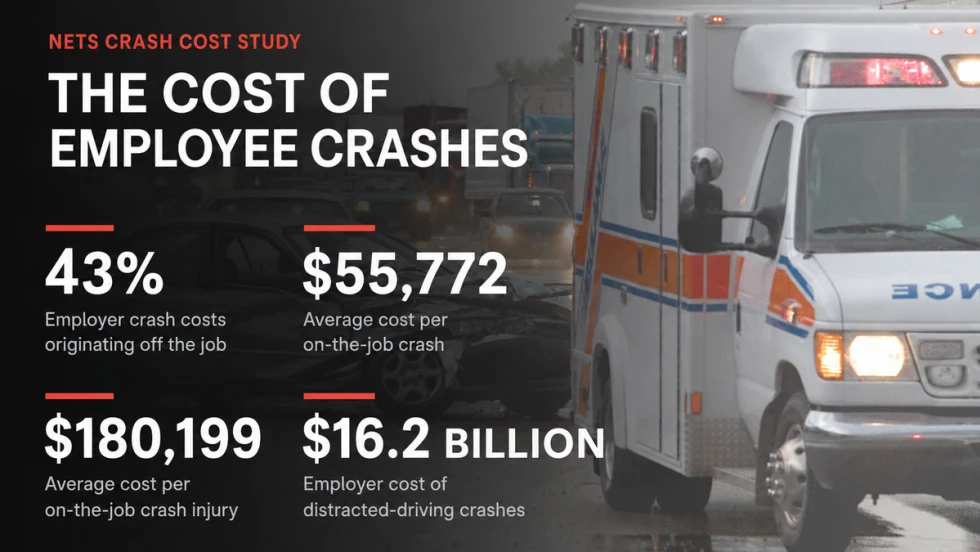
Off-the-Job Crashes Account for 43% of Employers’ $61.7 Billion Crash Burden
NETS quantifies costs dispersed across fleet, risk, HR, and other departments while providing new per-crash benchmarks for employers.
Read More →
Ram Recalls More Than 1.27 Million 1500 Pickups for Seat Belt Anchor Issue
The recall affects certain 2019-2026 Ram 1500 pickups that may have improperly attached second-row seat belt buckle anchors.
Read More →