




Read More: 10 Things Drivers Should Do in Case of an Accident
Best Practices for Dealing with Traffic Signals
While traffic signals may seem rudimentary, even professional drivers can benefit from reminders that clarify precisely what they are expected to do — and not do — when they come face to face with red lights, flashing signals, green arrows, and more.
by Judie Nuskey
July 26, 2023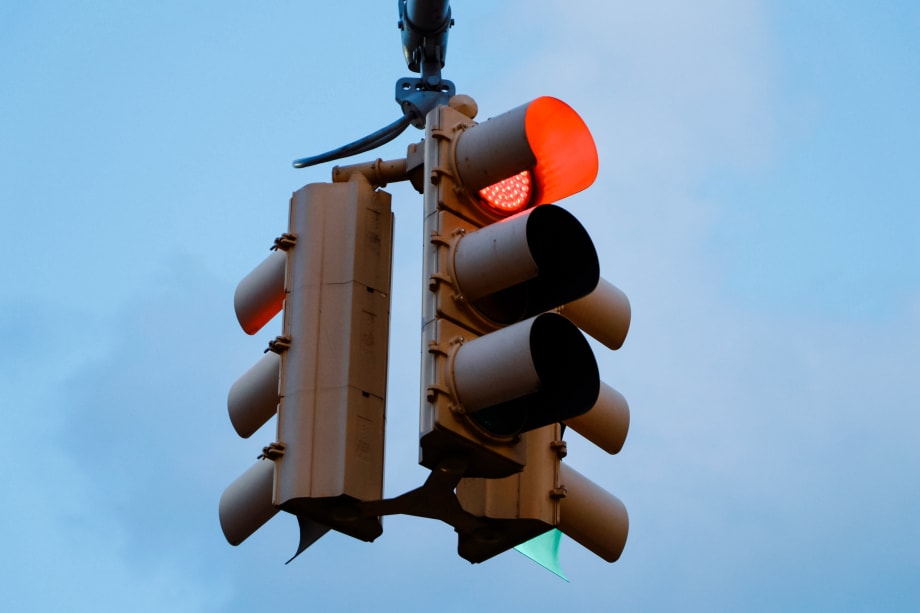
In 2021 alone, some 1,109 people lost their lives in crashes that involved red light running.
Photo: pexels.com/Oscar Portan
6 min to read
Red light running happens frequently and is often deadly. In 2021, 1,109 people were killed in crashes that involved red light running, according to the Insurance Institute for Highway Safety (IIHS). Moreover, an analysis of red-light violation data from 19 intersections without red-light safety cameras in four states found a violation rate of 3.2 per hour per intersection.
What constitutes red light running? If a vehicle enters an intersection any time after the signal light has turned red, the driver has committed a violation. Motorists who are inadvertently in an intersection when the signal changes — waiting to turn left, for example — are not red light runners.
In locations where a right turn on red is permitted, drivers who fail to come to a complete stop before turning may be considered red light runners. Violations also include people turning right on red at intersections where doing so is prohibited, notes IIHS.
This dangerous practice is especially common on city streets, where crashes that involve motorists running red lights, stop signs, and other traffic controls account for almost one in four collisions. The frequency of red light running makes it critical that your drivers obey all intersection signs and signals, and that they never assume other drivers will do the same.
Even professional drivers should be reminded from time to time about what specific traffic signals mean and how to obey them. Share the following guidance about traffic signals with your fleet drivers.
Red Light
It may seem obvious that drivers must come to a full stop at a red light. But that’s not the only thing to keep in mind. When stopped at a red light, it may be tempting to attend to other tasks, like checking e-mail or texts or opening snacks or drinks. Remind your drivers that a red light isn’t a timeout from driving. Rather, it’s critical that they remain focused on their surroundings.
For example, if another driver is headed toward them from behind and not slowing down, and they’re not paying attention, they won’t have time to take evasive action. When stopped at a red signal, drivers should scan continuously in all directions, using all mirrors. It’s also wise to leave some room between your vehicle and the one ahead of you. This provides time and space to move forward to avoid a vehicle that is in danger of hitting you from behind.
Green Light
We all know that green means “go,” but it doesn’t mean proceed without looking. Because red light running is so common, it’s critical that fleet drivers approach a green light with the assumption that other drivers may not obey the traffic signals on their side of the road. When approaching a green light, scan carefully in all directions, noting what other drivers and pedestrians are doing. Pay special attention to the cross street to ensure a vehicle isn’t headed toward the intersection at a high speed and doesn’t seem to be slowing. If you see a pedestrian waiting to cross, even if that person has the red light, drivers should hover their foot over the brake as a precaution in case the walker doesn’t wait for the light.
When driving toward a green light a driver will not always know how long the light has been green and whether it is a “stale green light” that may turn yellow soon. That’s why it’s wise to choose a “point of no return” — a point after which you will continue through the intersection even if the light turns yellow. When choosing this point, keep in mind that roads with lower speed limits tend to have shorter yellow lights.
Yellow Light
Your drivers know that a yellow light means “caution,” but what does that really mean? A yellow traffic signal is designed to give the driver transition time between the red and green lights. How they should respond to a yellow light will depend on how far the driver is from the intersection and what type of road they’re traveling.
Here’s some advice you can share with your fleet drivers: If you’re very close to an intersection and the light turns yellow, it may be best to proceed through the intersection, especially on higher-limit roads. Because if you need to slam on your brakes to stop before the light changes from yellow to red, it puts you at high risk of being struck from behind. But if you’re further from the intersection when the light turns yellow, it may be best to slow down and prepare to stop at the light, especially on roads with a lower speed limit. By scanning your driving environment continuously and thoroughly, you’ll have the information you need to decide whether it is safer to proceed or stop for a yellow light.
Flashing Signals
Some intersections have a flashing light — either red or yellow — in one or more directions. These signals are different from the traditional red/yellow/green light and often create confusion for drivers, but they are equally important for safety.
Explain the following to your drivers: If you come upon an intersection with a flashing red light, always respond as if it is a solid red light or a stop sign. A flashing red light requires you to come to a full stop and only proceed if it is safe. Never assume another driver will stop at a flashing red light; some motorists aren’t clear what it means and others simply choose to run the light because they’re in a hurry or impatient.
If you come upon an intersection with a flashing yellow light, you are required to slow down and scan the area entirely before proceeding. Never assume other drivers will do the same, and never drive through the intersection as if you have a green light.
Green Arrow
At some intersections, you’ll see a traditional traffic signal with a red, yellow, and green light, along with a green arrow. The green arrow is meant to allow for what is called a protected left turn, meaning that the
traffic moving in one direction can turn left while other traffic is stopped. Typically, the oncoming traffic doesn’t have a green light yet (or may only have a green arrow, too), which is what makes it a protected turn.
Once the green arrow is no longer lit and the regular green traffic signal is shown, drivers should assume that oncoming traffic now has a green light as well. While you can normally still make a left turn, you no longer have the right of way and must yield to oncoming traffic traveling straight through the intersection. If the green arrow turns to a red arrow, that means you cannot make a left turn and must wait for the green arrow again before proceeding.
Subscribe to Our Newsletter
More Safety

Sponsored•October 1, 2026
Fleet Manager’s Ultimate Playbook: Navigating the New Standard in OEM Connectivity
Rising operating costs, driver safety concerns, and unplanned downtime are putting unprecedented pressure on modern fleets. Discover how fleet managers use embedded OEM connectivity and real-time vehicle data to cut TCO, prevent downtime, and protect drivers without aftermarket telematics hardware.
Read More →
From Driver Well-Being to EV Charging | AF News Recap
Mental health belongs in the fleet safety conversation. This week, we’re looking at five ways fleets can support employee well-being before a crisis, plus Holman’s expansion in Mexico, new one-day Fleet Forward passes, and why EV charging demand is outpacing infrastructure growth.
Read More →
Nexar-Nauto Merger Aims to Give Fleets Better Safety Intelligence Through Larger Driving Dataset
Stefan Heck tells Automotive Fleet that combining more than 10 billion miles of driving history with Nexar's AI models will give fleets deeper insights into driver risk and roadway conditions than either company could provide independently.
Read More →
Don't Wait for a Crisis: 5 Ways to Build Mental Health Into Your Fleet Safety Program
For Suicide Prevention Month, fleet and safety leaders have an opportunity to put mental health where it belongs: at the center of workplace safety.
Read More →
How Camera Data Can Strengthen a Fleet’s Insurance Renewal
Insights from a commercial insurance carrier and a broker show how fleets can turn video telematic data, driver coaching, and improved claims results into a stronger case at insurance renewal.
Read More →
The Safest Fleets Aren’t the Ones with the Most Technology
You’ve made the telematics investment. Here’s how to capture the other half of its value and build the safest fleet on the road.
Read More →
Sponsored•August 7, 2026
Hidden in Plain Sight: Fleet Compliance Risks
Fleet compliance isn't just about having policies — it's about consistently enforcing them. This practical guide reveals six hidden compliance risks common in public sector and shared fleet operations and outlines proven strategies to improve visibility, accountability, and audit readiness
Read More →
NETS Sets 2026 Fleet Safety Benchmark Conference for Indianapolis
The Sept. 15–17 program will feature fleet benchmarking data, case studies, emerging technologies, and implementation strategies while running alongside the NSC Safety Congress & Expo.
Read More →
Off-the-Job Crashes Account for 43% of Employers’ $61.7 Billion Crash Burden
NETS quantifies costs dispersed across fleet, risk, HR, and other departments while providing new per-crash benchmarks for employers.
Read More →
Ram Recalls More Than 1.27 Million 1500 Pickups for Seat Belt Anchor Issue
The recall affects certain 2019-2026 Ram 1500 pickups that may have improperly attached second-row seat belt buckle anchors.
Read More →