




Battery Capacity an Overlooked Factor in Autonomous Vehicle Deployment, Performance
Autonomous services using electric vehicles will need to consider battery limitations to optimize service deployment, fleet performance, and fleet orchestration.
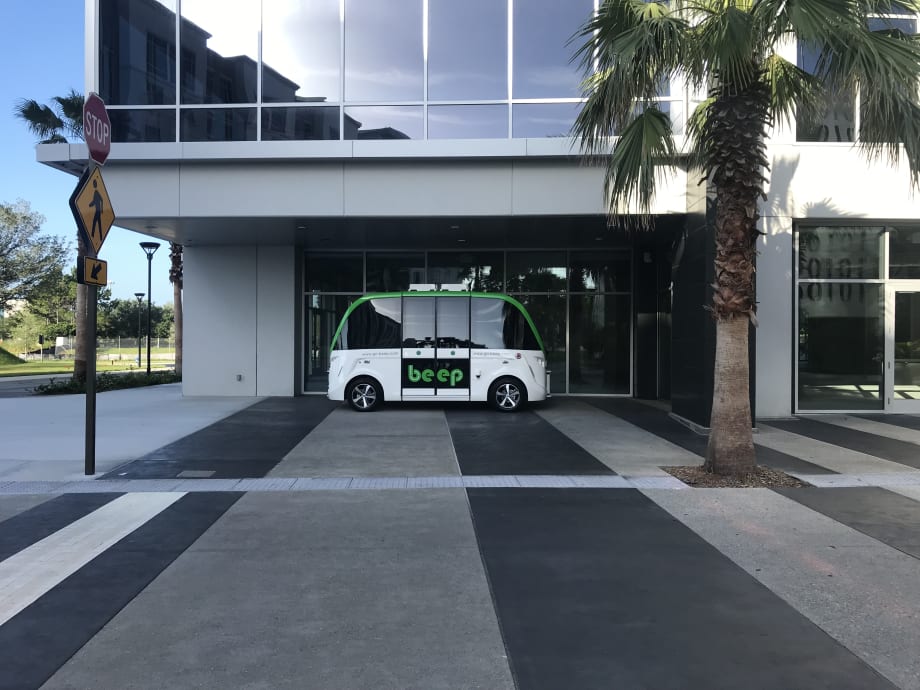
Beep Inc. provides autonomous shuttle services in planned communities and low-speed environments. Beep has partnered with Bestmile to manage its autonomous shuttle fleets. Beep and other autonomous service providers must consider issues such as vehicle weight, travel speed, terrain grade, and temperature ranges to ascertain battery capacity and range.
Photo courtesy of Bestmile.
Amazon recently announced the order of 100,000 electric vans to be delivered by 2030. For perspective, that’s more vehicles than FedEx currently uses worldwide. Of the many points of discussion around autonomous electric vehicles and the services they are expected to deliver, one underrepresented topic is the battery capacity of electric vehicles and the limitations this imposes.
Most autonomous vehicles, in the long term, are expected to be electric for several reasons. Electric drivetrains require less maintenance than their gas counterparts. The fuel is less expensive than gasoline. They are easier to refuel without human intervention. Electric vehicle batteries are subject to variations of range and power that introduce new variables for fleet orchestration.
More than Just Range
Vehicle range is usually the first topic that comes to mind when it comes to electric vehicles — how far can the vehicle travel. But that is a tricky issue because the range is impacted by a number of factors unrelated to sheer distance.
As with a gas-powered vehicle, electric vehicles use more power as their speed increases. Autonomous vehicles use energy as they process data, and the computers driving the cars process some 11 terabytes of data per day by some estimates.
Battery capacity is also influenced by temperatures — lithium, the type of battery most electric vehicles use, doesn’t like cold, and some AV shuttle services have been forced to shut down during cold weather. Air conditioning is another power drain, to the chagrin of an agency in Rhode Island that found its shuttles were not equipped with air conditioning and had to keep them garaged during summer heatwaves.
Vehicle weight (number of passengers, presence of bicycles or wheelchairs, etc.) is another factor in energy use. And there are limits to the steepness of the grades that some vehicles can climb due to power constraints.
No Two Rides Are Alike
As a result, no two rides consume the same amount of battery power.
Vehicle energy availability becomes an even bigger issue when it comes to managing on-demand mobility services using electric vehicles. Whether moving packages or people, if there are constraints like guaranteed delivery times, ride times, and wait times, a vehicle’s battery strength is one of the many variables that need to be considered when deciding what vehicle to send to what traveler at what time.
Does the vehicle have the juice to complete a mission? Does it have enough battery power to reach a charging station after the mission? Where is the nearest charging station? Are there any hills or other energy intensive features of the route? How many vehicles are already waiting to be charged? How long can a vehicle afford to wait before it runs out of power?
Those are the issues on the front side of autonomous vehicle refueling. On the backside are questions like, when will a vehicle that is being charged return to service? Where should it be positioned in the event that there are no current ride requests near the charging station?
Service Design Issues
The location and capacity of charging stations are important considerations in service design. The number of vehicles, their passenger/package space, and service area dimensions and geography will be limited by the proximity and capacity of charging depots. Because each mission will consume different amounts of energy on every trip, this data has to be monitored and factored into every dispatch in real-time.
Energy use and availability are just two of the factors that make fleet orchestration so complex. For passenger services, the locations of every ride request; the number of passengers; the available vehicles; the vehicle locations; status; traffic; construction; weather; geography; ride times; wait times; and more all factor into matching the right vehicle with the right mission.
Included in the “more” are the considerations of surrounding demand and predicted future demand. Operators must make sure that there is always enough supply on hand and in the right locations to meet demand within defined service levels and operator utilization requirements.
Doing More with Less
The goal of fleet orchestration is all about sending the right mission to the right vehicle at the right time. Most mobility providers aim to carry as many paying riders (or goods) as possible while driving the fewest vehicles and miles/kilometers. Service providers that own their fleets and/or pay drivers by the hour want to make the most of every vehicle-mile/km.
Deadheading, the time traveling empty to fetch a new ride or to move to a different neighborhood, incurs costs (driver pay, fuel) while reducing revenue.
For autonomous vehicle services using electric vehicles, battery power plays a critical role in assigning missions to vehicles. It is also is an important service constraint that needs to be factored into fleet performance and fleet orchestration.
Anne Mellano is cofounder of Bestmile and directs the company’s global management activities. Bestmile empowers mobility providers to deploy, manage, and optimize autonomous and conventional driven vehicle fleets.
More Fleet Forward

Erin Gilchrist Receives Mike Antich Spirit of Fleet Award
Last week at AFLA in Vegas, Erin Gilchrist received the inaugural, brand-new Spirit of Fleet Award.
Read More →
Dominika Leja Named the 2026 Fleet Manager of the Year
The AstraZeneca associate director of fleet was recognized for her leadership in fleet electrification, cost savings, and operational transformation.
Read More →
Jamie McKay Named the 2026 Fleet Visionary Award Winner
The Aptive Pest Control fleet manager was recognized for her approach to operations, data, lifecycle management, and driver needs.
Read More →
Fleet Forward Conference Introduces One-Day Passes for 2026
New one-day registration gives fleet professionals the flexibility to attend Tuesday, Wednesday, or Thursday, with passes available for $199 through Sept. 18.
Read More →
Vibe Coding: When Fleet Managers Become Software Builders
Five fleet professionals — none with programming skills — discuss how they’re using AI to build fleet solutions in-house and in a fraction of the time.
Read More →
Fleet Forward Conference Tackles Fleet Industry’s Growing Leadership Gap
This session will examine succession planning, knowledge transfer, and the skills the next generation of fleet leaders will need as veteran professionals leave the industry.
Read More →
2026 Fleet Manager of the Year Finalists Announced
Who are the 2026 Fleet Manager of the Year finalists?
Read More →
John Rossant to Deliver Opening Keynote at 2026 Fleet Forward Conference
The CoMotion founder will draw on developments across Europe, China, the Middle East, and other international markets to identify trends that could influence how U.S. fleets plan for the coming decade.
Read More →
How to Build Custom Fleet Tools With AI and Vibe Coding [Webinar]
A new Automotive Fleet webinar explores how fleet managers are using AI and vibe coding to automate routine work and create simple operational tools without traditional programming skills.
Read More →