




AT&T’s Webber Named 2013 Fleet Executive of the Year
Jerome Webber, VP of global fleet operations for AT&T, credits his success to teamwork, a global outlook, and adapting to stay ahead of the learning curve.


Jerome Webber, VP of global fleet operations for AT&T, was named the 2013 Fleet Executive of the Year by a panel of industry judges.
Jerome Webber, VP of global fleet operations for AT&T, received Fleet Financials’ 2013 Fleet Executive of the Year award during the Automotive Fleet & Leasing Association (AFLA) 2013 Annual Conference in Scottsdale, Ariz. Webber provides oversight of AT&T’s enterprise-wide policy, strategy, and operating effectiveness for the company’s domestic and international fleet operation.
The 2013 Fleet Executive of the Year award, exclusively sponsored by The CEI Group and Fleet Financials magazine, recognizes exceptional leadership by managers who have a title of vice president or higher and/or have other responsibilities beyond fleet.
A panel of industry judges evaluated submissions using several criteria, including cost-saving initiatives, policy setting, creation of innovative programs, and cultivation of fleet manager training and management.
The other three finalists for this year’s Fleet Executive of the Year award were Bo Cupps, AVP, office services, for Infinity Insurance Company; Kevin Fisher, VP, strategic fleet operations, for Aramark; and Steve Saltzgiver, CAFM, vice president, fleet operations, for Coca-Cola Refreshments.
Diverse Fleet Depends on Exceptional Leadership to Survive
AT&T Global Fleet Operations, based in Dallas (with a large portion of the team’s centralized operations located in St. Louis), operates a unique and diverse fleet inventory.
Approximately 75,000 vehicles (plus 24,000 wheeled equipment units) — predominantly Ford and GM trucks, vans, and passenger vehicles — primarily support the company’s wireless, broadband, entertainment, and communications services.
Webber oversees acquisitions, end-to-end lifecycle management of vehicles and wheeled equipment, fuel management, and provides direction for the development and implementation of the strategy, technology selection, and deployment of alternative-fueled vehicles. He also handles nationwide emergency vehicle and generator staging, deployment, and vehicle fueling during natural disaster recovery efforts.
With more than 400 AT&T-managed facilities across the U.S., the fleet team includes 1,000-plus employees and contracted resources across the nation. The fleet’s global reach includes fleet vehicles in more than 20 countries around the world.
“Our structure is a mix of centralized asset management, support services functions, and geographically dispersed field personnel across the nation,” Webber explained. “We proudly mobilize 25 percent of AT&T employees.”[PAGEBREAK]
Aligning Efforts with Goals Leads to Success
Webber believes his management success results from seamless teamwork with internal and external groups. He specifically credits his team for the fleet’s success as well as for his Fleet Executive of the Year honor.
“I have the best team in the industry,” Webber said. “I cannot say enough about these folks. They constantly amaze me with their innovation, energy, and passion about fleet management.”
Webber revealed the secret of his success is remaining flexible, adapting, taking risks, and continually learning. In fact, these represent the top best practices he utilizes in his role every day.
“We are successful when our efforts align with the goals and priorities of our internal clients. Our strategies must balance workforce productivity with effective management of vehicle and wheeled equipment assets,” Webber explained. “This industry is ever evolving, and the entire landscape has changed, not just vehicle technologies. We must be able to adapt when those changes happen.”
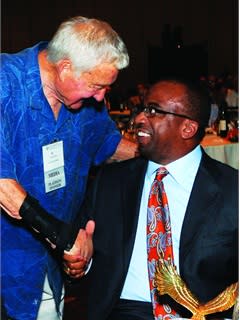
(Left) Ed Bobit, founder and chairman of Bobit Business Media, congratulates Webber on his prestigious win.
When asked how he confidently takes risk in his role, Webber revealed that he often wonders if people viewed his team as a little crazy for going down one road versus another. Then he cited Robert Frost’s “The Road Not Taken”:
Two roads diverged in a wood, and I—
I took the one less traveled by,
And that has made all the difference.
In his current position since August 2007, and with AT&T for more than 20 years, Webber also believes in “failing fast” and continually learning.
“Great success usually follows a few false starts. Don’t wallow — accept and learn from your failures, and then move on,” he stated. “And, never stop learning, reading, investigating, and being curious.”
Webber also relies on his own personal talents as a leader within AT&T, including an ability to recognize and cultivate talented people, remaining passionate, inspiring others, and having a strategic vision.[PAGEBREAK]
Initiatives Propel Fleet Toward Improved Efficiencies
During the past few years, Webber and the AT&T fleet team rolled out significant initiatives that allowed the company to lower the fleet’s environmental footprint, reduce vehicle fuel costs, and streamline fleet operations.
In 2009, Webber spearheaded key strategy and deployment plans for AT&T’s corporate commitment to deploy approximately 15,000 alternative-fuel vehicles (AFVs) by the end of 2018. The initiative hit its halfway mark in July 2013, with 7,500 AFVs deployed. AFVs now comprise approximately 10 percent of AT&T’s corporate fleet, the majority of which will never consume a single drop of gasoline.
“Our investment in more fuel-efficient vehicles helps minimize our impact on the environment, delivers bottom-line benefits to our company, and helps to spur job growth in the domestic clean energy sector,” according to Webber.
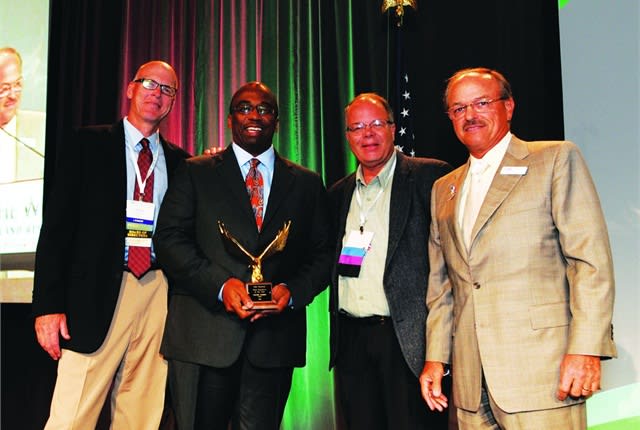
The 2013 Fleet Executive of the Year award, sponsored by The CEI Group and Fleet Financials magazine, was presented at the 2013 Automotive Fleet & Leasing Association (AFLA) conference in Scottsdale, Ariz. Present for the award were (L-R) Tom Callahan, now past-president of AFLA; Jerome Webber of AT&T; Mike Antich of Fleet Financials; and Wayne Smolda of The CEI Group.
To ensure success of the company’s alternative-fuel fleet, Webber and his team had to learn before they leaped. Since the fleet’s initial AFV deployments, the alternative-fuel vehicle industry has progressed tremendously, Webber said.
“Initially, alternative-fuel technologies and infrastructure were fragmented and experts had yet to determine a path forward that could be sustained over time,” he stated. “So, we took advantage of industry group relationships, sought contacts at large national fleets that had successfully deployed alternative-fuel technologies, and evaluated best practices, setting the stage for AT&T to hit the ground running.”
Webber and his team have made great strides with this initiative, not just internally, but in concert with the industry as a whole. He added that the company still has a long way to go with AFVs, but “each small step in the right direction is still a step in the right direction,” he said.
AT&T’s AFV deployment continues to deliver great value. The company has avoided the purchase of 4.6 million gallons of fuel and 12.3 million gallons project-to-date in 2013.
Webber stated the key to AT&T’s success with its AFV deployment includes remaining nimble and being willing to reevaluate, reassess, and adjust strategy where necessary to deliver ultimate value for the company.[PAGEBREAK]
Economies of Scale & Cost-Reduction Contracts Yield Benefits
Under Webber’s leadership, in 2010 AT&T awarded the most comprehensive vehicle repair and maintenance contract in its fleet history. Webber helped transition from multiple regional providers to one national provider, which allowed the company to take advantage of economies of scale, focus on cost reduction, streamline processes, and deliver a high level of service to its internal clients.
The biggest benefit of this initiative turned out to be having a single point of contact. This change has allowed Webber’s team to adjust its business operations at an exceptional speed, which is advantageous when setting a new course, implementing changes, and responding to emergencies.
Another initiative spearheaded by Webber included the integration of AT&T’s diverse legacy fleets following the acquisition of BellSouth in 2006, and the consolidated ownership of Cingular Wireless. The 18-month fleet standardization project involved 19 initiatives, ranging from tire procurement, parts, preventive maintenance intervals, waste fluid disposal, electronic billing, and call center consolidation.
And, in another program aimed at cleaner operation, Webber’s team implemented the “Leaner Cleaner Smarter” (LCS) strategy. The aim of this strategy includes reducing the fleet’s carbon footprint beyond AFVs. Utilizing lighter composite bodies, recyclable materials for the shelving component, smaller chassis, and smaller engines allows AT&T’s fleet to maximize miles-per-gallon consumption and reduce overall operating cost.
The leaner component of this strategy involved looking at a fit-to-function approach that required Webber and his team to assess whether the right size of vehicle was being utilized for the right job function.
“But, after getting leaner and cleaner, we needed to get smarter. We understood the need to take advantage of in-vehicle technology to let the vehicles proactively inform us of their operation and help us to get ahead of potential service issues,” Webber said. “Vehicle location-based technology and idling monitoring were the initial benefits, with more to come as we begin to further implement proactive service-related features.”
Key Factors to Getting Fleet Back on Track

Aimed at cleaner operations, Webber’s team implemented the “Leaner Cleaner Smarter” strategies, an approach to fleet management, including lighter, more sustainable materials in vehicle specifications, among other factors.
Webber offered some advice for other fleet executives struggling to run a more cost-efficient fleet. He advises management to take a moment to regroup, reflect, benchmark with other similar fleets to determine where they stand, and consider a major organizational overhaul or restructuring to ensure alignment.
“Also, ask whether there are just too many choices and practices being modeled or followed within the fleet,” Webber suggested. “If so, consolidate, integrate, and eliminate where necessary to take advantage of economies of scale and reinforce cost and operational discipline.”
Finally, he shared that, to be successful, a company’s fleet must deliver unparalleled effortless service experience providing what their clients or customers need, when and where they need it. n
More Operations

How Fleets Can Recruit and Train Veterans for Technician Roles
Here's how the technician shortage has affected uptime for fleets, and what to do about it.
Read More →
Avis Budget Group Deploys Neology Toll Management Technology Across Major Brands
Neology’s neoFleet platform will manage toll transactions and toll-authority operations for vehicles across Avis, Budget, Payless, Budget Truck and Zipcar.
Read More →
Fleet Personal-Use Charges Edge Higher in 2026
Nearly eight in 10 surveyed fleets allow personal use of company vehicles, while just over half of respondents report charging employees for the privilege.
Read More →
The Future of Fleet + What’s Changing Right Now | AF News Recap
Could developments overseas offer a preview of what’s coming for U.S. fleets? This week, we’re looking at the future of AI, autonomy, and electrification, plus Ford Pro’s new certified pre-owned program, smarter vehicle offboarding, and a new way for fleets to manage toll expenses.
Read More →
How to Handle Vehicle Offboarding
What do fleet managers need to do when a driver leaves?
Read More →
Fleet Manager’s Ultimate Playbook: Navigating the New Standard in OEM Connectivity
Rising operating costs, driver safety concerns, and unplanned downtime are putting unprecedented pressure on modern fleets. Discover how fleet managers use embedded OEM connectivity and real-time vehicle data to cut TCO, prevent downtime, and protect drivers without aftermarket telematics hardware.
Read More →
U.S. Bank Adds Verra Mobility Toll Management to Voyager Fleet Platform
The integration allows U.S. Bank Voyager fleet customers to manage toll payments and violations alongside fuel, EV charging and maintenance expenses.
Read More →
ADAS Prevents Crashes. But Repairs Cost More | AF News Recap
ADAS-equipped vehicles may crash less often, but they can cost more when they do. This week, we’re breaking down what that tradeoff means for fleets, plus Subaru’s first Forester Wilderness Hybrid, Nissan’s new e-POWER Rogue, and why Calstart has become Catalyst Mobility.
Read More →
Moventum Fleet Management Names Mark Iorillo Head of Sales
Iorillo brings nearly 20 years of fleet management and sales experience to the role, including previous positions at Element Fleet Management, CEI, Donlen and Ryder.
Read More →
Fleet Has a Talent Pipeline Problem. What Comes Next? | AF News Recap
Where will fleet’s next generation of leaders come from? This week, we’re looking at the industry’s talent pipeline, what certification can add to a fleet career, how to build an award-worthy track record, and the return of Automotive Fleet’s Personal Use Survey.
Read More →