




ARI Details Integration with Amazon Alexa
ARI’s integration of Amazon Alexa allows fleet managers to interact with their fleet data and ARI insights, the company’s web-based portal, by asking to receive information out loud.
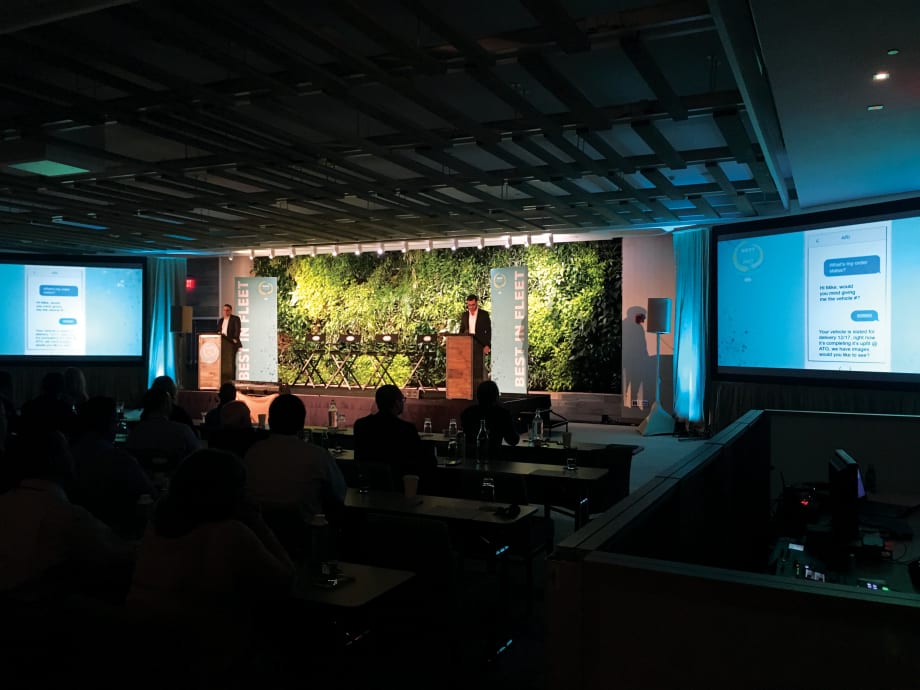
Don Woods (left) and Mike Stallone of ARI speak during a presentation at the 2017 ARI Best in Fleet Symposium on ARI’s integration of Amazon Alexa. Photo by Andy Lundin.
ARI has been tesing the Amazon Alexa app to allow its fleet clients to access their fleet data and the company's web portal with voice commands.
The app has been designed by ARI to allow fleet clients to access their data and the ARI insights portal
For example, a fleet manager named Jackie is driving to work and asks the Amazon Alexa voice-based device, “What’s new in ARI?”
Alexa answers back with specific information about Jackie’s fleet: “Hi Jackie. There is one driver who hasn’t reported their odometers in the last 14 days. There are five vehicles due for PM. There are six suspicious fuel events in the last 30 days. There are three tank violations in the last seven days. There is one reported accident in the last seven days. You do not have any POs awaiting your approval. You have no vehicles that have been down more than two hours. Would you like to hear a menu of commands?”
That dialogue took place with the Alexa App product from fleet management company ARI, through a pilot program that ARI unveiled this past November at its Annual Best in Fleet conference. The app, which ARI is describing as “the fleet industry’s first voice-based technology,” is expected to be released to clients later this year.
Foundations of ARI with Alexa
The concept of ARI’s Alexa app pilot program stemmed from an initiative to explore if clients would benefit from this new way of engaging with ARI, said Don Woods, director of client information services for ARI. Woods added that the program is an effort for the company to engage differently with its customers than the usual e-mails and phone calls. “We also created efficiencies for the fleets, looking for ways to reduce the amount of back and forth that we need to do by engaging differently with these customers,” Woods said. “We were looking at multiple technologies to do that, and Alexa is one of them.”
As it began work on the Alexa initiative, ARI asked for feedback from its customers as to the Alexa features that would be most useful to them. Measuring vehicle downtime was a common response from the fleet managers. ARI determined that users could ask Alexa questions such as: “How many vehicles are currently down?” About 50 individuals are currently participating in the pilot program, and ARI is gathering additional feedback. The company is learning which questions fleet managers commonly ask the device and which questions it still cannot answer.
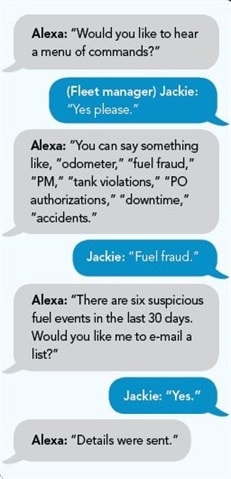
ARI provided samples of actual interactions that have taken place through the Amazon Alexa pilot program.
“People see the value in it,” Woods said, noting that he heard from the manager of one large fleet who wanted all of his fleet’s key metrics entered into the Alexa device. Woods was somewhat surprised, stating that fleet managers traditionally prefer to see information presented in charts and graphs.
“Fleet managers have such a hectic schedule that just getting a briefing in the morning, saying ‘you have this much downtime, this many vehicles are out in the shops getting worked on, this many vehicles are overdue for preventive maintenance’ and things like that and being able to take an action, like ‘please email me the list or please email the drivers,’ right from there, is really helpful to these guys and speeds up the interaction,” Woods said. “They don’t have to sit down at their computer, log in to the system, go to the screen where they need to, and click on the button to do it. They can do it in a conversation to and from Alexa. So those are the efficiency things we were hoping for, that we’re on the verge of completing here, and it’s been more feedback than we thought we were going to get from the first few months or so of people using it, so it has been really good.”
What Alexa Can Provide Fleets
Metrics that Alexa can provide for fleet managers include information such as preventive maintenance issues for vehicles overdue for oil changes and purchase orders awaiting authorization, and fuel issues such as tank capacity violations and identifying potential fuel fraud. If a fleet manager simply asks: “Alexa, give me my ARI briefing” or “Alexa, what’s new in ARI?” Alexa will run through those and other key measures.
The system can go deeper than that if the fleet manager wishes. If Alexa states, for example: “You have 43 vehicles overdue for preventive maintenance,” the fleet manager can ask for an email listing those vehicles. Fleet managers in the pilot program have asked for additional enhancements, such as the ability for Alexa to email drivers directly.
If 43 vehicles are due for an oil change, for example, the fleet manager could state: “Please email the drivers, Alexa,” and Alexa would send an email to the drivers, asking them to “Please get your oil changed.” or “Please get your preventive maintenance done.” Maintenance awaiting approval is another enhancement fleet managers have asked for, and ARI is working to implement these additional commands. If a vehicle breaks down at a high cost requiring fleet manager approval, the fleet manager could tell Alexa: “Please approve this purchase order.”
“So by the time you get to work, you don’t have to log in to the system to perform your daily tasks,” Woods said. “You’ve taken care of it on the go.”
When asked which additional capabilities they would like to see in the system, fleet managers participating in the pilot program requested enhanced ability to email results of the queries, reporting capabilities, status updates in areas such as vehicle delivery status, and fuel card ordering and administration.
“It’s all very valuable, especially with the younger generation of fleet managers,” Woods said. “This is the way we’re seeing that people want to engage with us.”
Woods noted that announcements such as one from the Consumer Electronics Show that Ford and Amazon were teaming up to offer Alexa functionality in their vehicles show “how pervasive Alexa is going to be.” He added that Alexa could soon be available through televisions and other devices.
“Amazon wants to put it everywhere, and if they want to go everywhere, we want to go with them,” he said. “We’re not stalking our fleet managers, but if they want access at a specific point, we’ll be with Alexa wherever it is.”
More Operations

Personal-Use Charges Rise as Vehicle Values Fall | AF News Recap
Personal-use charges are climbing, wholesale used-vehicle values are declining, and commercial fleet sales growth is slowing. This week, we're breaking down the latest fleet data, plus how Element Fleet Management is helping Waymo prepare for its first Canadian robotaxi market.
Read More →
Here's When You Should Make an Exception to Fleet Policy
Fleet policies are designed to create consistency, but not every driver or situation fits neatly within standard rules.
Read More →
AI-Native or AI-Acquired: What Should Fleet Managers Look for in an AI Platform?
Six questions can help fleet managers look beyond AI marketing claims to evaluate integration, data access, and real-world operational performance.
Read More →

A buyer's guide to fleet management software in 2027
Buying fleet management software in 2027 means looking beyond features and price. As fleet operations, technology and expectations evolve, this guide explores what today’s fleet professionals should consider when choosing a system that can deliver value now and adapt to what comes next.
Read More →
What Will Shape the Next Era of Fleet Management?
EVs, AI, and autonomous vehicles are reshaping fleet management. Discover what’s ahead—and how fleet leaders can prepare for the next era.
Read More →
How Fleets Can Recruit and Train Veterans for Technician Roles
Here's how the technician shortage has affected uptime for fleets, and what to do about it.
Read More →
Avis Budget Group Deploys Neology Toll Management Technology Across Major Brands
Neology’s neoFleet platform will manage toll transactions and toll-authority operations for vehicles across Avis, Budget, Payless, Budget Truck and Zipcar.
Read More →
Fleet Personal-Use Charges Edge Higher in 2026
Nearly eight in 10 surveyed fleets allow personal use of company vehicles, while just over half of respondents report charging employees for the privilege.
Read More →
The Future of Fleet + What’s Changing Right Now | AF News Recap
Could developments overseas offer a preview of what’s coming for U.S. fleets? This week, we’re looking at the future of AI, autonomy, and electrification, plus Ford Pro’s new certified pre-owned program, smarter vehicle offboarding, and a new way for fleets to manage toll expenses.
Read More →
How to Handle Vehicle Offboarding
What do fleet managers need to do when a driver leaves?
Read More →