




Alternative Fuels Gaining Speed in Dallas-Fort Worth
Dallas-Fort Worth Clean Cities is working with some of the largest fleets in the Lone Star State to reduce petroleum use and vehicle emissions.
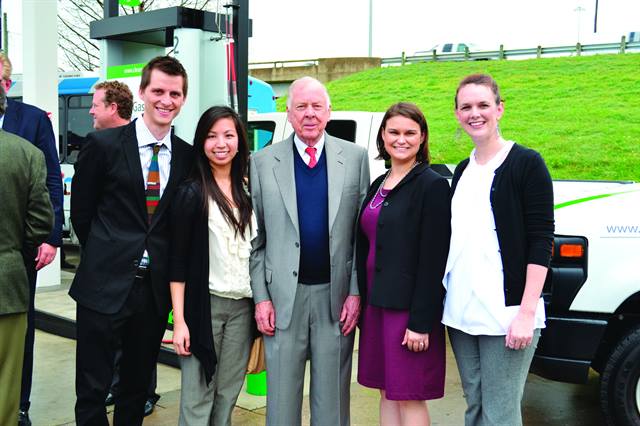
T. Boone Pickens (center) poses with Dallas-Fort Worth Clean Cities staff (from left, Kenny Bergstrom, Kimberlin To, Pamela Burns, and Mindy Mize) at the Fuel City CNG station opening.
Hollywood may have many people believing that the Dallas-Fort Worth area is overrun with uber-rich Texas oil barons peddling black gold. But, in fact, from an energy perspective, there’s a lot more to this immense metropolitan area in north-central Texas. It’s nothing short of a hotbed for alternative-fuel deployment.
With help from Dallas-Fort Worth Clean Cities (DFWCC), some of the area’s largest vehicle fleets are using biodiesel, ethanol, natural gas, propane autogas, and electricity to displace millions of gallons of petroleum every year. In 2011 alone, DFWCC members averted using more than 12 million gallons of petroleum fuels.
“That’s what’s most rewarding about this work,” said DFWCC Coordinator Pamela Burns, who came onboard with the organization in 2006. “When you’re driving down the street or talking with fleet managers, you can see first hand that the coalition’s efforts are making a difference on the ground every single day.”
DFWCC is housed within the North Central Texas Council of Governments and comprises 322 local stakeholders, roughly half of which come from the private sector.
The City of Fort Worth is among those leading the charge, with plans under way to construct an E-85 fueling infrastructure for its 600-plus flexible-fuel vehicles. The city also has plans to deploy natural gas, and already operates hundreds of vehicles that run on propane autogas, electricity, or biodiesel blends.
Other heavy hitters include Dallas/Fort Worth International Airport and the cities of Dallas and Denton, Texas. In some cases, these larger fleets stoke demand for public fueling infrastructure that, in turn, facilitates deployment for smaller fleets.
“With multiple publicly accessible natural gas stations on or near airport property, many of the taxis going in and out use natural gas,” Burns said.
Get Involved With Clean Cities
Through the work of nearly 100 local coalitions, Clean Cities advances the nation’s economic, environmental, and energy security by reducing petroleum use in transportation. Clean Cities is an initiative of the U.S. Department of Energy. Find out more at www.cleancities.energy.gov.
For more information about DFWCC, visit www.nctcog.org/trans/clean/cities or
e-mail Pamela Burns at pburns@nctcog.org.
More Green Fleet

EV Charging Use Is Outpacing Infrastructure Growth
ChargePoint’s 2026 Charging Forward Report points to rising charger use, higher-powered charging, commercial vehicle electrification, and energy-management technology. Here’s what fleets should know.
Read More →
Merchants Fleet Reports 290M EV Miles as Fleets Navigate Changing Electrification Market
From millions in operating savings to hundreds of millions of EV miles, Merchants Fleet’s latest report reveals what’s working and what’s changing in fleet electrification.
Read More →
The EV Breakdown Nobody's Talking About: Why Most Electric Vehicle Roadside Calls Aren't Mechanical Failures
Here's why EV breakdowns are widely misunderstood.
Read More →
ChargePoint Now Available in Energy Pass
ChargePoint and additional planned charging network integrations were added to GM's Energy Pass.
Read More →

First Look: Slate Auto's Electric Fleet Pickup
Could an affordable, modular EV pickup make electrification more practical for fleets?
Read More →
Slate Debuts Colorful, Unique EV Models
A recent media and client event, studded with electric vehicles dressed up on platforms, planted a new position for the manufacturer in the wider EV market. Fleets will find cost-saving advantages.
Read More →
Slate Electric SUV, Pickup Switchable Model Aims For Light-Duty Fleets
Everything about this EV is counterintuitive and understated, making it stand out from the crowd.
Read More →
Inspiration Mobility Acquires Key Electrada Assets
Inspiration Mobility Group has acquired select assets of Electrada, adding the fleet electrification provider's team, technology, and charging infrastructure development capabilities to its energy management business.
Read More →
Turning Connected Vehicle Data Into Decisions That Matter
Fleet leaders have more data than ever, but turning that data into clear, actionable decisions remains a challenge. This white paper shows how leading organizations are using connected vehicle data to improve safety, reduce costs, and optimize fleet performance. Learn how to turn insight into action across your fleet.
Read More →