




Learn More: The Future of Medium-Duty Truck Engines
All About Medium-Duty Work Truck Engines
Defining exactly what a truck must do is the first step in spec’ing a medium-duty truck engine.
by Lauren Fletcher & Sean Lyden
February 3, 2009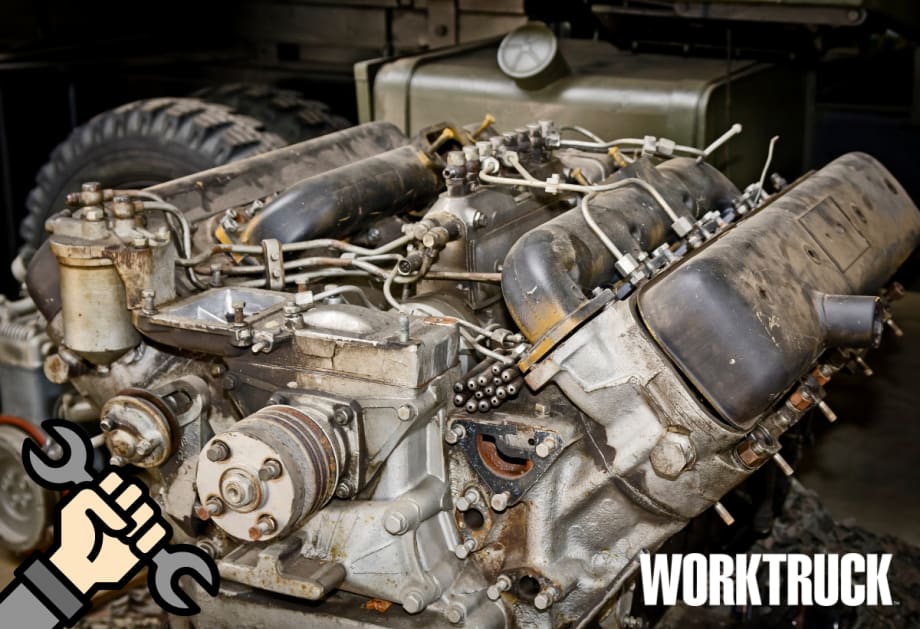
When deciding whether to overhaul/rebuild, remanufacture, or purchase a new engine, according to Boeglin, it comes down to how long you need the engine to last and your goals for the vehicle.
Photo: Work Truck
4 min to read
Matching a medium-duty truck engine to a fleet application depends on the size truck needed.
Here’s a breakdown of what to consider when spec’ing engines for medium-duty trucks up to a 33,000-lb. gross vehicle weight rating (GVWR).
Medium-Duty Truck Class 4 & 5 Engine Options
If the truck you need is a Class 4 or 5 (14,001-lb. – 19,500-lb. GVWR), engine selection is relatively simple. In many cases, only one option is available — diesel. Some manufacturers, such as Ford (F-450, F-550), GM (C-Series, W-Series), and Isuzu (N-Series, H-Series), offer both gasoline and diesel. Either way, you’re not overwhelmed with engine options.
How do you decide between gas and diesel on a Class 4 or 5? While diesel offers better fuel efficiency and engine longevity, gas engines have much lower up-front costs — a difference ranging anywhere from $6,500-$8,000 or more, depending on make and model.
Therefore, the key deciding factor is: How many miles per year will you be putting on that vehicle? Do you anticipate putting a substantial number of miles to recoup the higher investment in a diesel in a reasonable amount of time?
A general rule of thumb is 25,000-30,000 miles. If you project going over that threshold, diesel makes sense. If you’ll be doing less, then gasoline may be more cost-effective.
Run the numbers yourself to confirm what works best for you. Contact your manufacturer’s rep for approximate fuel economy numbers for both gasoline and diesel to plug in your calculations.
Medium-Duty Class 6 & 7 Options
If you’re spec’ing a Class 6 or 7 truck, engine selection becomes more complicated. For example, the Isuzu Diesel 6H 7.8L in the Chevrolet Kodiak C-7500 offers five different horsepower and torque options, ranging from 215 hp and 560 ft.-lb. torque to 300 hp and 860 ft.-lb. torque, with 230 hp and 260 hp in between. The approximate cost difference between the lowest and highest hp ratings, factoring in a heavier transmission required for the 300 hp engine, is as much as $8,500. This variance in engine hp/torque availability and cost is common across all Class 6 and 7 truck OEMs.
Matching the right hp and torque ratings to your application. How do you choose among hp and torque options? An under-spec’d engine presents performance and potential premature maintenance issues. If you over-spec, you pay a much higher cost per unit without a corresponding return on investment. How do you strike the right balance?
At this stage, involve your equipment upfitter and truck OEM rep for their counsel. They often have experience working with fleets in your industry and can offer specific recommendations so you don’t have to reinvent the wheel.
However, a few general principles, based on common applications can serve as a guide.
Higher hp and torque applications:
Over-the-road with heavy load, such as a towing and recovery vehicle.
Hilly, mountainous region.
Over-the-road pulling a heavy trailer.
Lower to mid-range hp and torque application:
Pickup and delivery where the truck does not need to reach full highway speed often.
Slower speed applications such as asphalt spreader, dump body, or mechanic’s crane/service body truck.
Over-the-road, on flat terrain, with lighter load.
Which scenario best matches your application? When you’ve defined exactly what you need the truck to do, you have the information you need to match the right engine to do the job.
Rebuild, Remanufacturer, or Buy New?
When it comes to replacing a truck engine, should you rebuild or overhaul, purchase a remanufactured engine, or just get a new truck? Bob Boeglin, national sales manager, from Jasper Engines and Transmissions offers his advice.
First, what’s the difference between these engines?
"Many times, the difference between remanufactured, rebuilt, or overhauled engines is simply how long it will last," said Boeglin.
Overhauling an engine is a less labor-intensive process. The repair shop will fix any problems, re-ring the pistons, grind the valves, and wash and paint the engine.
According to Boeglin, a rebuilt engine is better still, "but not at the grade of new." In a rebuilt engine, pistons are replaced, the valves are ground, old springs are reused, there may be some updates, and parts may or may not meet OEM specs.
To rebuild is to recondition by cleaning, inspecting, and replacing severely worn or broken parts. Serviceable parts are reused within the manufacturer’s acceptable wear limits. The quality of rebuilt components varies widely and many come with only a limited warranty.
Used components are pulled directly from a vehicle — typically a junkyard vehicle — and generally not so much as surface-cleaned. Used or junkyard components may have high mileage and a poor maintenance history — a failure waiting to happen, according to Boeglin. Many used or junkyard components come from a vehicle that was involved in an accident and may have unseen damage.
Remanufacturing is the process of building an engine as good as or better than new with the most current updates and new parts.
Most wearable parts are automatically replaced and all core material is closely inspected and checked against original equipment specifications. Replacement parts are new or requalified. If new, parts are made in the same production processes as original equipment.
When deciding whether to overhaul/rebuild, remanufacture, or purchase a new engine, according to Boeglin, it comes down to how long you need the engine to last and your goals for the vehicle.
Topics:EngineCumminsDetroit DieselInternationalMaxxForcePaccarPeterbiltGeneral MotorsIsuzuMedium-Duty TrucksMedium-Duty EnginesOperationsMaintenanceVehicle Research
Originally posted on Work Truck Online
Subscribe to Our Newsletter
More Operations

What Will Shape the Next Era of Fleet Management?
EVs, AI, and autonomous vehicles are reshaping fleet management. Discover what’s ahead—and how fleet leaders can prepare for the next era.
Read More →
How Fleets Can Recruit and Train Veterans for Technician Roles
Here's how the technician shortage has affected uptime for fleets, and what to do about it.
Read More →
Avis Budget Group Deploys Neology Toll Management Technology Across Major Brands
Neology’s neoFleet platform will manage toll transactions and toll-authority operations for vehicles across Avis, Budget, Payless, Budget Truck and Zipcar.
Read More →

Fleet Personal-Use Charges Edge Higher in 2026
Nearly eight in 10 surveyed fleets allow personal use of company vehicles, while just over half of respondents report charging employees for the privilege.
Read More →
The Future of Fleet + What’s Changing Right Now | AF News Recap
Could developments overseas offer a preview of what’s coming for U.S. fleets? This week, we’re looking at the future of AI, autonomy, and electrification, plus Ford Pro’s new certified pre-owned program, smarter vehicle offboarding, and a new way for fleets to manage toll expenses.
Read More →
How to Handle Vehicle Offboarding
What do fleet managers need to do when a driver leaves?
Read More →
Sponsored•October 1, 2026
Fleet Manager’s Ultimate Playbook: Navigating the New Standard in OEM Connectivity
Rising operating costs, driver safety concerns, and unplanned downtime are putting unprecedented pressure on modern fleets. Discover how fleet managers use embedded OEM connectivity and real-time vehicle data to cut TCO, prevent downtime, and protect drivers without aftermarket telematics hardware.
Read More →
U.S. Bank Adds Verra Mobility Toll Management to Voyager Fleet Platform
The integration allows U.S. Bank Voyager fleet customers to manage toll payments and violations alongside fuel, EV charging and maintenance expenses.
Read More →
ADAS Prevents Crashes. But Repairs Cost More | AF News Recap
ADAS-equipped vehicles may crash less often, but they can cost more when they do. This week, we’re breaking down what that tradeoff means for fleets, plus Subaru’s first Forester Wilderness Hybrid, Nissan’s new e-POWER Rogue, and why Calstart has become Catalyst Mobility.
Read More →
Moventum Fleet Management Names Mark Iorillo Head of Sales
Iorillo brings nearly 20 years of fleet management and sales experience to the role, including previous positions at Element Fleet Management, CEI, Donlen and Ryder.
Read More →