




7 Factors to Consider When Upfitting Cargo Vans
Upfitting can be an involved process, but it can be broken down into seven factors to maximize productivity and benefit the company’s bottom line.

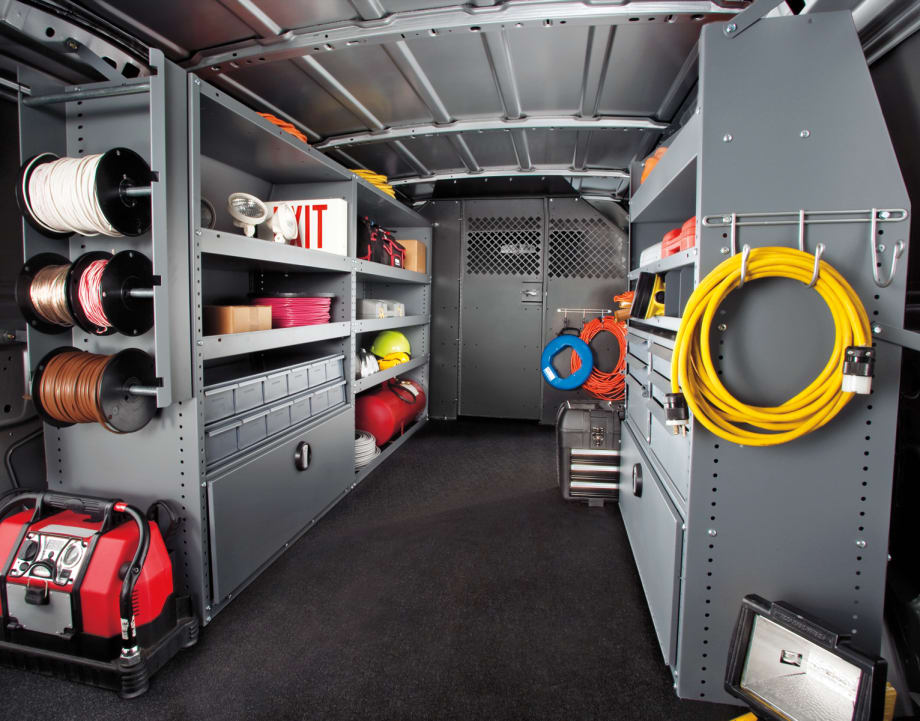
Enhancing product visibilty helps technicians more readily keep track of inventory. Keeping a van organized based on repetition of duties increases efficency.

Enhancing product visibilty helps technicians more readily keep track of inventory. Keeping a van organized based on repetition of duties increases efficency.
Shelving and drawer systems, partitions, ladder racks, spot mirrors, conduit carriers — these are just a few examples of upfits for cargo vans that can directly impact worker productivity. But, with a wide range of products and configurations to choose from, what should fleet managers consider when upfitting cargo vans?
Here are seven factors to keep in mind:
1-Taking Inventory
With a typical load, what equipment, tools, parts, and product is the van expected to haul daily? Are there occasional use, bulkier items that the van will need space to carry as well? After accounting for all of the fleet’s needs for storage, a clearer insight will be gained into how to best organize those items for technicians to do their jobs more efficiently.
2-Measuring Repetition
When working out of the van, what does the technician do most often at each stop throughout the day? What products, equipment, and parts does he or she need access to the most?
“We worked with a telecommunications company and followed its drivers in three different regions of the country for a total of 48 hours to understand how they were using their vans,” said Dick Rose, vice president of engineering for Adrian Steel Company, a van and truck equipment manufacturer headquartered in Adrian, Mich. “One of the things we found is that every driver did the same three things every time: They put cones out for the vehicle, put on their tool belt, and got the same tester that was used for each job.”
The Adrian team analyzed how the vans were organized. “We noticed right away that the cones were haphazardly placed [inside the cargo area] from one van to the next,” Rose said. “The other thing is the tool belt. Some drivers carried the tool belt inside the cab, some carried the belt along the side doors, and others by the back door. Again there was no standardized position, from van to van, which created a lot of inefficiencies, and time lost getting the things they needed.”
3-Be Ergonomic
Repetitive tasks also increase risk of muscle strain, injury, and lost productivity if the van isn’t upfitted with ergonomics in mind, Rose said.
“Is there any kind of repetitive motion stressor? Are there difficult lifts for technicians that could cause a repetitive motion injury? You can imagine that if you’re constantly leaning into a cargo van to pick up something heavy, and it’s an arm’s length away from you, the chances of you getting injured are much greater than if that same cargo is stored much closer to where you can retrieve it with less strain,” Rose explained. “So, in those cases, what you’re going to want to do is configure a cargo management system that will allow those heavier items to be stored right at the door opening or install a sliding mechanism so you can lift the item straight out from the door.”
Ergonomics is also an important factor to consider when selecting ladder racks, said Jenn Voelker, marketing manager for Leggett & Platt Commercial Vehicle Products, an Atlanta-based firm that designs, manufactures, and installs commercial vehicle interior systems, truck equipment, and accessories. “What’s the weight and length of the ladder? If they’re carrying a fairly heavy ladder, we recommend a slide-down style ladder rack, which brings the ladder down the side of the van. It’s more ergonomic and safer to use,” she said.
This is especially a concern as new vans come to market with taller roof heights, such as the Nissan NV, Ford Transit, and Ram ProMaster, Rose said. “The roofs are physically higher on those vehicles, so the conventional grip-lock style ladder rack is really not going to be a good solution if the person is not at least 6-feet tall,” Rose cautioned. “You’ll have technicians climbing on bumpers and tires to get up there, which creates another opportunity for a slip and fall. In those cases, you want to be able to bring the ladder rack closer to the ground so that the person who is using the ladder doesn’t have to reach as high to load it back on the van. You’re reducing the chance of ergonomic injury and slip and fall by selecting the right ladder rack.”
4-Maximize Protection
Will the van carry any delicate or fragile cargo that will need to be protected from damage? “Many electricians, for example, haul light switches and other electrical components, which can get damaged very easily if you just throw them into the back of the van with all your tools,” said Todd Goldmeyer, marketing manager for Adrian Steel. “Those contractors will likely want a pull-out drawer unit or something that will protect those delicate pieces. This way, when they show up at a customer’s facility, those components look brand new.”
Theft protection is also an important consideration, added Goldmeyer. “A technician may be carrying a lot of expensive components, tools, and testing equipment inside the van, so you’ll want to look at more door storage and lockable storage in those situations to reduce risk of theft,” he said.
5-Enhance Visibility
“You want to organize the van cargo in a visual way where you can quickly and easily find what you need and be able to determine, ‘Have I depleted my inventory? Are my tools in the right place? Have I left something at a customer’s business or home?’ ” Rose recommended.
Goldmeyer agreed. “Cargo management is all about efficiency. You’re not spending 20 minutes in the back of a van looking for that one part or that one tool,” he said.
In terms of enhancing visibility, LED lighting systems are useful for technicians that work at night, Rose said. “The standard OEM dome light isn’t usually enough for nighttime operations. In those applications, fleets will want to consider an LED lighting system that shines in three different zones inside the cargo area of the van — both sides of the shelving and straight down on the center aisle.”
6-Increase Safety
“Remember the partition,” Goldmeyer cautioned. “We get requests from time to time where customers don’t want to put a partition in the van. But, we see it as an essential safety feature, such as air bags. You wouldn’t want to delete the air bags; you need to treat a partition the same way. We always start with the partition and design the cargo management system around that.” Other upfits that enhance van safety include spot mirrors, backup cameras, and parking sensors.
7-Consider Materials
Steel, aluminum, or composite — what material is best for van shelving, drawers, and other upfits?
“It depends on what is most important to that fleet,” said Voelker with Leggett & Platt. “If upfit cost is important, traditional steel interiors are typically the most cost-effective up front. If fuel economy is important, we recommend composite and aluminum materials, because they’re lighter weight and can help save in fuel cost over the life of the vehicle.”
According to Adrian Steel’s Rose, “Generally, if the vehicle has to carry a broad range of weight in varying road conditions — gravel roads, dirt roads, or roads with a lot of pot holes — then we tend to go toward steel in those types of situations. If it’s an application where the fleet is carrying small parts, using a lot of drawers, and they want a lot of options on how those drawers can be configured, composites make a lot of sense.”
In addition to weight-saving components, some fleets are turning to composite storage systems because of the material’s noise-reduction capabilities, said Voelker. “The steel, and even aluminum systems, get a lot of rattle from products on the shelves, whereas the composite material helps dampen the noise. And, that’s really important to drivers, because they’re in the vehicles all day,” she said. WT
More Operations
A buyer's guide to fleet management software in 2027
Buying fleet management software in 2027 means looking beyond features and price. As fleet operations, technology and expectations evolve, this guide explores what today’s fleet professionals should consider when choosing a system that can deliver value now and adapt to what comes next.
Read More →
What Will Shape the Next Era of Fleet Management?
EVs, AI, and autonomous vehicles are reshaping fleet management. Discover what’s ahead—and how fleet leaders can prepare for the next era.
Read More →
How Fleets Can Recruit and Train Veterans for Technician Roles
Here's how the technician shortage has affected uptime for fleets, and what to do about it.
Read More →

Avis Budget Group Deploys Neology Toll Management Technology Across Major Brands
Neology’s neoFleet platform will manage toll transactions and toll-authority operations for vehicles across Avis, Budget, Payless, Budget Truck and Zipcar.
Read More →
Fleet Personal-Use Charges Edge Higher in 2026
Nearly eight in 10 surveyed fleets allow personal use of company vehicles, while just over half of respondents report charging employees for the privilege.
Read More →
The Future of Fleet + What’s Changing Right Now | AF News Recap
Could developments overseas offer a preview of what’s coming for U.S. fleets? This week, we’re looking at the future of AI, autonomy, and electrification, plus Ford Pro’s new certified pre-owned program, smarter vehicle offboarding, and a new way for fleets to manage toll expenses.
Read More →
How to Handle Vehicle Offboarding
What do fleet managers need to do when a driver leaves?
Read More →
Fleet Manager’s Ultimate Playbook: Navigating the New Standard in OEM Connectivity
Rising operating costs, driver safety concerns, and unplanned downtime are putting unprecedented pressure on modern fleets. Discover how fleet managers use embedded OEM connectivity and real-time vehicle data to cut TCO, prevent downtime, and protect drivers without aftermarket telematics hardware.
Read More →
U.S. Bank Adds Verra Mobility Toll Management to Voyager Fleet Platform
The integration allows U.S. Bank Voyager fleet customers to manage toll payments and violations alongside fuel, EV charging and maintenance expenses.
Read More →
ADAS Prevents Crashes. But Repairs Cost More | AF News Recap
ADAS-equipped vehicles may crash less often, but they can cost more when they do. This week, we’re breaking down what that tradeoff means for fleets, plus Subaru’s first Forester Wilderness Hybrid, Nissan’s new e-POWER Rogue, and why Calstart has become Catalyst Mobility.
Read More →