




5-Year Analysis: Accident Management Trends
How have accident management statistics changed over the past five years? With increased attention on driver education and distracted driving, you may be surprised by what you see.

Accidents impact not only a company's bottom line, but the safety of fleet's greatest resource: its drivers and the vehicles they operate. The past five years have seen an increased focus on driver safety, accident management, and minimizing distracted driving.
Automotive Fleet has been analyzing fleet accident management trends for several years. The following pages review the past five years and are chock full of important trends and data.
Interesting trends that emerged include the age range of drivers involved in accidents and driver tenure, which continue to illustrate just how important continued driver education and training can be.

Between 2006 and 2010, drivers with less than one-year tenure in both the sales and service segments experienced the lowest percentage of accidents - with the exception of 2007 for sales drivers. These statistics help show the necessity of continued driver education, beyond initial training.
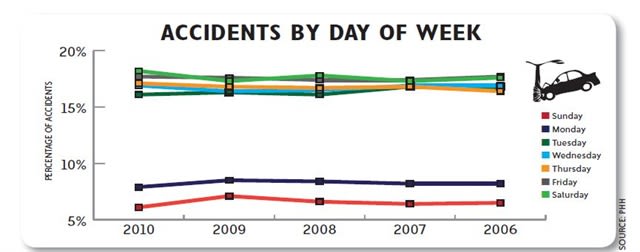
Over the past five years, the lowest percentage of accidents occurred on Sunday and Monday, with Friday and Saturday typically showing the highest percentage of accidents. The overall percentage of accidents by day of week has remained constant since 2006, with accidents on Sunday showing the highest percentage decrease.
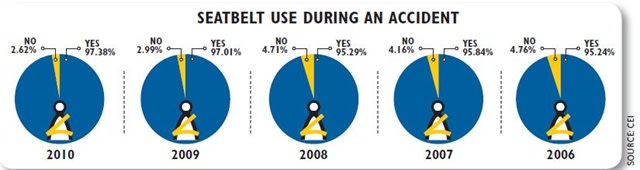
Seatbelts save lives - and drivers are catching on. Seatbelt use has steadily increased over the past five years from a low of 95.24 percent utilizing a seatbelt during an accident in 2006 to a high of 97.38 percent in 2010.
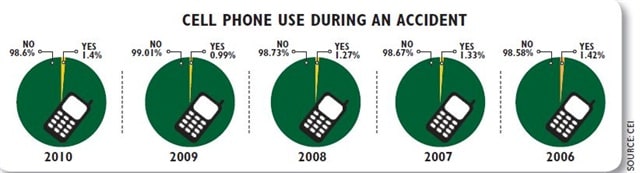
Overall, the percentage of accidents in which a cell phone was in use has stayed steady over the past five years, dropping 0.02 percentage points, hitting a low point of less than 1 percent in 2009.
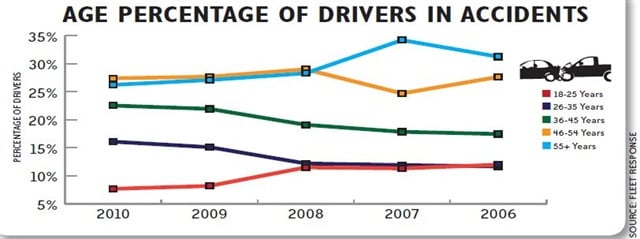
Overall, the percentage of drivers in accidents by age group has declined over the past five years, with drivers between 46 and 54 years old and those over the age of 55 experiencing the highest percentage of accidents. Accidents by drivers aged 18-25 have been decreasing year-over-year, while accidents by drivers aged 26-35 and 36-45 have been increasing.
More Operations

What Will Shape the Next Era of Fleet Management?
EVs, AI, and autonomous vehicles are reshaping fleet management. Discover what’s ahead—and how fleet leaders can prepare for the next era.
Read More →
How Fleets Can Recruit and Train Veterans for Technician Roles
Here's how the technician shortage has affected uptime for fleets, and what to do about it.
Read More →
Avis Budget Group Deploys Neology Toll Management Technology Across Major Brands
Neology’s neoFleet platform will manage toll transactions and toll-authority operations for vehicles across Avis, Budget, Payless, Budget Truck and Zipcar.
Read More →

Fleet Personal-Use Charges Edge Higher in 2026
Nearly eight in 10 surveyed fleets allow personal use of company vehicles, while just over half of respondents report charging employees for the privilege.
Read More →
The Future of Fleet + What’s Changing Right Now | AF News Recap
Could developments overseas offer a preview of what’s coming for U.S. fleets? This week, we’re looking at the future of AI, autonomy, and electrification, plus Ford Pro’s new certified pre-owned program, smarter vehicle offboarding, and a new way for fleets to manage toll expenses.
Read More →
How to Handle Vehicle Offboarding
What do fleet managers need to do when a driver leaves?
Read More →
Fleet Manager’s Ultimate Playbook: Navigating the New Standard in OEM Connectivity
Rising operating costs, driver safety concerns, and unplanned downtime are putting unprecedented pressure on modern fleets. Discover how fleet managers use embedded OEM connectivity and real-time vehicle data to cut TCO, prevent downtime, and protect drivers without aftermarket telematics hardware.
Read More →
U.S. Bank Adds Verra Mobility Toll Management to Voyager Fleet Platform
The integration allows U.S. Bank Voyager fleet customers to manage toll payments and violations alongside fuel, EV charging and maintenance expenses.
Read More →
ADAS Prevents Crashes. But Repairs Cost More | AF News Recap
ADAS-equipped vehicles may crash less often, but they can cost more when they do. This week, we’re breaking down what that tradeoff means for fleets, plus Subaru’s first Forester Wilderness Hybrid, Nissan’s new e-POWER Rogue, and why Calstart has become Catalyst Mobility.
Read More →
Moventum Fleet Management Names Mark Iorillo Head of Sales
Iorillo brings nearly 20 years of fleet management and sales experience to the role, including previous positions at Element Fleet Management, CEI, Donlen and Ryder.
Read More →