




2007 Toyota Tundra Blends V-8 Power with Sport Styling
Offered in 31 model configurations, the all-new next-generation Toyota Tundra full-size pickup borrows some sporty styling cues from the FTX Concept while maintaining its uncompromising resilience.
by Chad Simon
February 2, 2007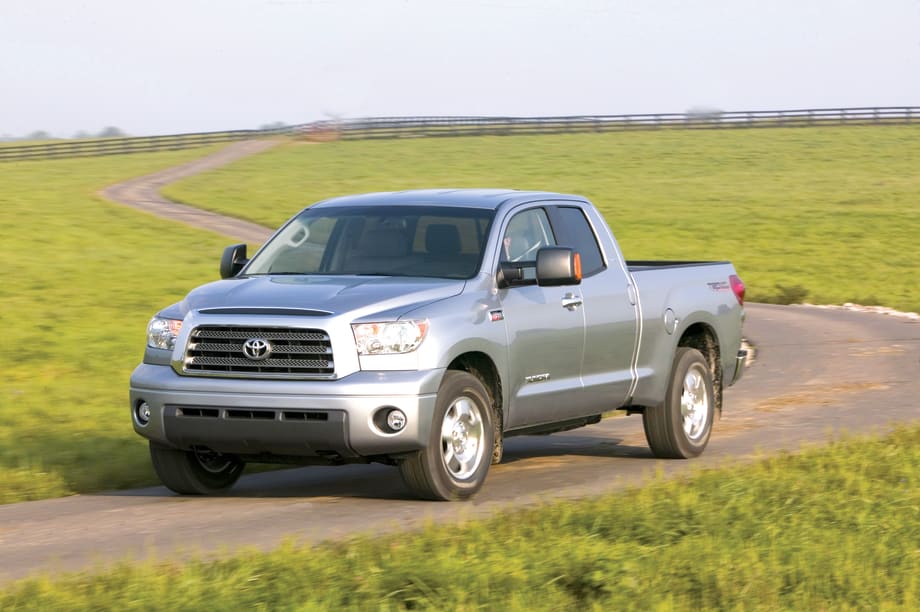
With 31 model configurations, the 2007 Tundra is offered in three trim levels.
Photo: Toyota
3 min to read
Unveiled to the media last fall in Louisville, Ky., Toyota’s all-new next-generation full-size Tundra pickup has been completely redesigned for the 2007-MY. Mammoth in size and equipped with a knockout V-8 punch, the new Tundra is 10 inches longer, five inches taller, and four inches wider than its predecessor.
Built entirely in the U.S., Toyota set its sights on “Americanizing” the Tundra to compete in the domestic light-truck market.
With 31 model configurations, the 2007 Tundra is offered in three trim levels (Base, SR5, Limited), three cabs (Regular, Double, CrewMax), three wheelbases (126.8, 145.7, 164.6 inches), and three bed lengths (5.5, 6.5, 8 feet). All beds are 22.2 inches deep, and CrewMax — not currently fleet available — and Double cabs seat up to six passengers.
Styling Inspired by FTX Concept
Sporty and agile in complexion, the 2007 Tundra was styled after the FTX Concept, which debuted in 2004. Borrowed exterior styling features include a pronounced trapezoidal grille, high-mounted jewel-like headlamps, 18-inch wheels, and rounded, athletic body.
Inside, the Tundra also adopted the FTX “command and control” philosophy, which provides the driver an unobstructed view of the road and easy access to all knobs and controls. The truck’s adaptable interior is designed to fulfill workstation, comfort, and storage needs.
For maximized cargo capacity, the Regular Cab features a 40/20/40 front bench seat and passenger fold flat, while in Double and CrewMax cabs, rear seat backs fold flat into the floor.
Packing V-8 Power
Still reputed as a tough and rugged work truck, the Tundra hasn’t compromised its grit for glamour. It can tow up to 10,800 lbs. when equipped with Toyota’s Tow Package featuring the tow/haul shift mode. The Tundra’s powerful 4.0L V-6 236 hp and standard 4.7L i-Force V-8 271-hp engines are mated to a 5-speed automatic transmission, while the all-new 5.7L i-Force V-8 381-hp engine carries a 6-speed automatic.
All three integrate electronic throttle control and variable valve timing with intelligence and both V-8s are available in four-wheel drive. Depending on the powertrain, the 2007 Tundra’s EPA-estimated fuel economy ranges between 14 mpg (city) and 20 mpg (highway).
Standard Safety Features
The Tundra’s STAR safety system comprises a host of standard safety features, including an automatic limited-slip differential, providing some wheel slip for better acceleration in snow or mud. Vehicle stability control integrates traction control, helping to keep the truck on the road by automatically applying the brakes to individual wheels when the system detects front- and rear-wheel slide.
Four-wheel anti-lock brakes with electronic brake-force distribution and brake assist maximize brake pressure for better control. The Tundra is also equipped with standard front- and rear-seat side and roll-sensing side-curtain airbags.
Options and Warranty
Options include a navigation system, backup video camera, and dual-zone automatic climate control (standard in Limited models). The 2007 Tundra is backed by a basic 36-month/36,000-mile warranty.
Subscribe to Our Newsletter
More Operations

Avis Budget Group Deploys Neology Toll Management Technology Across Major Brands
Neology’s neoFleet platform will manage toll transactions and toll-authority operations for vehicles across Avis, Budget, Payless, Budget Truck and Zipcar.
Read More →
Fleet Personal-Use Charges Edge Higher in 2026
Nearly eight in 10 surveyed fleets allow personal use of company vehicles, while just over half of respondents report charging employees for the privilege.
Read More →
The Future of Fleet + What’s Changing Right Now | AF News Recap
Could developments overseas offer a preview of what’s coming for U.S. fleets? This week, we’re looking at the future of AI, autonomy, and electrification, plus Ford Pro’s new certified pre-owned program, smarter vehicle offboarding, and a new way for fleets to manage toll expenses.
Read More →
How to Handle Vehicle Offboarding
What do fleet managers need to do when a driver leaves?
Read More →
Sponsored•October 1, 2026
Fleet Manager’s Ultimate Playbook: Navigating the New Standard in OEM Connectivity
Rising operating costs, driver safety concerns, and unplanned downtime are putting unprecedented pressure on modern fleets. Discover how fleet managers use embedded OEM connectivity and real-time vehicle data to cut TCO, prevent downtime, and protect drivers without aftermarket telematics hardware.
Read More →
U.S. Bank Adds Verra Mobility Toll Management to Voyager Fleet Platform
The integration allows U.S. Bank Voyager fleet customers to manage toll payments and violations alongside fuel, EV charging and maintenance expenses.
Read More →
ADAS Prevents Crashes. But Repairs Cost More | AF News Recap
ADAS-equipped vehicles may crash less often, but they can cost more when they do. This week, we’re breaking down what that tradeoff means for fleets, plus Subaru’s first Forester Wilderness Hybrid, Nissan’s new e-POWER Rogue, and why Calstart has become Catalyst Mobility.
Read More →
Moventum Fleet Management Names Mark Iorillo Head of Sales
Iorillo brings nearly 20 years of fleet management and sales experience to the role, including previous positions at Element Fleet Management, CEI, Donlen and Ryder.
Read More →
Fleet Has a Talent Pipeline Problem. What Comes Next? | AF News Recap
Where will fleet’s next generation of leaders come from? This week, we’re looking at the industry’s talent pipeline, what certification can add to a fleet career, how to build an award-worthy track record, and the return of Automotive Fleet’s Personal Use Survey.
Read More →
Smith System Launches Driver Risk Management Program
Fleets have more driver data than ever, but identifying risky behavior doesn't necessarily correct it. Smith System's new Driver Risk Management program combines monitoring, training, and follow-up coaching to help fleets connect risk signals with driver intervention.
Read More →