




Buick's eAssist Improves 2012 Regal Fuel Economy by 25 Percent
CHICAGO – Buick will offer its new eAssist fuel-saving technology on the 2012 Regal, which improves overall fuel economy by 25 percent over the 2011 four-cylinder/six-speed powertrain.

A diagram showing the positioning of Buick's eAssist technology in the 2012 Regal.

CHICAGO – Buick will offer its new eAssist fuel-saving technology on the 2012 Regal, which the automaker said improves overall fuel economy by 25 percent over the 2011 four-cylinder/six-speed powertrain. Estimated fuel economy is 26 mpg city and 37 mpg on the highway (pending EPA certification).
Regal with eAssist joins the 2012 LaCrosse as the second Buick to feature the efficiency-enhancing technology. The eAssist system uses a lithium-ion battery system, electric induction motor-generator, and regenerative braking capability to improve fuel economy. Buick’s eAssist technology assist’s the 2012 Regal’s 2.4L Ecotec direct-injection four-cylinder engine and six-speed automatic transmission by using power stored in the battery to provide an electric boost in different driving scenarios to optimize engine and transmission operation.
The system uses an 115v lithium-ion battery and a 15-kW induction motor-generator to increase fuel economy through regenerative breaking, which provides up to 15 kW of electricity to charge the batter; automatic engine shut-off when the vehicle stops; fuel cut-off during deceleration down to zero vehicle speed, enabled by the torque smoothing provided by the induction motor-generator unit; intelligence charge/discharge of the high-voltage battery.
The eAssist power pack contains the lithium-ion battery pack, the integrated power inverter and 12v power supply. It is located in a compartment between the rear seat and trunk. It weighs about 65 pounds (29 kg). The 2012 Regal offers slightly less trunk space when compared with 2011 models with the four-cylinder/six-speed powertrain but still provides 11.1 cubic feet (314 liters) of storage. A quiet electric fan cools the power pack, drawing air from a vent located in the package tray, behind the rear seat.

The eAssist system’s electric induction motor-generator is mounted to the engine in place of the alternator to provide motor assist and electric-generating functions through an engine belt-drive system. The induction motor-generator is a high-performance, liquid-cooled compact induction motor.
In the Regal with eAssist, the engine is rated at 182 horsepower (136 kW) and the company’s Hydra-Matic 6T40 transmission technology features a number of changes designed to improve efficiency and work with the eAssist system. Significant internal transmission changes to clutch controls and hardware provide reduced spin losses while improving shift response and time. The added electric power provided by the eAssist system allows for higher gearing to improve steady state efficiency without impacting acceleration performance or driveability, Buick stated. The system’s ability to provide some electric assistance at cruising speeds allows the driver to accelerate lightly or ascend mild grades without the transmission downshifting.
An auxiliary, electric-driven transmission oil pump is added to the 6T40, which keeps the transmission primed and the fluid flowing when the engine shuts down at a stop. That keeps the transmission ready to perform when the driver accelerates, for a seamless, uncompromised driving experience.

In addition to these automatic features, the 2012 Regal offers a number of other options designed to allow a driver to further optimize fuel usage. First, the Regal features a driver-selectable, fuel economy-optimizing mode for the air conditioning system, which enables more frequent and longer-duration engine stop periods. Next, the Regal offers an ECO gauge on the instrument panel that continuously responds to driving behavior, which is designed to enable the driver to drive with greater efficiency. The vehicle also provides a power flow readout in the 7-inch infotainment screen, which shows the flow of energy through the electric assist system, such as battery charging from regeneration and electric power directed to the engine.
More Operations
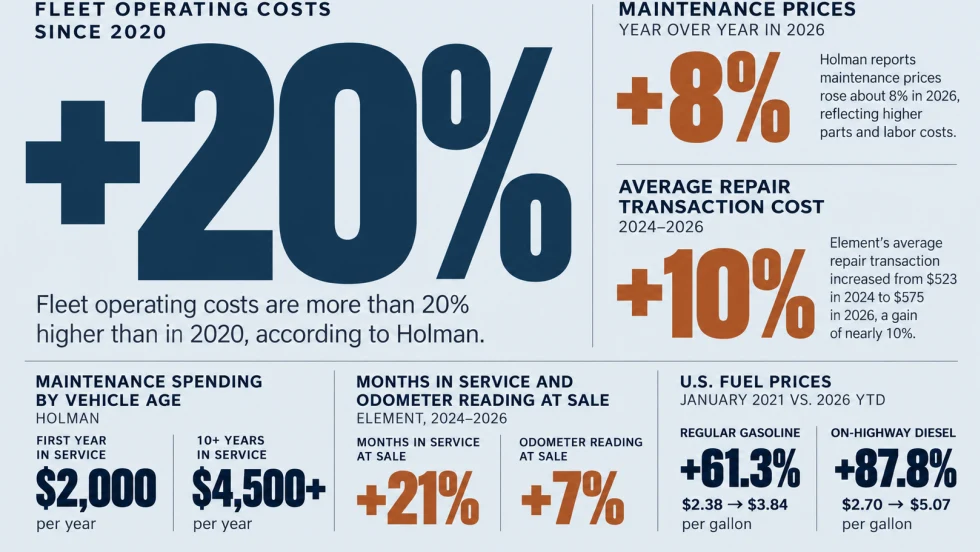
Managing Fleet Costs in an Era of Permanent Volatility
Fleet operating costs have risen more than 20% since 2020, raising a key question: When does extending a vehicle's service life stop making financial sense?
Read More →
The Next Evolution of Fleet Management: Autonomous Operations
This opening keynote session at the Fleet Forward Conference highlights the future of autonomous driving for fleets.
Read More →
How to Reduce the Total Cost of Risk From Catalytic Converter Theft
A stolen catalytic converter can cost fleets far more in downtime and lost productivity than in repairs. A total-cost-of-risk approach can help fleet managers quantify their exposure and prioritize theft prevention.
Read More →

Personal-Use Charges Rise as Vehicle Values Fall | AF News Recap
Personal-use charges are climbing, wholesale used-vehicle values are declining, and commercial fleet sales growth is slowing. This week, we're breaking down the latest fleet data, plus how Element Fleet Management is helping Waymo prepare for its first Canadian robotaxi market.
Read More →
Here's When You Should Make an Exception to Fleet Policy
Fleet policies are designed to create consistency, but not every driver or situation fits neatly within standard rules.
Read More →
AI-Native or AI-Acquired: What Should Fleet Managers Look for in an AI Platform?
Six questions can help fleet managers look beyond AI marketing claims to evaluate integration, data access, and real-world operational performance.
Read More →
A buyer's guide to fleet management software in 2027
Buying fleet management software in 2027 means looking beyond features and price. As fleet operations, technology and expectations evolve, this guide explores what today’s fleet professionals should consider when choosing a system that can deliver value now and adapt to what comes next.
Read More →
What Will Shape the Next Era of Fleet Management?
EVs, AI, and autonomous vehicles are reshaping fleet management. Discover what’s ahead—and how fleet leaders can prepare for the next era.
Read More →
How Fleets Can Recruit and Train Veterans for Technician Roles
Here's how the technician shortage has affected uptime for fleets, and what to do about it.
Read More →
Avis Budget Group Deploys Neology Toll Management Technology Across Major Brands
Neology’s neoFleet platform will manage toll transactions and toll-authority operations for vehicles across Avis, Budget, Payless, Budget Truck and Zipcar.
Read More →