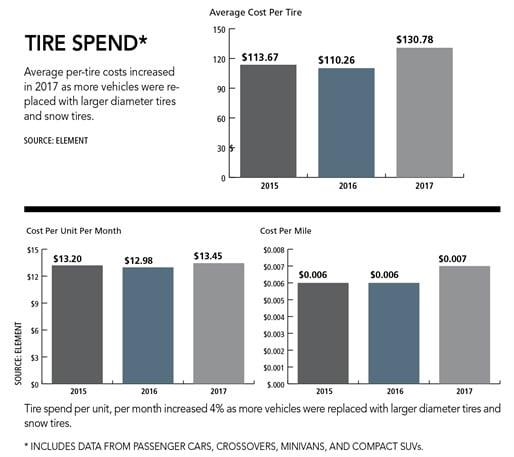
For the past four years, tire costs have been stable. But, new cost pressures have emerged in 2017, due to higher prices for the commodities used to manufacture tires and the trend to larger diameter, more expensive tires.
Like-for-like replacement tire prices for passenger cars increased 5-10% in calendar-year 2017 compared to 2016. A key reason is the increase in OEM automobile wheel diameters, which has driven up the price of fleet replacement tires, primarily because the larger the tire, the greater the manufacturing expense.
Ad Loading...
“The average cost per tire has increased due to larger diameter 17- to 18-inch wheels becoming more common on compact and mid-size vehicles,” said Chad Christensen, senior strategic consultant for Element Fleet Management. Wheel diameters are continuing to increase in size, further exerting upward pressure on replacement tire prices.
“More expensive tires found on larger diameter wheels – 18-inch and larger –are even more common than previous years, along with an increase in snow tire purchases,” added Christensen.
Agreeing with this assessment was Mark Lange, CAFM, technical services consultant for Element Fleet Management. “There were more snow tire purchases in 2017 than previous years,” said Lange. “Not only were there more snow tire purchases, but they were purchased in more geographic areas than we’ve seen historically.”
Though specialty tire purchases, such as all-weather or snow tires, are primarily impacted by the weather, more fleets are shifting toward allowing the purchase of these tires based on driver’s request versus a policy based solely on geographic location and expected snowfall. “We expect this trend to continue which could potentially push up the average cost per tire, as snow tires typically cost more than an all-season. This is, however, dependent of local weather,” said Christensen. The trend to larger diameter tires started in the retail market by consumers who wanted a better look for their vehicle by having a larger tire/wheel assembly to fill their wheel well. The auto manufacturers decided to produce vehicles with the larger wheels as optional equipment to keep the customer coming to the dealership and maintain some control of this phenomenon, which is extremely profitable.
At a Glance
The cost of commodities used to manufacture tires, such as oil, rubber, and steel, are increasing. Raw material prices were up 5% to 10% in 2017.
The increase in OEM automobile wheel diameters has driven up the cost of fleet’s replacement tires, primarily because the larger the tire, the greater the manufacturing expense.
One factor exerting downward pressure on fleet tire expenditures is the ongoing improvements in tire quality over the past decade, which has resulted in longer wear life.
During the past decade, tire diameters have increased in size to as much as 24-inch, 26-inch, and even larger.
Ad Loading...
But, with the larger tire sizes mounted on vehicles, the wheels are increasingly getting damaged from road hazards and pot holes. The replacement cost of the wheel and larger tire is very expensive.
The concern about the number of new vehicles equipped with larger diameter tires does not appear to be abating and promises to continue to be an issue in future years.
“Larger diameter wheels and the cost of the replacement tires has been an issue for the past 10-15 years and will continue to do so,” said Lange. “The trend has been for at least one popular model of vehicle to have a unique tire size which is uncommon and sourced from one or two manufacturers at a premium cost. We would expect this to continue.”
Increase Cost of Raw Materials
The cost of commodities used to manufacture tires, such as the price of oil and rubber, continue to be the key factors driving the price of replacement tires for passenger cars. These commodity prices increased during 2017 compared to the prior year.
“The primary factor in 2018 will be the increase in raw material costs that will put upward pressure on tire costs,” said Christensen. “We could see another 5-10% increase in 2018 if raw materials continue to increase at the same rate as they did in 2017.”
Ad Loading...
Although there have been price increases in replacement tires, it impacts consumers more so than fleets, which tend to buy from national account vendors based on pre-negotiated prices.
Ordering: Inventory Challenges
When ordering vehicles with unique tire sizes, many fleet drivers are surprised that they are unable to locate a replacement tire due to inventory constraints.
Unique tire sizes and specs on certain vehicles pose a challenge to fleet managers when a replacement tire is needed because there is often limited availability.
The availability of a replacement tire depends on many factors: volume, production costs, type of vehicle, and whether the tire will be profitable. Therefore, in some cases, there could be only one tire manufacturer with a replacement tire that is suitable for that vehicle.
Not only is there limited availability of unique tire sizes for individual vehicle models, but there may also be a limited number of store outlets that stock them.
Ad Loading...
Another factor proven to exert upward pressure on replacement tire costs is the ongoing trend to larger diameter tires and unique tire sizes. As auto manufacturers develop unique tire sizes for new-model vehicles, it impacts the replacement tire supplies for one to two years, as other aftermarket tire companies may not immediately meet the demand for these tire sizes. This lag time limits the selection and availability of replacement tires.
Forecast of 2018 Tire Costs
Predicting future tire costs is very difficult due to the many variables that influence tire pricing. The unpredictable cost variable for tire prices is the price of commodities, such as oil, rubber, and steel, which are three key ingredients needed to manufacture tires.
Tire costs are driven by raw materials cost. If raw material prices stay consistent, tire prices stay consistent. The cost of raw materials influences most of the fluctuation in tire prices.
On average, raw material prices were up 5% to 10% in 2017, and the forecast is for a continuation of current prices into calendar-year 2018. But this forecast, based on past experience, can change quickly given the volatile nature of the commodity markets.
It is anticipated that replacement tire prices on light vehicles will continue to increase in 2018 to compensate for higher raw material costs. The magnitude of the price changes will be determined by the sustained strength of commodity prices.
Ad Loading...
Tire Manufacturing Innovations
One factor exerting downward pressure on fleet tire expenditures is the ongoing improvement in tire quality, which has resulted in longer wear life during the past decade. Tire tread life has been extended by 10% in the past 10 years. This has helped offset some of the recent price increases since the expense is spread out over a longer period.
There are a number of manufacturing innovations being explored and implemented by tire OEMs to reduce costs and extend wear life. One approach has been to research the use of alternate materials and commodities to manufacture tires.
Rising operating costs, driver safety concerns, and unplanned downtime are putting unprecedented pressure on modern fleets. Discover how fleet managers use embedded OEM connectivity and real-time vehicle data to cut TCO, prevent downtime, and protect drivers without aftermarket telematics hardware.
Fleetio’s Brianna Perry demonstrates how Service Advisor evaluates maintenance requests, identifies pricing anomalies, and provides the context fleet managers need to focus their attention on potential problems.
Fleet compliance isn't just about having policies — it's about consistently enforcing them. This practical guide reveals six hidden compliance risks common in public sector and shared fleet operations and outlines proven strategies to improve visibility, accountability, and audit readiness
Vincentric’s three-year, 60,000-mile projections reveal wide differences for both scheduled and unscheduled maintenance among selected vehicle categories. Projected maintenance visits also play a factor.
Keeping fleet vehicles on the road has become as important as buying them. Darren Bradshaw of Mopar North America explains how connected vehicle data, AI, and proactive service strategies are helping Stellantis reduce downtime and move closer to predictive maintenance.
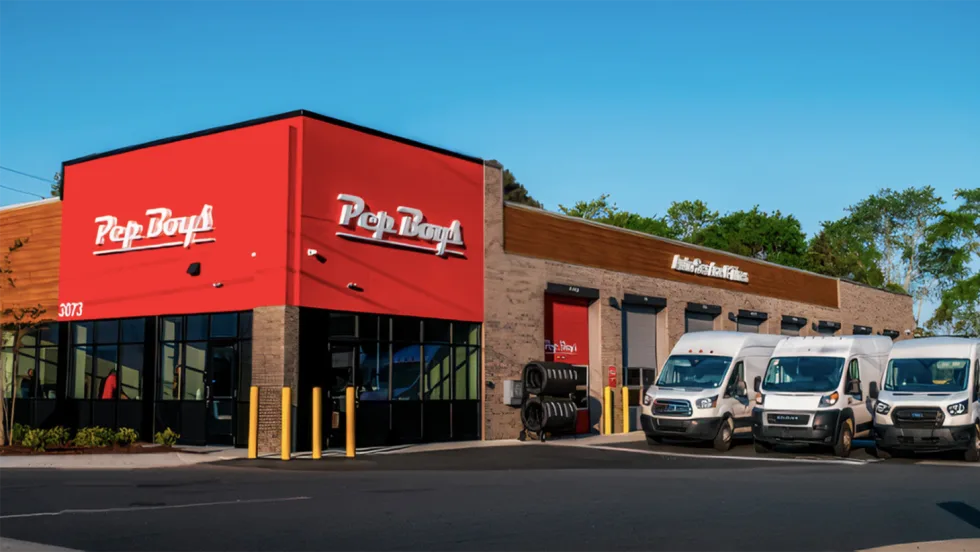
Merchants Fleet has expanded its relationship with Pep Boys, increasing the service provider's role within its national maintenance network. The move is intended to enhance maintenance coordination and support commercial fleets through Pep Boys' nationwide footprint.
Cesar Ayala of O’Connell Landscape Maintenance shares how he transitioned from the Marine Corps to managing a 460-vehicle fleet—and the real-world challenges of maintenance, compliance, and driver management in California.