




Fleets Part of Ford's 2018 Mobility Strategy
Ford is looking to leverage burgeoning vehicle connectivity technology to deliver improved data services and fleet optimization for commercial fleets, which is part of the Ford Mobility team’s strategy to accelerate delivery of mobility products and services to customers in 2018.
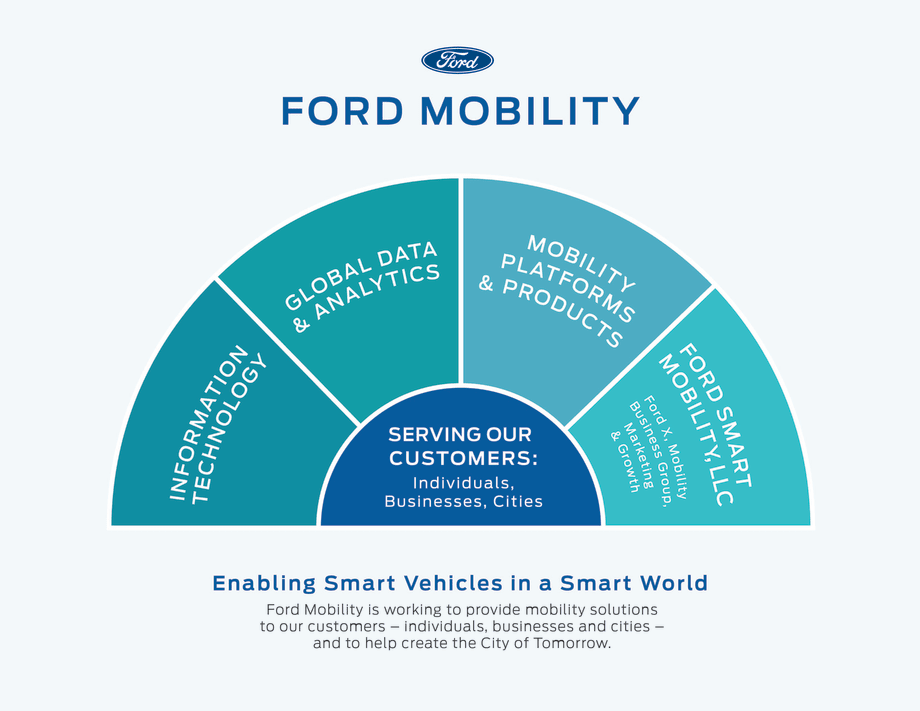
Graphic courtesy of Ford.
Graphic courtesy of Ford.
Ford is looking to leverage burgeoning vehicle connectivity technology to deliver improved data services and fleet optimization for commercial fleets, which is part of the Ford Mobility team’s strategy to accelerate delivery of mobility products and services to customers in 2018.
Ford’s mobility team looks to deliver improved digital services to fleet, personal, and city customers by providing 100% connectivity of new vehicles in the U.S. by 2019, with a goal of 90% connectivity on a global scale by 2020, according to the automaker.
Ford also plans to accelerate its strategy via the expansion of the Transportation Mobility Cloud, its open, cloud-based platform, which manages information flow and basic transactions between a variety of components in the transportation ecosystem, said Ford. The expansion will include the involvement of other automakers, suppliers, partners and cities. Also, a developer network to build and support the system also will be launched.
Ford is also expanding its ride-sharing technologies via Chariot, the cornerstone of Ford’s microtransit solutions, and will see an acceleration of city launches globally this year. Further still, Ford Mobility will expand its non-emergency medical transportation operation from a Southeast Michigan pilot with Beaumont Health into a full business serving multiple medical systems, Ford announced in a release.
Ford acquired two organizations to support its growth in mobility solutions: Autonomic, which specializes in scale, architecture and leverage for transportation industry solutions; and TransLoc, which is a provider of demand-response technology for city-owned microtransit solutions, according to the automaker.
Ford also is announcing the reorganization of the teams developing and scaling mobility solutions.
The reorganization will establish four new groups focused on mobility products, services and businesses: Ford X, which is responsible for ensuring Ford is continuously discovering and actively incubating new business models, and will oversee the Transportation Mobility Cloud platform; Mobility Business Group, which will oversee Ford Commercial Solutions, Ford’s microtransit businesses, autonomous vehicle businesses, and other future businesses; Mobility Platforms and Products, which will lead design and development for the technology underpinning Ford’s mobility businesses; and Mobility Marketing and Growth, which will seek to drive demand with consumers and commercial customers, and ensure the voice of the customer is heard throughout the organization.
With the new reorganization, several leadership appointments are also being announced: Sunny Madra, CEO and cofounder of Autonomic, will join Ford as VP, Ford X; Marion Harris, CFO, Ford Credit, will be named VP, Mobility Business Group; Rich Strader, who is named VP, Mobility Platforms and Products; and Brett Wheatley, director, Ford Marketing, Sales and Service Fitness Transformation, named VP, Mobility Marketing and Growth.
More Operations

How Fleets Can Recruit and Train Veterans for Technician Roles
Here's how the technician shortage has affected uptime for fleets, and what to do about it.
Read More →
Avis Budget Group Deploys Neology Toll Management Technology Across Major Brands
Neology’s neoFleet platform will manage toll transactions and toll-authority operations for vehicles across Avis, Budget, Payless, Budget Truck and Zipcar.
Read More →
Fleet Personal-Use Charges Edge Higher in 2026
Nearly eight in 10 surveyed fleets allow personal use of company vehicles, while just over half of respondents report charging employees for the privilege.
Read More →
The Future of Fleet + What’s Changing Right Now | AF News Recap
Could developments overseas offer a preview of what’s coming for U.S. fleets? This week, we’re looking at the future of AI, autonomy, and electrification, plus Ford Pro’s new certified pre-owned program, smarter vehicle offboarding, and a new way for fleets to manage toll expenses.
Read More →
How to Handle Vehicle Offboarding
What do fleet managers need to do when a driver leaves?
Read More →
Fleet Manager’s Ultimate Playbook: Navigating the New Standard in OEM Connectivity
Rising operating costs, driver safety concerns, and unplanned downtime are putting unprecedented pressure on modern fleets. Discover how fleet managers use embedded OEM connectivity and real-time vehicle data to cut TCO, prevent downtime, and protect drivers without aftermarket telematics hardware.
Read More →
U.S. Bank Adds Verra Mobility Toll Management to Voyager Fleet Platform
The integration allows U.S. Bank Voyager fleet customers to manage toll payments and violations alongside fuel, EV charging and maintenance expenses.
Read More →
ADAS Prevents Crashes. But Repairs Cost More | AF News Recap
ADAS-equipped vehicles may crash less often, but they can cost more when they do. This week, we’re breaking down what that tradeoff means for fleets, plus Subaru’s first Forester Wilderness Hybrid, Nissan’s new e-POWER Rogue, and why Calstart has become Catalyst Mobility.
Read More →
Moventum Fleet Management Names Mark Iorillo Head of Sales
Iorillo brings nearly 20 years of fleet management and sales experience to the role, including previous positions at Element Fleet Management, CEI, Donlen and Ryder.
Read More →
Fleet Has a Talent Pipeline Problem. What Comes Next? | AF News Recap
Where will fleet’s next generation of leaders come from? This week, we’re looking at the industry’s talent pipeline, what certification can add to a fleet career, how to build an award-worthy track record, and the return of Automotive Fleet’s Personal Use Survey.
Read More →