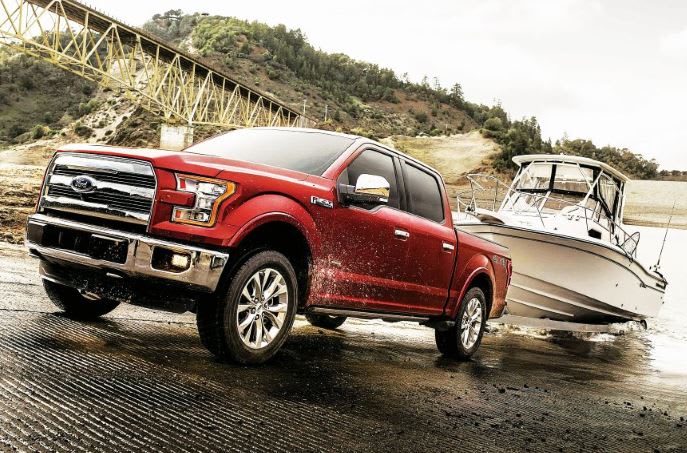
The light-duty truck has a maximum towing capability of up to 12,200 pounds, also features its award-winning Pro Trailer Backup Assist.
Andy Lundin・Former Senior Editor
December 1, 2016
Photo of the Ford F-150 courtesy of Ford.
4 min to read
Photo of the Ford F-150 courtesy of Ford.
The Ford F-150 has been named the 2016 Fleet Truck of the year. This is the third time the light-duty truck has been honored with the annual Automotive Fleet and Business Fleet award in the past six years.
Ad Loading...
The F-150, a frequently utilized vehicle in the fleet industry, received the most votes by fleet managers in an online ballot, beating out 37 trucks to earn the honor.
Ad Loading...
At a Glance
Voted by fleet managers as Fleet Truck of the Year by readers of Automotive Fleet and Business Fleet. The Ford-150 features
Five available engines for the MY-17 truck.
A maximum towing capability of 12,200 lbs.
The SYNC 3, an improved infotainment
system.
And LED strobe light kit for fleet customers.
“It is an honor for F-150 to be the top choice among fleet managers,” said Brian Bell, Ford marketing manager for F-150. “Thanks in part to the input we received from fleets, the new F-150 is the toughest, smartest, most capable, and safest F-150 ever.”
Under the Hood of the F-150
The MY-17 F-150 offers a choice of four engines that includes the 2.7L EcoBoost V-6, second generation 3.5L EcoBoost V6, 3.5L Ti-VCT V6, and the 5.0L Ti-VCT V-8.
Ford announced in October that the 3.5L EcoBoost V-6 engine for the MY-17 model offers an improved EPA over the previous generation engine.
For the MY-17 model, the 3.5L EcoBoost V-6 engine will be able to produce 375 hp and 470 lb.-ft. of torque for a gain of 10 hp and 50 lb.-ft. over the outgoing 3.5L EcoBoost. It’s EPA-estimated and combined fuel economy is 21 mpg for the 4x2 model and 20 mpg for the 4x4, according to the company.
The 3.5-L EcoBoost V-6 engine is also mated with an all-new 10-speed automatic transmission, which is a new addition to the F-150 and replaces the existing 6-speed transmission.
“The second-generation 3.5L EcoBoost engine and the transformative 10-speed automatic transmission improve nearly every aspect of F-150 performance,” Bell said.
Ad Loading...
For the other models, the 2.7L EcoBoost V-6 offers 325 hp and 375 lb.-ft. of torque and has an EPA-estimated combined fuel economy of 22 mpg for the 4x2 model, and 20 for the 4x4. The 3.5L Ti-VCT V6 offers 282 hp and 253 lb.-ft of torque, and offers and EPA-estimated combined fuel economy of 20 for the 4x2 model and 19 for the 4x4.
Finally, the 5.0L Ti-VCT V8 has 385 hp and offers 387 lb.-ft of torque. It has an EPA-estimated combined fuel economy of 18 for the 4x2 and 17 for the 4x4 model. The 5.0L V-8 engine offers a gaseous-fuel prep option, making it the only light-duty pickup capable of running on compressed natural gas or propane, according to the company.
A fifth available engine exclusive to the MY-17 F-150 Raptor is the High-Output 3.5L EcoBoost V-6, which features 450 hp and 510 lb.-ft of torque.
New Technologies
New to the MY-16 was the addition of SYNC 3 infotainment system. The system features enhanced voice recognition, capacitive touch screen, and more intuitive graphical interface.
Another new technological improvement to the MY-16 F-150 was the addition of the Pro Trailer Backup Assist feature, which simplifies backing up a trailer. To operate, the driver rotates a knob to indicate how much the system should turn the trailer. The technology automatically steers the truck to turn the trailer the desired amount.
Ad Loading...
This technology won a CES 2016 Best of Innovation Award in the vehicle intelligence category.
“Anything that makes towing easier benefits our fleet and retail customers — and could cut training and repair costs for fleets,” Bell said.
Pro Trailer Backup Assist for the MY-16 F-150 is the latest in a long line of Ford truck innovations and capabilities that have made trailer towing easier. Previous improved trailer technologies introduced on the F-150 over the years includes the Integrated Trailer Brake Controller, Trailer Sway Control, the Smart Trailer Control Module, and Dynamic Hitch Assist.
Maximum towing capability for the F-150 is 12,200 lbs, and the vehicle features a maximum payload of 3,270 pounds.
Additional Offerings
Also new to the F-150 was the addition of LED strobe light kit for its fleet customers on the MY-16 truck, which was originally available only for Super Duty trucks. The strobe light kit is designed for utility, road construction, and municipal crews that need enhanced vehicle visibility to warn motorists to proceed with caution, according to the company.
Ad Loading...
“Ford designed the first-ever factory-installed LED warning light kit based on fleet customer input,” Bell said. “Because it comes directly from Ford, customers can trust that this light kit is Built Ford Tough. Ordering is as easy as checking a box, and the truck is delivered to your dealer with the system installed.”
Ford also developed a new aluminum alloy for the 2016 F-150 in collaboration with Alcoa that’s more formable and design-friendly than material previously used on the light-duty truck.
“Lightweighting enables us to reinvest in capabilities, such as towing more, hauling more, accelerating quicker, and stopping faster than the previous F-150,” Bell said
Neology’s neoFleet platform will manage toll transactions and toll-authority operations for vehicles across Avis, Budget, Payless, Budget Truck and Zipcar.
Nearly eight in 10 surveyed fleets allow personal use of company vehicles, while just over half of respondents report charging employees for the privilege.
Could developments overseas offer a preview of what’s coming for U.S. fleets? This week, we’re looking at the future of AI, autonomy, and electrification, plus Ford Pro’s new certified pre-owned program, smarter vehicle offboarding, and a new way for fleets to manage toll expenses.
Rising operating costs, driver safety concerns, and unplanned downtime are putting unprecedented pressure on modern fleets. Discover how fleet managers use embedded OEM connectivity and real-time vehicle data to cut TCO, prevent downtime, and protect drivers without aftermarket telematics hardware.
ADAS-equipped vehicles may crash less often, but they can cost more when they do. This week, we’re breaking down what that tradeoff means for fleets, plus Subaru’s first Forester Wilderness Hybrid, Nissan’s new e-POWER Rogue, and why Calstart has become Catalyst Mobility.
Iorillo brings nearly 20 years of fleet management and sales experience to the role, including previous positions at Element Fleet Management, CEI, Donlen and Ryder.
Where will fleet’s next generation of leaders come from? This week, we’re looking at the industry’s talent pipeline, what certification can add to a fleet career, how to build an award-worthy track record, and the return of Automotive Fleet’s Personal Use Survey.