





Related: Jaguar Land Rover's 2016-MY Fleet Incentives Announced
Jaguar's New 'Cat' In the Jungle
Jaguar's 2017 model-year XE will stalk its way into the competitive entry level luxury vehicle segment. The automaker is taking a more aggressive approach to fleet sales.
March 11, 2016
3 min to read
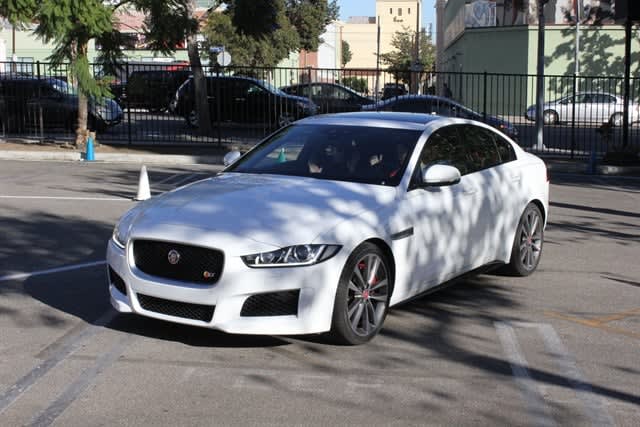
The 2017 Jaguar XE. Photo: Paul Clinton
Jaguar has been updating its lineup by revamping established models and adding new vehicles in higher-volume segments to better compete within the entry-level luxury vehicle segment. The Tata Motors-owned British brand has also taken a more aggressive approach to commercial sales by bringing back fleet incentives.
When Jaguar’s 2017 XE arrives in early May, it enters an extremely competitive automotive segment to compete with the Mercedes-Benz C-Class, BMW 3 Series, Lexus IS, and Cadillac ATS.
Members of the media were invited to test drive the XE around West Hollywood, Calif., for a driving event preceding its North American debut at the Los Angeles Auto Show.
Attending journalists were impressed by the vehicle’s sure-footed handling, easy power delivery, and attractive body style.
The test-drive vehicle was a Mexican-market XE S with left-hand drive, which will be equivalent to the 35t R-Sport model Jaguar will offer in the U.S.
Delivering Power and Elegance
Jaguar will offer three XE models, including the 20d, 25t, and 35t with respective engine choices of a 2.0L four-cylinder Ingenium diesel (180 hp), turbocharged 2.0L four-cylinder gasoline engine (240 hp), and a supercharged 3.0L V-6 (340 hp). Trim grades include the XE, XE Premium, XE Prestige, and XE R-Sport.
Jaguar delivers the power via an 8-speed automatic transmission to a standard rear-wheel drivetrain. Optional all-wheel drive will be available on the 20d and 35t. Jaguar uses a torque-vectoring system that comes from the F-Type called Intelligent Driveline Dynamics, which collects data from the yaw rate, lateral acceleration, and steering wheel angle sensors and estimates friction between the tires and road to determine how much torque to deliver.
The XE uses extensive aluminum alloy as part of its body structure. Without an earlier, non-aluminum model for comparison, it’s difficult to gauge the impact of this decision, but the vehicle handled responsively on congested Los Angeles streets, and deftly navigated an autocross course set up at a surface parking lot.
Executive-Level Tech Features
The XE includes plenty of driver-assistance technologies including a new traction-control system known as All-Surface Progress Control. The system, which can be activated via several buttons behind the shift dial works similarly to a low-speed cruise control. From 2 mph to 19 mph, the system precisely controls brake and powertrain systems to deliver optimal traction in various road conditions.
An optional laser head-up display shows the driver speed and navigation instructions using amber characters projected onto the windshield.
Safety technologies include an available Automatic Emergency Braking system, which uses sensors to calculate the speed and distance of objects on the road ahead. The system can slow the car or initiate full braking at lower speeds. A new Adaptive Speed Limiter can increase or decrease the vehicle’s speed to retain a pre-set following distance. Additionally, lane keep assist guides the vehicle back into the lane by applying a small amount of counter-steering.
Two cameras mounted inside the headliner support traffic sign recognition and lane departure warning systems.
Jaguar is introducing its InControl Touch and InControl Touch Pro infotainment systems with the XE. The latter is paired with a 10.2-inch touchscreen. Both support Bluetooth audio streaming. Jaguar will offer an app for the Apple Watch.
Jaguar is also rolling out EliteCare, which includes complimentary scheduled maintenance, a limited warranty, 24/7 roadside assistance, and the InControl Remote & Protect connectivity package for five years/60,000 miles. Jaguar will offer EliteCare with all of its 2017 model-year vehicles, including the F-Pace luxury SUV.
Jaguar has competitively priced the vehicle, which retails for $35,895, $37,395 for the 20d, and $42,695 for the 35t.
Jaguar Land Rover has been ramping up its approach to commercial vehicle sales by implementing a fleet program managed by Erin Goward, fleet and business sales manager, which includes two levels of incentives ranging from $1,000 to $2,500 for Jaguar nameplates starting with the 2016 model-year. Fleets must apply for a Fleet Account Number (FAN) or Employee Vehicle Account Number (EVAN) to gain eligibility. The company is currently finalizing incentives for the 2017-MY.
Subscribe to Our Newsletter
More Operations

Fleet Has a Talent Pipeline Problem. What Comes Next? | AF News Recap
Where will fleet’s next generation of leaders come from? This week, we’re looking at the industry’s talent pipeline, what certification can add to a fleet career, how to build an award-worthy track record, and the return of Automotive Fleet’s Personal Use Survey.
Read More →
Smith System Launches Driver Risk Management Program
Fleets have more driver data than ever, but identifying risky behavior doesn't necessarily correct it. Smith System's new Driver Risk Management program combines monitoring, training, and follow-up coaching to help fleets connect risk signals with driver intervention.
Read More →
Automotive Fleet Opens 2026 Personal Use Survey for Commercial Fleet Managers
Less than two weeks left! Commercial and corporate fleet managers are invited to share how their organizations handle company vehicle personal-use policies, charges, and driver eligibility.
Read More →
From AI Prompts to AI-Generated Safety Songs | AF News Recap
Can better prompts make AI more useful for fleet managers? This week, we’re breaking down smarter fleet analysis, an AI-assisted experiment that turned safety training into music, and what happened to fuel prices in August.
Read More →
How to Write Better AI Prompts for Fleet Analysis
Include these six elements in your fleet prompts to generate more relevant analysis and accurate answers.
Read More →
Fleet Meets: Eric Kilgore
This edition of the Fleet Meets series features one of the industry's best leaders driving multi-market and national operations.
Read More →
Why Reactive Fleet Management Is Becoming Too Expensive to Sustain
Research highlights a growing need for proactive management strategies to address rising costs in fleet operations effectively.
Read More →
Sponsored•August 12, 2026
What Your Fleet KPIs Aren’t Telling You
Tracking fleet metrics is only useful when the data leads to better decisions. This guide helps fleet leaders assess cost, utilization, and downtime more accurately, identify performance gaps, and prioritize the actions that can improve operational results.
Read More →
Sponsored•August 7, 2026
Hidden in Plain Sight: Fleet Compliance Risks
Fleet compliance isn't just about having policies — it's about consistently enforcing them. This practical guide reveals six hidden compliance risks common in public sector and shared fleet operations and outlines proven strategies to improve visibility, accountability, and audit readiness
Read More →
Turning Fleet Payment Data into Executive Insights
Does data alone drive results in operations?
Read More →