Automotive Fleet
MenuMENU
SearchSEARCH

Fleet Maintenance Tire Costs Remain Flat

The current tire cost stability may be short lived. The forecast is for a 2- to 3-percent cost increase in CY-2016 driven by unique tire sizes, run-flats, and limited replacement tire availability for certain vehicles.

Mike Antich
Mike AntichFormer Editor and Associate Publisher
Read Mike's Posts
March 1, 2016
Fleet Maintenance Tire Costs Remain Flat

Photo via iStockphoto.com

4 min to read


Photo via iStockphoto.com

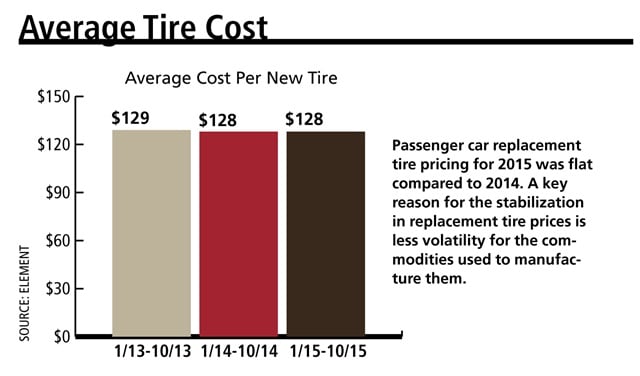
Passenger car replacement tire pricing was flat in 2015 compared to 2014. A key reason for tire price stabilization was less volatility in prices for commodities used to manufacture them.

The cost of commodities used to manufacture tires continues to be the key cost lever driving the price of replacement tires for passenger cars.

Ad Loading...

“Raw material and transportation costs continue to be big drivers in this area. And, of course, the challenge is that both are outside of the control of our company and can fluctuate based on seasonality, regulations, and region of the country,” said Kevin Stephens, North American Sales Manager for Michelin North America.

At A Glance

  • Commodities continue to be the key cost levers driving the price of replacement tires for passenger cars. 

  • As auto manufacturers develop unique tire sizes for new-model vehicles, it impacts the replacement tire supplies in the aftermarket for one to two years.

  • The increase in OEM automobile wheel diameters has driven up the cost of replacement tires.

  • The wildcard continues to be the price of oil, which is the key commodity used to manufacture tires.

In addition, there continues to be limited inventory for some replacement tires. “Several vehicle models have unique factory tire sizes with limited, if any, snow tire availability for at least 12 months,” said Frank Stracke, case manager, managed maintenance for Element, a fleet management business.

As auto manufacturers develop unique tire sizes for new-model vehicles, it impacts the replacement tire supplies for one to two years, as other aftermarket tire companies may not immediately meet the demand for these tire sizes. This lag time limits the selection and availability of replacement tires.

Larger Tire Diameters

The increase in OEM automobile wheel diameters has driven up the cost of fleet replacement tires. The question is, what does the industry foresee for wheel diameter sizes in the future?

“There is no doubt we will see a continuation of this trend. Think about it this way; consumers are demanding performance, not just from the vehicle itself, but all components that make up that vehicle. Part of getting that performance includes such things as larger tire sizes, which gives you larger brakes to be able to handle the performance needs of today’s vehicles and driving experience. It seems difficult to have one, without the other,” said Stephens of Michelin North America.

Ad Loading...

Another factor influencing tire availability in the aftermarket is existing purchasing agreements between auto OEMs and tire OEMs. “The challenge is determining which OEMs have signed tire company agreements for unique tire brands and sizes, as this can impact a fleet’s vehicle selector list,” said Stracke of Element.

Another factor influencing the spread of larger diameter tires within fleets are driver-paid options.

“Driver-paid options allowing different trim levels have resulted in moving to larger wheel diameters, which are more expensive and challenging to replace,” said Stracke.

Photo: Element

Forecast for Tire Expenses

The forecast is that tire expenses will increase in the 2016 calendar-year.

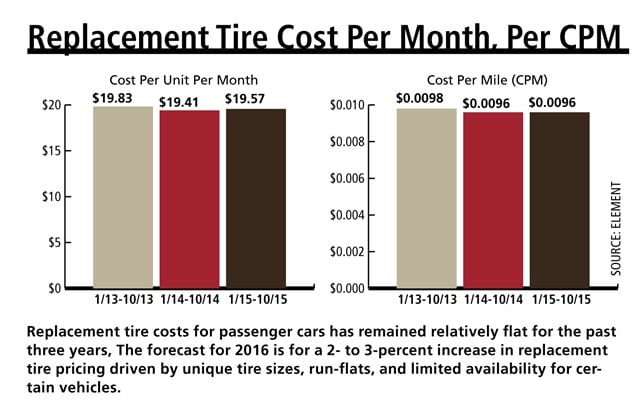
“We foresee a 2- to 3-percent increase in replacement tire pricing driven by unique tire sizes, run-flats, and limited availability for certain vehicles. This commonly occurs with the continued introduction of new tire models and sizes. Like-for-like replacement tire pricing should remain flat. Vehicle selection and options will be very important in determining future tire replacement costs,” said Stracke.

Ad Loading...

Seasonality is also a factor in replacement tire pricing, especially with snow tires, which result in product shortages with the onset of severe weather conditions.

The wildcard continues to be the price of the key commodities used to manufacture tires, in particular, the price of oil. The key to future tire prices is the price of oil, but the near-term outlook appears to be that pricing will remain stable.

Photo: Element

Tire Company Innovations

One factor exerting downward pressure on total fleet tire expenditures is the ongoing improvement in tire quality, which has resulted in longer wear life during the past decade. Tire life has been extended by 10 percent in the past 10 years. This has helped offset some of the recent price increases since the expense is spread out for a longer period.

In addition, there are a number of manufacturing innovations that are being explored/implemented by tire OEMs to reduce costs and the impact on wear.

“Self-seal technology has a unique rubber compound that plugs holes in the tread that has been punctured. There is a thin layer of rubber compound, composed of natural rubber. The compound surrounds the area and the object causing the protrusion, keeping air from escaping and the tire pressure at its previous level,” said Stephens of Michelin North America.

Ad Loading...

Retrospective: The Early Days Of Fleet Maintenance

Goodyear, Firestone, and Sears are all relatively well-known stores today, but it was around the 1960s-1970s when they started making a name for themselves in the fleet industry. It was during this time that these national account chains — along with such others as BFGoodrich, Maaco, and Lee Myles — started partnering with fleet management companies (FMCs) to provide consolidated billing, product codes, and nationwide pricing.

“This was a big deal for fleet managers,” said Eric Strom, maintenance and safety product manager for Element and a 36-year industry veteran. “It gave them confidence, knowing that the national account network was made up of well-recognized chain stores with consistent billing and pricing.”

It was also a big deal for the FMCs, which often didn’t have enough garages around the country to service all their nationwide customers. In addition to establishing relationships with these chains, FMCs also formed relationships with glass and rental car companies, which served as an added program. According to Strom, these supplier relationships created a lot of efficiencies from a payment, billing, and processing standpoint.

In addition, technology has been one of the main game changers for maintenance management. In the early 1980s, FMCs started developing online maintenance reporting tools.

“Being able to quickly get their data at their desktop was really the beginning of a self-serve model for fleet managers. Up until that point, FMCs would get all the billing. Everything was paper-based, so there would be boxes and boxes of paper,” said Strom.

No doubt, the fleet professionals from the 1980s would be amazed as to how far fleet maintenance management has evolved in a relatively short period of time. It is exciting to visualize what changes are on the horizon of fleet maintenance management.


Editor's note: This article is part of a three-part package dealing with fleet maintenance costs in 2015. Read related articles covering maintenance costs and oil service costs.

Subscribe to Our Newsletter

More Maintenance

Chris Brown and O'Connell Landscape Maintenance rep sit across from each other during an interview at Geotab Connect 2026.
Maintenanceby Chris BrownApril 2, 2026

From Marine Corps Motor Pool to Managing 460 Fleet Vehicles

Cesar Ayala of O’Connell Landscape Maintenance shares how he transitioned from the Marine Corps to managing a 460-vehicle fleet—and the real-world challenges of maintenance, compliance, and driver management in California.

Read More →
Graphic with text and a border of mechanics tools and car parts.
Maintenanceby Chris BrownApril 1, 2026

If Repair Delays Are the New Normal, How Should Fleets Respond?

The repair crisis gets blamed on technician shortages and parts delays. But a big part of the problem is what's happening before the vehicle even reaches the shop, and that's within your control.

Read More →
SponsoredMarch 30, 2026

Safety by Design: Power and Protection in the Freightliner 114SD Plus

Safer crews. Fewer incidents. Better uptime. Learn how driver-assist technology is changing the way vocational fleets operate.

Read More →
Ad Loading...
Man using tablet to monitor connected fleet vehicles and EV chargers near highway, representing Bosch’s AI-driven predictive maintenance and Uptake acquisition.
Maintenanceby News/Media ReleaseMarch 19, 2026

Bosch to Acquire AI Predictive Maintenance Startup Uptake Technologies

The deal brings Uptake's fleet diagnostics platform into Bosch's ecosystem, combining predictive analytics with Bosch's telematics infrastructure to help fleets reduce downtime and anticipate component failures.

Read More →
SponsoredMarch 1, 2026

One University Cut Motor Pool Costs by $45K. Here's the Playbook.

Still managing your motor pool with spreadsheets and manual approvals? Loyola University replaced outdated processes with automated fleet management, eliminating overtime and saving up to $50,000 annually. See how they did it.

Read More →
SponsoredMarch 1, 2026

Artificial Intelligence in Field Service: North America

48% of field service leaders are investing in AI to manage customer communication and self-service. Get the latest on how fleets are using AI and thinking about the future.

Read More →
Ad Loading...
SponsoredJanuary 14, 2026

It’s here: The 2026 Fleet Technology Trends Report

What does AI mean for fleets? Get the answer — and learn other top tech trends.

Read More →
Blue-themed digital circuitry board to suggest AI connectivity.
Operationsby Martin RomjueDecember 17, 2025

AI Emerging As Must-Have Fleet Technology

Within the next six to 12 months, artificial intelligence programs designed specifically for smaller operations will become more affordable, intuitive, and integrated.

Read More →
A fleet maintenance graphic with a man on the right side holding a clipboard.
Maintenanceby Chris BrownOctober 23, 2025

Labor, Parts, and Price: What’s Powering Fleet Maintenance Costs in 2025

Five quarters of data on the six most common maintenance activities reveal how cost composition and labor intensity influence fleet service trends.

Read More →
Ad Loading...
A fleet manager uses a digital tablet displaying telematics data and repair analytics in front of parked commercial vans. Modern fleet management technology helps reduce downtime, control repair costs
MaintenanceOctober 13, 2025

How Fleet Managers Are Finding New Ways to Control Maintenance Costs & Downtime

By standardizing repair workflows and building trusted vendor networks, fleets are cutting costs and keeping vehicles on the road.

Read More →