Fleet policy, driver training and education, use of both in-vehicle and telematics technology, and a review of repair processes and costs can all lead to substantial reductions in accidents and related costs.
Reducing accident management costs and making long-lasting changes in a fleet operation is hard work. But, it can lead to substantial cost savings as well as the potential to save the lives of fleet drivers and the general public.
Ad Loading...
Accident costs saw a modest increase in 2014 vs. 2013 figures, with the percentage of preventable accidents remaining mostly flat, according to Element Fleet Management, The CEI Group, Corporate Claims Management (CCM), and Fleet Response.
Ad Loading...
Every day, fleet managers can make changes in their fleet operations to reduce the occurrence of accidents and avoid costly mistakes. From technology to training, subject-matter experts shared four ways fleet managers can make change:
At A Glance
Fleet managers should look at four primary areas to reduce overall accidents and related costs:
Policy and procedures.
Driver training and education.
Technology such as telematics as well as in-vehicle accident avoidance technology.
Repair costs and shops.
1. Working on Fleet Policy
First, work to control costs through strong programs and policies. Fleet managers can do this by ensuring proper driver training.
“It sounds old-fashioned, but many fleets still need to establish a thorough and complete fleet safety policy as a first step. It’s always surprising to find out how many fleets haven’t even created this foundation,” said Brian Kinniry, senior director of strategic services at The CEI Group.
The fleets with the best record of reducing preventable accidents take the next step, adopting an online fleet driver safety and risk management system.
“This kind of system constantly assigns risk scores to drivers based on an on-going stream of behavioral data, and then automatically delivers consequences when a driver’s score rises above defined risk thresholds,” Kinniry continued.
Ad Loading...
Fleet managers should ensure the fleet policy also clearly explains when motor vehicle records (MVR) will be pulled.
“Minimally, fleet managers should pull two MVRs per year, plus institute annual online training modules as well as assess accident types. A fleet, risk, or safety manager can get a very true assessment of their entire driving force by using this practice. Once they have the information, they need to be proactive and do something positive with it. It’s great knowing who a fleet’s strong or weak drivers are; however, doing something about the information should be the goal,” recommended Bob Martines, president and CEO for CCM.
In the long run, have a complete policy in place.
“Create a comprehensive safety policy that is read and signed by drivers. The policy can be updated and can evolve over time depending on situations, trends and results of safety trainings,” said Eliot Bensel, director, accident management, risk and safety for Element Fleet Management.
2. Completing Driver Training
Once a thorough driver policy is in place, take a look at driver training options.
Ad Loading...
“Whether the process is managed internally or outsourced, embracing safety awareness and driver training will have the biggest impact for any company fleet manager and the company fleet budget,” said Martines of CCM.
Safety awareness and training continue to be the main components for reducing accidents.
“Technology has helped in some instances but not to the magnitude safety training impacts the decrease in accidents. Companies that embrace safety awareness and ongoing training have reaped multiple benefits, including decreased number of incidents, less real dollars paid for repairs for company vehicles and third party vehicles, decreased liability claims, and most importantly, fewer injuries and fatalities,” Martines continued.
Training can help lead to the prevention of accidents in the first place, and creative driver training programs can help keep drivers engaged.
“To build their safety culture, we’re seeing more fleets using customized driver videos that target problem areas for their fleet’s safety performance. We’re seeing fleets take a more aggressive approach to using cell phones and texting to prevent distracted driving,” said Kinniry of The CEI Group.
Ad Loading...
Ultimately, driver training is vital to a fleet’s accident management ability.
“More often than not, fleet managers don’t treat their drivers as professional drivers. Start with comprehensive driver training — online training isn’t sufficient — they need to be educated in a classroom and behind the wheel. Work with drivers to provide training and seasonal tips, giving them the necessary tools for fulfilling your organizational goal of building a safer culture,” according to Bensel of Element Fleet Management.
3. Utilizing Technology
Additionally, fleet managers can leverage technology to further reduce accident rates and costs.
“We believe telematics will continue to evolve and help with managing accident programs. Costs will see about a 5 to 8 percent year-over-year increase. We predict fleet managers will have subject matter experts advising them on all aspects of fleet management,” said Bensel of Element Fleet Management.
Additionally, telematics can assist your company, regardless of your industry or type of fleet, Bensel continued.
Ad Loading...
“Now, many telematics programs are evolving to cover driver safety, increased employee productivity and efficiency, route compliance and improved customer service. It’s important to let drivers know that this technology will be used in supportive ways to assist with safety and reducing accident management,” Bensel said.
Fleet managers should also begin to examine technology that can help reduce preventable accidents.
“Some fleets may find that in technology that disables cell phones while a vehicle is in motion. Others may find it in such on-board crash avoidance systems as forward-looking autonomous braking systems or lane departure warning systems. These systems have yet to be completely proven in field use, but tests show that some of them could be very effective,” said Kinniry of The CEI Group.
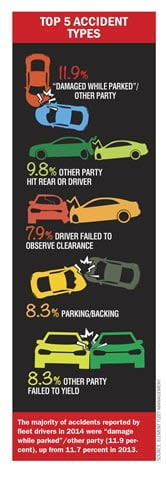
The majority of accidents reported by fleet drivers in 2014 were “damage while parked”/other party (11.9 percent), up from 11.7 percent in 2013.
Martines of CCM also recommended an emphasis on reducing distracted driving.
“Companies must take a stronger initiative in preventing driving while on a cell phone or with texting. We all know this is very difficult to police; however, if drivers lost the right to drive a company vehicle due to the fact they ignored a company procedure or violated it and senior management supported the disciplinary actions, we can make a difference,” said Martines. “There are still too many incidents occurring due to texting while driving or cell-phone usage. Until laws with significant consequences are passed mandating fines, penalties or jail time, company fleet, risk, and safety manager must take on the responsibility to deter the cell-phone usage and texting.”
Ad Loading...
In-vehicle technology is also an option fleet managers can consider to reduce accidents.
“Some fleets are also starting to consider adopting crash-avoidance technology, both in their new-vehicle selections and it retrofitting their current vehicles with aftermarket systems, and we’re consulting with them to make the best choices,” said Kinniry for The CEI Group.
4. Reviewing Repairs
Repair costs are one other area fleet managers are looking toward for reduced overall accident costs.
“Repair costs will continue to slightly increase based on parts and labor increases, while the costs associated to a safety program will most likely remain flat,” said Allison Lanzilotta, executive vice president for Fleet Response.
However, while repair costs are forecast to continually increase, it’s not all doom and gloom, and there are avenues fleet managers can take to reduce this expense.
Ad Loading...
“To control repair expenses, more fleets are accepting the use of certified aftermarket and high-quality used parts, and resorting to less-expensive paintless dent repair (PDR). And, to offset accident expenses, there is more interest in loss recovery services, which identifies recovery potential,” said Bob Glose, senior director of operations for The CEI Group.
Additionally, the materials vehicles are made of can also impact repair costs.
“According to industry reports, repairs on vehicles made mostly of steel can save $1,000 or more in repairs versus what the industry calls ‘substrate materials,’ such as steel alloys, plastic, carbon fibers, and aluminum. But, because there is more of this kind of material in the latest models, as fleets replace their older vehicles, they’re going to feel more and more of the effect on their repair estimates,” said Glose. “On the other hand, fleets are doing more to prevent accidents, both by adopting proven online fleet safety solutions that change driver behavior, integrating telematics data into those solutions, and taking advantage of crash avoidance technologies.”
One area of improvement is how long it sometimes takes fleets to authorize repairs.
“From our perspective, it should normally take only 24 to 48 hours to make that decision, but we’ve seen take as much as 10 days. And, when you make a repair shop wait that long, it’s likely to put another vehicle in the bay, and then you have to wait even longer to get yours repaired,” said John Wolford, associate director of provider network services and loss recovery for The CEI Group. “The result is higher replacement vehicle rental costs, which average more than $40 per day.”
Ad Loading...
A final repair-related cost involves the choice of what repair shops to use.
“Another thing we see is fleets allowing drivers to take their vehicles to out-of-network shops. This doesn’t happen a lot — maybe 5 percent of the time, if that — but, when it does, the fleet loses the leverage and oversight we provide to be sure the right repairs are done for the right price as quickly as possible,” Wolford said.
The Bottom Line
Remember, the best way to reduce accident costs is through working to prevent accidents in the first place.
Overall, a team effort between all fleet stakeholders as well as communication and policy compliance is key.
“Many fleet managers exercise only partial control over the decision process to manage accidents or safety training and risk control. When there is compliance with companies to work hand-in-hand with fleet, risk, and safety, an awareness to the challenges facing the ‘team’ becomes more apparent and there is less of ‘it’s not my job’ mentality,” said Martines of CCM. “Whether the accident count is measured as a percentage of vehicles of the entire fleet or per million miles driven, when the costs decrease, everyone wants to feel they have had a part in the decrease.”
This week, we're breaking down which industries have the highest rates, how Jamie McKay manages 2,400 vehicles, what's happening with the 2027 fleet awards, and why software-defined vehicles could introduce new costs.
Fleet managers continue to rely on FMCs for essential services but are taking a closer look at where working directly with suppliers can improve efficiency and responsiveness.
Meet Erin Gilchrist, the inaugural Mike Antich Spirit of Fleet Award winner, as she shares insights on leadership, mentorship, the power of industry connections, and why people remain at the heart of fleet's future.
How do you keep 2,400 vehicles running across 37 states? Fleet Visionary Award winner Jamie McKay shares how collaboration, flexibility, and a few simple strategies help her tackle fleet management challenges at Aptive Pest Control.
Fleet operating costs have risen more than 20% since 2020, raising a key question: When does extending a vehicle's service life stop making financial sense?
A stolen catalytic converter can cost fleets far more in downtime and lost productivity than in repairs. A total-cost-of-risk approach can help fleet managers quantify their exposure and prioritize theft prevention.
Personal-use charges are climbing, wholesale used-vehicle values are declining, and commercial fleet sales growth is slowing. This week, we're breaking down the latest fleet data, plus how Element Fleet Management is helping Waymo prepare for its first Canadian robotaxi market.