




Germany's Fleet Market Conditions in 2014
More than 50 million vehicles are registered in Germany, about 10 percent of which are registered as company cars. Despite a 3-percent drop in new-vehicle registrations for 2013, about 23 percent of the 3.1 million were registered as company cars — the second-best result after 2011 for the past 10 years.

Photo courtesy of Wikipedia.

Photo courtesy of Wikipedia.
More than 50 million vehicles are registered in Germany, about 10 percent of which are registered as company cars. Despite a 3-percent drop in new-vehicle registrations for 2013, about 23 percent of the 3.1 million were registered as company cars — the second-best result after 2011 for the past 10 years, according to Karsten Rösel, general manager for ALD Automotive.
To compensate the weak demand and overcapacity, automakers and dealers pushed so-called “one-day registrations.” This is the registration of a car in the dealer's name for a maximum of 30 days, and the sale of the unit as a used vehicle with a considerable discount. For the first time in five years, the number of one-day registrations exceeded the 100,000-mark, which reflects an increase of 9.5 percent compared to 2011. This has led to a high volume of nearly new cars that have to be placed on the market and brings massive pressure to the residual value stability of used vehicles.
The German fleet market is dominated by national automakers, including Volkswagen, Audi, BMW, and Mercedes-Benz. Continuous cost pressure is also driving the growth and acceptance of importers, such as Hyundai. According to a survey by Dataforce, 56 percent of the questioned companies have a fleet size of more than 10 units. Larger fleets operating thousands of vehicles usually can be found within public enterprises and large energy companies. Almost 60 percent of company cars are leased.
The primary fleet leases are on operating lease and full-service leasing, including cost-guarantee products and high-end services.
“The fleet leasing market is dominated by the captive companies of the OEMs (e.g., VW Leasing and BMW's Alphabet), which heavily used subsidies and high incentives to stimulate fleet sales in 2013. Besides the captives, non-captives such as ALD Automotive and LeasePlan are among the key players in the market,” Rösel said.
According to Gunter Glueck, director of sales and customer service for LeasePlan Germany, full-service leasing is very popular, especially in the big fleet segment. “Closed-end products are the most commonly required leasing solutions, including high-end services that deliver a high level of cost efficiency and transparency,” Glueck said. Rising fuel prices have resulted in a trend to reduce fuel consumption and CO2 emissions, Glueck added.
For the coming years, a stabilization and further increase of the fleet market is expected, said Rösel of ALD. In this context, company cars will remain a significant motivation factor within the compensation package to successfully attract and tie up qualified workers.
“Since the Euro crisis caused companies to become more cautious about capital expenditures (and due to rising fuel and vehicle costs), total cost of ownership, cost containment, and process optimization remained high priorities within fleet management, alongside simultaneous fulfillment of governmental sustainability requirements without raising additional fleet costs,” Rösel said.
Among the key trends in the field of sustainability are fleet downsizing and smaller engine displacement. According to Rosel with ALD, fleet managers are increasingly relying on fuel-saving models to reach preset fuel economic goals and CO2 emissions levels.
“In addition, alternative-fuel systems are assuming increasing importance, whereas the greatest potential is attributed to hybrid cars in the near future. The further need to reduce CO2 emissions is attended by the environmentally friendly configuration of the car policy, as well as the implementation of incentive programs and fuel-saving trainings for users.
So, the types of fleet-related services in demand are in particular CO2-related services including CO2 calculators, consultancy, and reporting service,” Rösel said.
Other ongoing trends cited by Rosel that are influencing the German fleet market are alternative mobility concepts, such as corporate car sharing and e-mobility. “The German government has supported the push for sustainability by extending the tax breaks for electric cars from five to 10 years for new cars registered by 2015; however, due to limited range capacity and low network coverage, additionally burdened by higher acquisition prices, fleet managers tend to a rather reserved buying behavior. The majority believes e-mobility is only capable of asserting itself with the help of additional governmental incentive program,” Rösel said.
Users are also required to take on more responsibility to outbalance high fuel prices and achieve additional cost savings, especially in the field of insurance, resulting in more fleet customer demand for professional risk management and claim ratio optimization, as well as tools for a direct driver management. Additional fleet-related services in demand are electronic driver’s licence verification system, as well as pan-European and international fleet management capabilities. Telematics use within fleets has not been very popular, and is unlikely to play a major role in 2013, Rösel said.
Data Box
● Capital: Berlin
● Population: 81.1 million
● GDP: $3.123 trillion
● Total Vehicles (incl. private
fleet): 50.2 million
More Global Fleet
Holman Takes Full Ownership of ARIZA in Mexico
Holman is bringing its Mexican fleet management operation fully under its own brand after more than 30 years as a joint venture. The change gives multinational fleet customers a single Holman operation across the U.S., Canada, and Mexico.
Read More →
Proven Ways to Reduce Work Truck Downtime
The age-old problem of downtime will always be a reality, but with new strategies at hand, fleets have more ways to keep trucks on the road longer.
Read More →
The Top 300 Commercial Fleets
The Top 300 Commercial Fleets: See the List
Read More →

Cameras, Safety and Insurance: From Reactive Claims to Real-Time Prevention (Part 2 of 2)
Part Two: Commercial auto remains one of the most challenging and costly lines of coverage for fleet operators and insurers alike. Continue learning more about how to effectively address these issues from Onur Aksan, Enterprise Business Development Executive, Geotab
Read More →
Cameras, Safety and Insurance: From Reactive Claims to Real-time Prevention
Commercial auto remains one of the most challenging and costly lines of coverage for fleet operators and insurers alike. Learn more about how to effectively address these issues from Onur Aksan, Enterprise Business Development Executive, Geotab.
Read More →
Fleet Costs Are Rising: Here’s How Leaders Are Responding
Fleet leaders are under pressure to reduce costs, adapt to economic uncertainty, and make smarter decisions. See how peers across North America are responding with real data, proven strategies, and forward-looking insights. Download the 2026 Market Pulse Report to benchmark your strategy and uncover where you can gain an edge.
Read More →
Enterprise Fleet Management Surpasses 900,000 Vehicles in U.S. & Canada
Enterprise Mobility connects with mobility solutions around the globe
Read More →
Automotive Fleet's Guide to Fleet Electrification
Unlock the secrets to a successful transition to electric fleets with Automotive Fleet's comprehensive Fleet Electrification Guide!
Read More →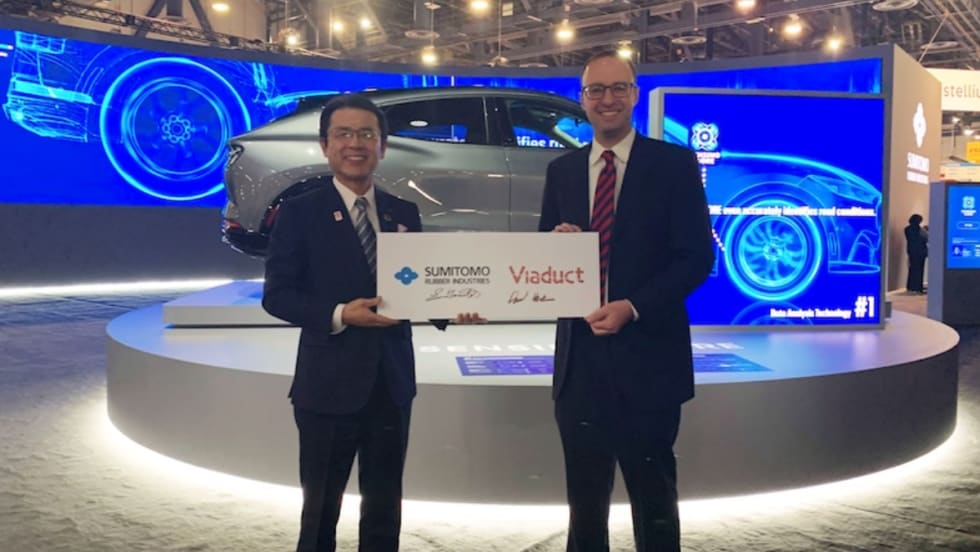
Sumitomo Rubber Industries to Acquire Viaduct
Viaduct will join Sumitomo as an independent subsidiary. Partnership strengthens global reach and accelerates AI-driven innovation for fleets and manufacturing.
Read More →