




Helen Bland: At the Helm of Hallmark's Fleet
Helen Bland is anything but. Having served as the fleet manger for 15 of her 42 years with Hallmark Cards, she personifies the highest level of managerial professionalism. Not only has she always done her homework, but her meticulous financial analyses have enabled her to win the ears of management and the respect of her co-workers.
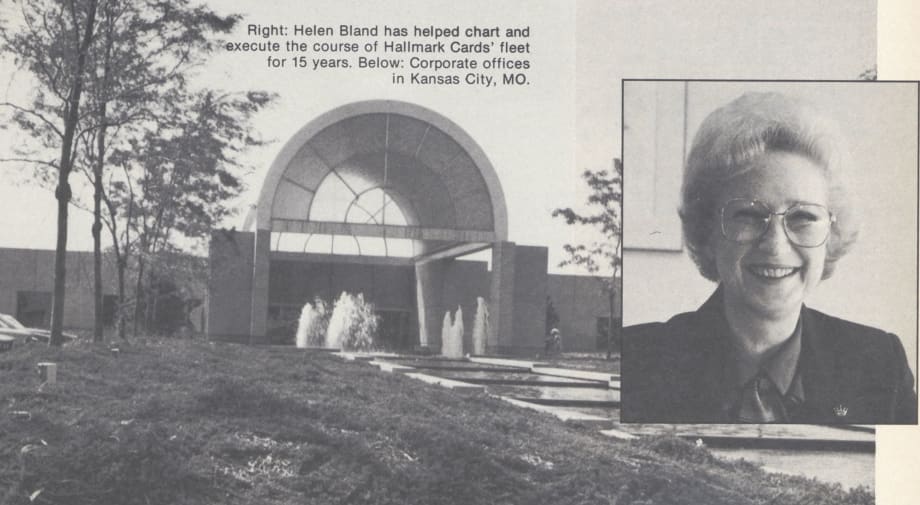
Helen Bland is anything but. Having served as the fleet manger for 15 of her 42 years with Hallmark Cards, she personifies the highest level of managerial professionalism. Not only has she always done her homework, but her meticulous financial analyses have enabled her to win the ears of management and the respect of her co-workers. And that, in an industry which, in Bland's words, "is a man's world."
Bland began working as assistant fleet manger in '63 and took over the fleet manger's job title in '69. Hallmark Cards has approximately 16,000 employees nationwide, 6,000 of whom live in the Kansas City metropolitan area. The fleet of 1,550 cars is administered as part of the personnel department. Bland explains the company's thinking: "When the fleet department was set up, there was a general consensus of opinion that it should be a personnel-service operation. Rather than having it be part of marketing, and maybe going a little overboard one way, or having it be part of finance, and maybe having the strings pulled a little too tight, we felt it would be better to have a service-oriented department operating with corporate checks and balances."
But although fleet is part of personnel, job classification still determines who gets a car and what kind of car. "Of course we have other department cars and plant production cars, but basically, when we're talking fleet, we're talking sales." According to job classification, account coordinators drive Ford Tempos and Plymouth Reliants. Salespersons drive Chevy Celebrity CLSs, LTD Broughams, Dodge 600's and Plymouth Caravelles. District managers drive Olds Cieras, Buick Centuries, Pontiac 6000s, Chrysler LeBarons, and Ford base-model Thunderbirds, but the company pays half the dollar amount on additional optional equipment. Regional vice presidents get the same cars but more money for accessories; and sales division managers, a little bit more money for accessories. Corporate officers drive full-size cars, but in keeping with the company's conservative mentality, there are no luxury cars in the fleet and no foreign cars.
An overview of the entire fleet shows 70 percent four-cylinder and 30 percent six-cylinder, with automatic transmission, power steering and brakes, air conditioning, tinted glass, AM/FM stereo, cruise control, and tilt wheel standard. The last three items were made standard in '82 when the company moved almost totally toward four-cylinders. "The object was to make going down to four-cylinder cars more palatable," says Bland. The first year was disastrous as far as driver satisfaction was concerned. But with the incoming '83 LTDs, Celebrities, and Dodge 600s, we have not had any problems. I frankly think we give them a well-equipped, nice car, and they're happy with it. And strangely enough, in a choice between the three major car makers, drivers have been dividing up the pie in equal thirds, which is surprising, considering that we had almost 70 percent Fords for years."
All of Hallmark's cars are company-owned. Company cost analysts do a study every spring as to whether buying or leasing is the most advantageous, and to date, purchase is still winning out. When speaking of acquisitions, Bland believes her connections with fleet-minded dealers are of paramount importance. "I don't like not knowing the dealer who's delivering my car. If he doesn't know you, you don't have any opportunity to sell him your used car. And he may be prone to deliver his own fleet deals ahead of a drop-ship courtesy delivery. But from a cost standpoint, I have to be happy with the arrangement." Bland believes that she has "the cream of the crop as far as ordering dealers are concerned. I've got a dozen good dealers, some of whom I've used for a long time." But she stresses the importance of always having two dealers per nameplate in order to ensure economies of competition and delivery.
Bland disposes of fleet vehicles four different ways. The first option is driver sale, which accounts for about 30 percent of disposals, and is a preferred method. The second option is the dealer. "If the car is a good, clean car with reasonably low mileage, you can have pretty good luck with dealers, and you can have a sales tax break on new acquisitions." But unfortunately, Bland can only dispose of about 5 percent of the fleet this way.
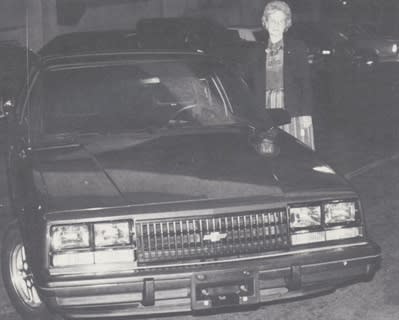
Bland poses beside one of the big vehicles on her selector list, a Chevy Celebrity.
Her next-best option is auction sales, and she says she has had good luck with this method. She cautions, however, that "it takes a little bit of work to know which ones to use. You've got to stay right on top of them and know what makes of cars they do best with. It takes perseverance and study, watching the market. I get all their papers, showing what they sell cars for, and I get to know the people." Bland uses auctions to dispose of about 50 percent of the fleet. The balance goes to wholesalers and brokers.
[PAGEBREAK]
Bland believes that disposals are a whole new ball game since the recent odometer-tampering/high-mileage developments. "High mileage has become extremely important," she comments. "I almost had a stroke when I got the first AMI after they changed. All of a sudden you went from the normal mileage deductions we had gone on for years to almost double in some areas."
This fleet manager, however, believes the new AMR figures are extreme. "I don't think that the high mileage on a sales vehicle, put on fast on the highway, is as bad as the low mileage on a vehicle in a metropolitan area, driven by some little old lady. But that's not the way the public looks at it. If a car has got 55,000 miles on it, they shy away from it. If it's got 75,000, I don't know how anyone could sell it today."
The replacement policy that. Bland has charted is 50,000 to 55,000 miles, with the six-cylinder staying on the road to the upper limit. But in charting company fleet policy, Bland draws on a wealth of data. For example: "I encountered a little bit of resistance to four-cylinder vehicles in the used-car market late this spring, a resistance?' I hadn't had before. At this point, my total cost of operation has not skyrocketed due to four-cylinder cars. And we're more than making up the difference in mileage; the difference is better than three miles per gallon, 3.3 to be exact. So when you factor that by 25,000 miles a year, the savings far exceed what I'm spending in additional maintenance at this point."
Bland's analysis of knotty problems such as mileage parameters and fours vs. sixes shows an exemplary depth of thinking. "I think there is an advantage to having all the information at your fingertips, rather than having to depend on someone else for the answer. When management comes to me with any kind of question, and you get this from accounting all the time, I have accurate figures on our own fleet. I love all the other information I get, such as the NAFA surveys, but I use them for comparison purposes to see how I'm doing. And, of course, if I didn't have a computer, I couldn't give management the answer."
The comments point up the need for both self-reliance and computerization. Prior to '74, Hallmark didn't have a computer program, which made cost-per-mile analyses difficult, to say the least, not to mention trying to figure tire costs or accident costs before the end of the year. However, when the oil embargo hit, company management needed to know how many miles their cars were being driven and how much money they were spending.
Bland believes the oil-embargo will have a definite legacy on the professional status of the fleet manager."Priority-wise," Bland says, "I was clear on the bottom. But then management began to look at fleet in a different light. We were -able to show them what was available to us by computer, and they saw what it was costing them overall and what could be done. I am probably responsible for spending more money than any one part of the company outside of purchasing or payroll. So fleet ought to be important. And I think it has been important to management ever since they saw the figures."
The proof of Bland's comprehensive, self-reliant approach is in the operating costs that her fleet has achieved. Recorded in cent cost per mile, '83 operating expenses were: gas $.0575, 13.4 percent below '82; oil $.0010, 16.6 percent below '82; tires $.0029, 21.6 percent below '82, maintenance and repairs $.0159, 3 percent below '82; wash $.0025, 8.7 percent above '82, and accidents $.0068, 3 percent above '82. Total operating expense for '81 were - $.1024; for '82, $.0966; and for '83, $.0866. That equates to a 10.4 percent reduction in the last full year.
Having such results and having them at her fingertips has won Bland the respect of both her peers, and superiors. "When I became fleet manager at Hallmark, one of our vice presidents didn't accept me as such. He looked at me, or at least I felt he looked at me, as not really knowing what I was doing. How could I know - a woman in this business? It took me three or four years to convince that man that I really did know what I was talking about. And once I gained that confidence, in any committee meeting we were in, whether we were talking about equipment or anything concerning cars and the marketing people, I didn't have to worry about whose side he was going to be on. He always went with what I recommended."
The experience of other women fleet managers reflects this state of affairs: Although a woman may encounter some initial resistance in what was once conceived of as a man's job, her professional knowledge can win career-long allies. "They stand by me," Bland states.
An example of one of Bland's plans that needed corporate approval and support is Hallmark's national account program. "We have saved hundreds of thousands over the years," she comments. National account billing for maintenance and tires is through Consolidated Services. Work on a vehicle with up to 5,000 miles is through an authorized dealer; above 35,000, work is through Salex.
Additionally, the fleet department also operates vanpools and has over 600 people pooling in Liberty, MO, and Lawrence and Leavenworth, KS. Vanpooling has not dropped off in popularity at Hallmark. "We've worked very hard to keep it," Bland explains. "The real reason is parking. We provide free parking for all our people, and if we've got 53 vanpools bringing in 600 people, we're saving 550 parking places."
There is, however, a time to punctuate any achievement. And Helen Bland's has been two-fold. In addition to her work at Hallmark, she was NAFA's first vice president and the first woman elected to the board, on which she has served for a decade. She will be president for the Boston conference next year and when she concludes that tenure after two years, she will probably conclude her Hallmark career at the same time.
She will have few regrets. "This job has been much more interesting than anything I've ever done. It's been more of a challenge to me. I suspect, because I'm a woman, and it's been a man's world. There were very few women in this kind of job when I got into it. And I think I've proven that it can be done and done well."
More Operations

Fleet Has a Talent Pipeline Problem. What Comes Next? | AF News Recap
Where will fleet’s next generation of leaders come from? This week, we’re looking at the industry’s talent pipeline, what certification can add to a fleet career, how to build an award-worthy track record, and the return of Automotive Fleet’s Personal Use Survey.
Read More →
Smith System Launches Driver Risk Management Program
Fleets have more driver data than ever, but identifying risky behavior doesn't necessarily correct it. Smith System's new Driver Risk Management program combines monitoring, training, and follow-up coaching to help fleets connect risk signals with driver intervention.
Read More →
Automotive Fleet Opens 2026 Personal Use Survey for Commercial Fleet Managers
Less than two weeks left! Commercial and corporate fleet managers are invited to share how their organizations handle company vehicle personal-use policies, charges, and driver eligibility.
Read More →
From AI Prompts to AI-Generated Safety Songs | AF News Recap
Can better prompts make AI more useful for fleet managers? This week, we’re breaking down smarter fleet analysis, an AI-assisted experiment that turned safety training into music, and what happened to fuel prices in August.
Read More →
How to Write Better AI Prompts for Fleet Analysis
Include these six elements in your fleet prompts to generate more relevant analysis and accurate answers.
Read More →
Fleet Meets: Eric Kilgore
This edition of the Fleet Meets series features one of the industry's best leaders driving multi-market and national operations.
Read More →
Why Reactive Fleet Management Is Becoming Too Expensive to Sustain
Research highlights a growing need for proactive management strategies to address rising costs in fleet operations effectively.
Read More →
What Your Fleet KPIs Aren’t Telling You
Tracking fleet metrics is only useful when the data leads to better decisions. This guide helps fleet leaders assess cost, utilization, and downtime more accurately, identify performance gaps, and prioritize the actions that can improve operational results.
Read More →
Hidden in Plain Sight: Fleet Compliance Risks
Fleet compliance isn't just about having policies — it's about consistently enforcing them. This practical guide reveals six hidden compliance risks common in public sector and shared fleet operations and outlines proven strategies to improve visibility, accountability, and audit readiness
Read More →
Turning Fleet Payment Data into Executive Insights
Does data alone drive results in operations?
Read More →