




A Diminishing Role for Fleet Managers?
Will fleet management companies ultimately replace the in-house fleet staff? This is one question NAFA President Paul Hubbard responds to in a candid interview on the topic of "total fleet management" programs.
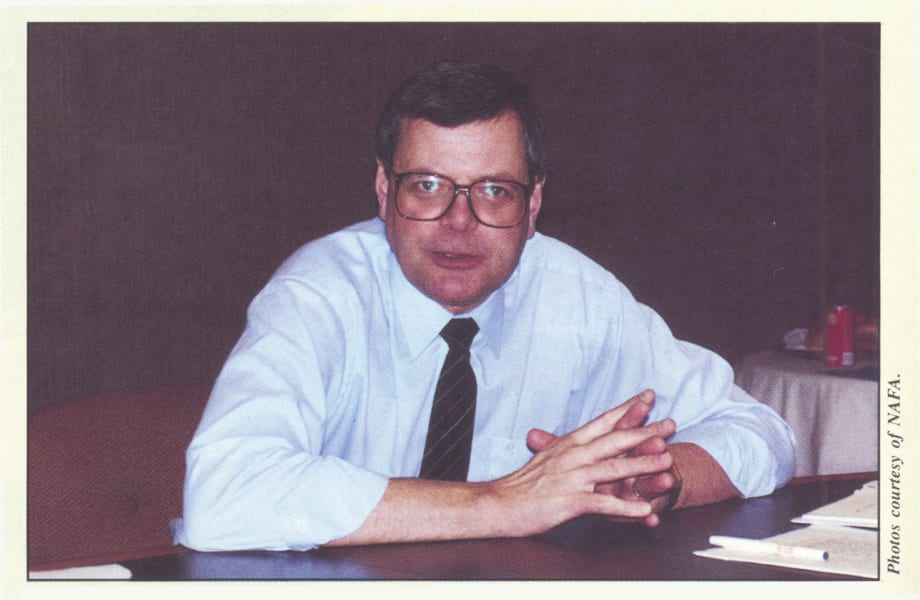
Paul Hubbard, president of NAFA (1990)
Paul Hubbard, president of NAFA (1990)
The following interview first appeared in the June/July, 1990 issue of Canadian Automotive Fleet, another Bobit publication, and is reprinted as a follow-up to the AF symposium on total fleet management which appeared in the July 1990 issue.
It is fairly certain that lessors will continue to introduce additional fleet management services to the fleet marketplace. What isn't clear is what this will mean for the fleet management profession in the coming years. Will fleet management companies ultimately replace the in-house fleet staff at certain companies? Canadian Automotive Fleet asked Paul Hubbard, president of the National Association of Fleet Administrators, to respond to this issue from a fleet manager's perspective. In addition, Hubbard is marketing administration manager for Imperial Tobacco Ltd. in Montreal, Canada.
CAF: How would you characterize the working relationship between fleet managers and leasing companies?
Hubbard: From my perspective, the fleet manager and the leasing company continue to be partners in solving transportation needs. Of course, the fleet manager is the senior partner. It's the fleet manager who represents only the interests of his or her employer. The fleet manager is responsible for recommending policy, evaluating information from a variety of sources, including leasing companies, and supervising the administrative work performed by the in-house staff or outside contractors. I view "management" as a broad, policy-related, decision-making function. Under that definition, the leasing companies and other vendors don't offer "management services" - they offer "administrative services." Despite what providers of such services may name their companies, or call their services, that work is not really fleet management. Unless, of course, the real fleet manager at the corporation or government simply turns all decision making for each area to the contractor and never evaluates their performance or independently evaluates services from other suppliers.
CAF: How has the NAFA membership and fleet managers in general responded to the introduction of lessor programs designed to encompass all functions usually performed by in-house fleet staff?
Hubbard: This issue has been a front-burner topic in the pages of our association's publication, at the NAFA Annual Conference, and around the tables at NAFA chapter meetings.
For the past few years, a growing number of fleet managers have expressed concern over the extent to which outside contractors started to include the word "management" in their names, some people began to worry that such companies were planning to take over the actual management and decision-making process. And, frankly, when you read what some leasing company executives have been quoted as saying in business publications, and when you read slick brochures, some companies appear to be saying that they're ready to take over true management of the fleet, eliminating the need for in-house expertise and decision making completely. That change prompted some fleet managers to view such services as a clear threat to their jobs.
Others view the transfer of some functions, and the reduction of in-house subordinate staff, as a loss of prestige and authority for the fleet manager. But such concerns have not been universal.
Many highly-respected fleet managers, from fleets of various sizes, argue that their position with their employers has improved since some services were contracted out. These fleet managers say that they now have a more important, executive function - reviewing the performance of vendors, assuring that charges are proper, perhaps comparing the performance of several vendors. These members say they now have more authority, greater visibility, and greater influence on policy in their companies since they have stepped up from the level of "paper-handler" and "telephone answerer" to a higher level of fleet management. These fleet managers still manage the fleet, with the vendor viewed as a source of valuable and important services which the employer is willing to pay.
CAF: If one of NAFA's goals is more cost-effective fleet management, does your organization argue against these programs, or suggest a better solution?
Hubbard: NAFA's purpose is not to argue for, or against, such services. NAFA's purpose is to facilitate the education and professional skills of fleet managers so they are in a position to analyze each service, then persuasively evaluate the advantages and the disadvantages to the employer.
I believe that NAFA members have already demonstrated their willingness to review each proposal on its merits. I see no evidence of widespread decisions by numerous employers to switch substantial fleet management responsibilities to outside suppliers. This issue - like so many others in fleet management-depends on the unique needs of the employer. I personally don't believe that outside suppliers can always provide better service at a better cost; clearly, any vendor is looking to make a profit on the service.
CAF: We've heard of one fleet manager who suggested his company adopt such a program knowing full well his position would become redundant. In that case, his company acknowledged his initiative and moved him into a position with even more responsibility. Comment on this kind of thinking.
Hubbard: I am familiar with situations where the employer decided to pare the fleet management staff, retaining only a few key supervisory personnel who represent the employer's best interests and who manage the performance of the contractor. In some of these cases, the fleet manager was very pleased with the new position, which actually provided increased responsibilities and compensation. I suppose we should congratulate an individual who so fully represents what he thought was in the best interest of his company that he recommended elimination of his own job; however, I suspect that situations where the company should eliminate the complete fleet management function from its structure are very, very rare.
CAF: How easily transferable are a fleet manager's skills and expertise if such a situation could mean a change of position within a company?
Hubbard: It is certainly true that Fleet, management has some unique aspects, at least in terms of specific daily functions. Yet, at the same time, an efficient fleet manager can demonstrate broad management skills which are often transferable to other positions. Certainly a professional licet manager should have substantial experience in financial matters, supervision of employer's most important priorities and needs. And often, the fleet manager is in the unique position of having direct contact, at least from time to time, with the highest levels of corporate management, where outstanding service should be appreciated.
I think each of us, as fleet managers; owe it to ourselves to acquire broader management skills. I know of several fleet managers who were promoted to substantially higher positions by their companies because of the expertise they demonstrated in fleet. In fact, I was promoted to my position at Imperial Tobacco based on my performance on day-to-day fleet operations. Fleet management is not a dead end job - at least not for individuals who develop broad management skills and who ensure that their employers know about their accomplishments.
CAF: If such programs become widespread, will fleet managers see their responsibilities expand to other areas?
Hubbard: I'm reluctant to predict the future; I don't even own a crystal ball. But, yes, if more employers decided to contract out some administrative responsibilities, the fleet manager of the future will probably spend the day in a manner somewhat unlike the norm of a decade or two ago. But a lot of fleet managers have already made this change. Some of the most visible fleet managers, with responsibilities for many thousands of vehicles, and perhaps the highest salaries, supervise only a small in-house staff and may never personally shuffle orders, maintenance reports, or vehicle titles.
CAF: Is this development inevitable, considering the costs involved in developing sophisticated computer systems to handle fleet functions similar to those employed by large leasing companies?
Hubbard: I don't think many "fleet management" companies claim their real expertise is computers; real expertise is in people. Currently we're witnessing an increase in the speed and capacity of computers while their costs are dropping dramatically. At the same time, fleet managers can develop their own software, purchase some from vendors, or buy computer time from leasing companies for key management information functions. A far bigger issue, as I see it, is expertise. The small fleet may (or may not) require great expertise in maintenance issues, local law and regulation in every state. If the company needs such expertise, it often becomes a financial decision whether to employ your own experts for each detailed segment of fleet administration or whether you should pay someone else for a share of their expertise. And again I have not seen any evidence that a large number of companies in Canada or in the United States are opting for "outside expertise." Many experienced fleet managers can, and have, demonstrated that an in-house staff has only the employer's best interest in mind. Of course, the biggest question is over true management responsibilities. The ultimate responsibility of the fleet manager is not to provide the cheapest vehicle - that task isn't terribly challenging. The fleet manager's biggest role is to provide efficient and effective transportation services supporting the company's management goal. The fleet manager's obligation is to manage all the administrative services related to fleet in line with the goals the employer has set forth. And the manager - who owes loyalty to the employer and only the employer - must continue to assure that all services, whether performed by in-house colleagues or outside contractors - support and further the employer's goal.
More Operations
Here's When You Should Make an Exception to Fleet Policy
Fleet policies are designed to create consistency, but not every driver or situation fits neatly within standard rules.
Read More →
AI-Native or AI-Acquired: What Should Fleet Managers Look for in an AI Platform?
Six questions can help fleet managers look beyond AI marketing claims to evaluate integration, data access, and real-world operational performance.
Read More →
A buyer's guide to fleet management software in 2027
Buying fleet management software in 2027 means looking beyond features and price. As fleet operations, technology and expectations evolve, this guide explores what today’s fleet professionals should consider when choosing a system that can deliver value now and adapt to what comes next.
Read More →

What Will Shape the Next Era of Fleet Management?
EVs, AI, and autonomous vehicles are reshaping fleet management. Discover what’s ahead—and how fleet leaders can prepare for the next era.
Read More →
How Fleets Can Recruit and Train Veterans for Technician Roles
Here's how the technician shortage has affected uptime for fleets, and what to do about it.
Read More →
Avis Budget Group Deploys Neology Toll Management Technology Across Major Brands
Neology’s neoFleet platform will manage toll transactions and toll-authority operations for vehicles across Avis, Budget, Payless, Budget Truck and Zipcar.
Read More →
Fleet Personal-Use Charges Edge Higher in 2026
Nearly eight in 10 surveyed fleets allow personal use of company vehicles, while just over half of respondents report charging employees for the privilege.
Read More →
The Future of Fleet + What’s Changing Right Now | AF News Recap
Could developments overseas offer a preview of what’s coming for U.S. fleets? This week, we’re looking at the future of AI, autonomy, and electrification, plus Ford Pro’s new certified pre-owned program, smarter vehicle offboarding, and a new way for fleets to manage toll expenses.
Read More →
How to Handle Vehicle Offboarding
What do fleet managers need to do when a driver leaves?
Read More →
Fleet Manager’s Ultimate Playbook: Navigating the New Standard in OEM Connectivity
Rising operating costs, driver safety concerns, and unplanned downtime are putting unprecedented pressure on modern fleets. Discover how fleet managers use embedded OEM connectivity and real-time vehicle data to cut TCO, prevent downtime, and protect drivers without aftermarket telematics hardware.
Read More →