




Leasing, Renting Survey Shows Booming Industry
AF's first national survey of the leasing and renting industry finds that the billion-dollar industry, like so many other businesses, is faced with a multitude of problems, some can be easily solved; others are more difficult. Nevertheless, they concern all leasing and renting operators.
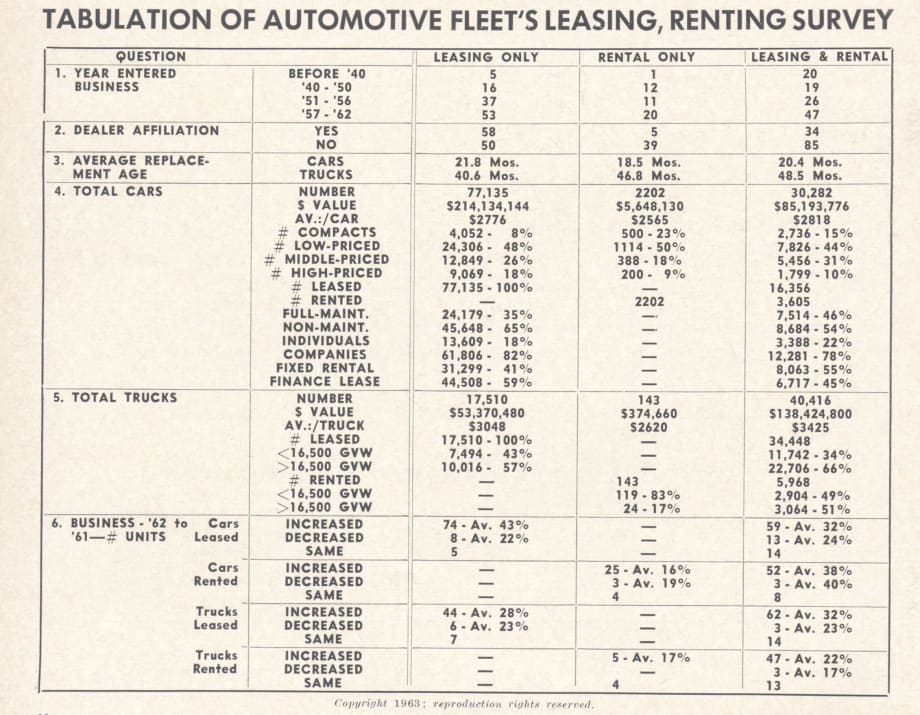
If there was any doubt before, AF's first national survey of the leasing and renting industry proves beyond a doubt what industry leaders have been saving for a long time-the renting and leasing of vehicles is a BIG BUSINESS. Indeed, it is a billion-dollar business.
AF sent a total of 2,240 questionnaires to individual renting and leasing operators, or to just about every known renting and leasing company in the country. The list was culled from every conceivable source, including AF's own circulation list and the rosters of national associations and organizations.
Of the 2,240 questionnaires sent out, 287 or 13.2 per cent were returned and 274 or 12.2 per cent were useable. Market researchers state that a 10 per cent return on a questionnaire is considered excellent; anything above 10 per cent increases the value of the survey. Based on this information, the AF survey can be viewed as a true picture of the renting and leasing survey.
To further help AF readers evaluate the industry, the results were individually tabulated for those firms operating in leasing only, rental only and a combination of both rental and leasing. Sub-total results of the 274 useable returns were 119 in the leasing and rental group, 111 in leasing alone and 44 in renting alone.
POINTS UP PROBLEMS
Amazingly, the survey revealed that despite its bigness, the renting and leasing industry is a mere infant. A total of 120, or 43 per cent of the firms who replied to the questionnaire have entered the business in the past six years. An even higher total-194 or 70 per cent, have entered the business in the last 11 years. There were merely a handful of renting and leasing operators in the business before 1940. In the leasing field alone, 90 per cent of the respondents have entered in the past 11 years.
The comparative newness of the operators in the industry makes clear some of the growing pains and problems faced by renting and leasing operators. It also points up to some of the criticism leveled against newcomers as reported on Page 19.
While very few of the rental companies have any new car affiliation, more than 50 per cent of the companies in leasing exclusively report an affiliation with a new car dealer. Combining rental with leasing, more than 66 per cent of the reporting companies operate independently.
The average price per car for rental cars only was $2,565; the average price per car for lease cars was $2,776 and the average price per car for cars operated by companies engaged in both renting and leasing was $2,818. The over-all average price per car was $2,790. AF interprets this to mean that there is a preference for larger, more expensive cars when price is no factor, say, for men on expense accounts. A further indication of this is that 18 per cent of the cars operated by leasing firms fall in the high-price class.
The rental group, considerably smaller in total size compared to leasing, reported they replace their cars every 18.6 months and their trucks every 46.8 months. Those firms engaged in leasing extend the replacement period to an average of 20.7 months for cars. Curiously, the replacement period for leased averages out to 45.2 months-below the rental figure. From a previous study, these cars register well over 20,000 miles per year and augment the accelerated replacement compared to the 31.2 month average replacement for the total car fleet market.
The respondents to the AF survey operate a total of 109,569 cars, or an average of approximately 400 per fleet. This 400 car fleet is about twice the size of the average fleet as revealed in a previous AF survey of passenger car fleets, indicating that many of the respondents to the leasing and renting survey were large operators and thus helped to raise the averages.
[PAGEBREAK]
Based on the results of the 109,569 cars with the original purchase value of $304,976,044, AF calculates that there are now 450,000 cars in lease use alone with a dollar volume of $1,268,000,000 and 100,000 cars in rental use with a dollar volume of $256,000,000.
The influence of compact cars is more pronounced in the rental business with approximately 23 per cent of the rental fleet consisting of compacts. The leasing companies reported only 8 per cent compacts, bringing the industry total to 10 per cent. Compact cars currently are accounting for better than 30 per cent of all new car sales, indicating that the compacts are not as popular with renting and leasing companies as they are with the general public.
[PAGEBREAK]
In analyzing the characteristics of the type of leasing being sold, it is revealing that leasing to companies accounts for 81 per cent of all the cars on lease. With more than 50 per cent operating under a finance lease arrangement and nearly 64 per cent on a non-maintenance contract, it would appear that companies are primarily using leasing for a capital source. A further conclusion is that the companies using leased cars prefer to handle their own maintenance, not only from a cost standpoint but from a control standpoint as well.
TRUCK TIE-IN
From a truck standpoint, the AF survey revealed that those firms engaged in truck renting almost always rent or lease cars as well, however, the reverse is not true.
Of the more than 58,000 trucks operated by respondents to the survey, nearly 52,000 were leased. With an average purchase value of only $3,313, coupled with the fact that more than 60 per cent of the trucks were over 16,500 GVW, AF concludes that the large majority of trucks under 16,500 GVW were of the panel and economical van-type delivery type. Those firms exclusively in truck renting typified the extensive use of the lighter units with more than 83 per cent in the under 16,500 GVW category.
The AF survey showed beyond a doubt that leasing and renting is a dynamic and growing business. Not only is the business attracting newcomers, but business is ever on the increase. The majority of the respondents reported that business was up from 34 to 38 per cent on cars and from 22 to 40 per cent on trucks. While many companies reported a pinch on profits, over-all revenues were up. This would indicate that many leasing and renting companies are experiencing growing pains in expansion and have yet to become accustomed to operating at their present and projected levels.
AF plans to continue research work in the leasing and rental field to further identify the trends and total growth of the industry.
More Operations
Here's When You Should Make an Exception to Fleet Policy
Fleet policies are designed to create consistency, but not every driver or situation fits neatly within standard rules.
Read More →
AI-Native or AI-Acquired: What Should Fleet Managers Look for in an AI Platform?
Six questions can help fleet managers look beyond AI marketing claims to evaluate integration, data access, and real-world operational performance.
Read More →
A buyer's guide to fleet management software in 2027
Buying fleet management software in 2027 means looking beyond features and price. As fleet operations, technology and expectations evolve, this guide explores what today’s fleet professionals should consider when choosing a system that can deliver value now and adapt to what comes next.
Read More →

What Will Shape the Next Era of Fleet Management?
EVs, AI, and autonomous vehicles are reshaping fleet management. Discover what’s ahead—and how fleet leaders can prepare for the next era.
Read More →
How Fleets Can Recruit and Train Veterans for Technician Roles
Here's how the technician shortage has affected uptime for fleets, and what to do about it.
Read More →
Avis Budget Group Deploys Neology Toll Management Technology Across Major Brands
Neology’s neoFleet platform will manage toll transactions and toll-authority operations for vehicles across Avis, Budget, Payless, Budget Truck and Zipcar.
Read More →
Fleet Personal-Use Charges Edge Higher in 2026
Nearly eight in 10 surveyed fleets allow personal use of company vehicles, while just over half of respondents report charging employees for the privilege.
Read More →
The Future of Fleet + What’s Changing Right Now | AF News Recap
Could developments overseas offer a preview of what’s coming for U.S. fleets? This week, we’re looking at the future of AI, autonomy, and electrification, plus Ford Pro’s new certified pre-owned program, smarter vehicle offboarding, and a new way for fleets to manage toll expenses.
Read More →
How to Handle Vehicle Offboarding
What do fleet managers need to do when a driver leaves?
Read More →
Fleet Manager’s Ultimate Playbook: Navigating the New Standard in OEM Connectivity
Rising operating costs, driver safety concerns, and unplanned downtime are putting unprecedented pressure on modern fleets. Discover how fleet managers use embedded OEM connectivity and real-time vehicle data to cut TCO, prevent downtime, and protect drivers without aftermarket telematics hardware.
Read More →