




Toyota Debuts All-New 2009 Corolla
Featuring 12.3 cubic feet of cargo space, a plethora of standard features, and an environmentally friendly design, the 2009 Toyota Corolla is all-new from the inside out.

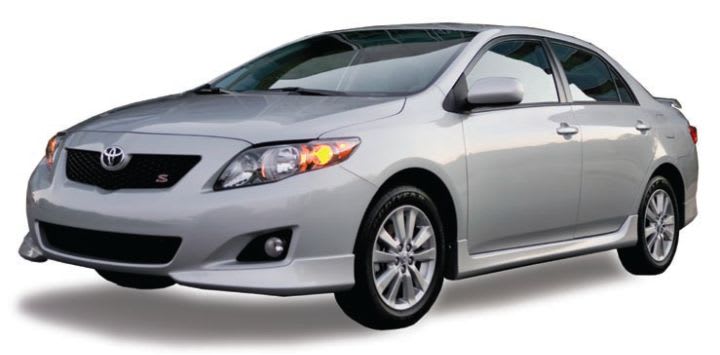
2009 Toyota Corolla
The all-new 2009 Toyota Corolla is now in its 10th generation. Launched originally in 1966, Corolla first arrived in the U.S. in 1968.
For nearly four decades, more than 30 million Corollas have been sold worldwide, making it one of the best-selling cars of all time.
Available in five grades — standard, LE, XLE, S, and XRS — the Corolla fits the needs of many automotive fleets.
Developed by Toyota Design in collaboration with styling studios in Turin, Italy, the 2009 Corolla features a wide, low profile for a lower, sportier shape. The angle of the window glass was increased, and the vehicle’s aerodynamics improved.
Design goals for the 2009 Corolla included creation of additional interior space, increased rigidity for reduced vibration and noise, and enhanced passenger safety.
The hood of the Corolla utilizes an interlayer anti-chip coating to reduce the effects of stone chips impacting the Corolla’s exterior paint.
Driver comfort was kept in mind as engineers repositioned the steering column and improved tilt and telescope capability to ensure all drivers find a comfortable driving position. The instrument panel was lowered as much as possible to ensure forward visibility as well.
Multiple easy-to-use storage areas are available and easy to access, with a total 12.3 cubic feet of available cargo space.
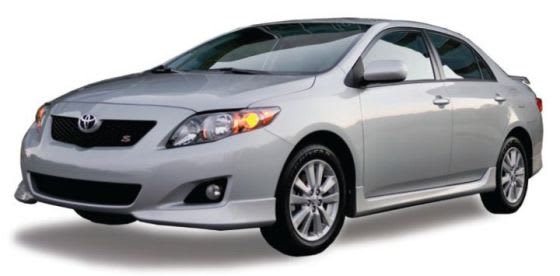
The all-new Corolla is equipped with several standard performance and safety features, including a heavy-duty rear window defogger, A/C, driver and passenger front airbags, front seat-mounted side airbags, side curtain airbags, intermittent windshield wipers, daytime running lights, two 12-volt power outlets, and 60/40 split folding rear seats.
Also standard are an anti-lock brake system, electronic brake-force distribution, brake assist, and tire pressure monitoring system. Vehicle stability control (VSC) and traction control (TRAC) are standard on the XRS grade. A new VSC off switch allows the driver to deactivate VSC and TRAC for complete control of vehicle performance.
A newly developed front suspension works to eliminate noise, vibration, and harshness (NVH) performance while achieving handling stability and ride comfort. Torsion-beam rear-suspension was also newly developed for the 2009 Corolla.
A first for Toyota, the 2009 Corolla comes equipped with a 2ZR-FE 1.8L DOHC 16-valve dual independent VVT-I, four-cylinder engine. Output at 132 hp, and torque at 128 lb.-ft., are both improved over previous models, and EPA-estimated mpg is 27 city, 35 highway. The vehicle also meets federal Tier 2 Bin 5 emissions standards.
The 2009 Corolla includes environmentally-friendly features in engine production such as hexavalent chromium-free plating, lead-free material for bearing and steel, element exchange-type oil, and long-lasting iridium spark plugs.
More Operations

90% Use Telematics. Are Fleets Getting Safer? | AF News Recap
This week, we're breaking down which industries have the highest rates, how Jamie McKay manages 2,400 vehicles, what's happening with the 2027 fleet awards, and why software-defined vehicles could introduce new costs.
Read More →
What's Best Handled by an FMC, and What's Better Done Directly?
Fleet managers continue to rely on FMCs for essential services but are taking a closer look at where working directly with suppliers can improve efficiency and responsiveness.
Read More →
Fleet Meets: Erin Gilchrist
Meet Erin Gilchrist, the inaugural Mike Antich Spirit of Fleet Award winner, as she shares insights on leadership, mentorship, the power of industry connections, and why people remain at the heart of fleet's future.
Read More →

How 2026 Fleet Visionary Jamie McKay Manages 2,400 Vehicles Across 37 States
How do you keep 2,400 vehicles running across 37 states? Fleet Visionary Award winner Jamie McKay shares how collaboration, flexibility, and a few simple strategies help her tackle fleet management challenges at Aptive Pest Control.
Read More →
Managing Fleet Costs in an Era of Permanent Volatility
Fleet operating costs have risen more than 20% since 2020, raising a key question: When does extending a vehicle's service life stop making financial sense?
Read More →
The Next Evolution of Fleet Management: Autonomous Operations
This opening keynote session at the Fleet Forward Conference highlights the future of autonomous driving for fleets.
Read More →
How to Reduce the Total Cost of Risk From Catalytic Converter Theft
A stolen catalytic converter can cost fleets far more in downtime and lost productivity than in repairs. A total-cost-of-risk approach can help fleet managers quantify their exposure and prioritize theft prevention.
Read More →
Personal-Use Charges Rise as Vehicle Values Fall | AF News Recap
Personal-use charges are climbing, wholesale used-vehicle values are declining, and commercial fleet sales growth is slowing. This week, we're breaking down the latest fleet data, plus how Element Fleet Management is helping Waymo prepare for its first Canadian robotaxi market.
Read More →
Here's When You Should Make an Exception to Fleet Policy
Fleet policies are designed to create consistency, but not every driver or situation fits neatly within standard rules.
Read More →
AI-Native or AI-Acquired: What Should Fleet Managers Look for in an AI Platform?
Six questions can help fleet managers look beyond AI marketing claims to evaluate integration, data access, and real-world operational performance.
Read More →