





Related: Chao Pitches Private Infrastructure Investment in Confirmation Hearing
Chao Confirmed as Transportation Chief
As expected, Elaine Chao was easily confirmed in largely bipartisan fashion on Jan. 31 as Secretary of Transportation by the U.S. Senate.
January 31, 2017
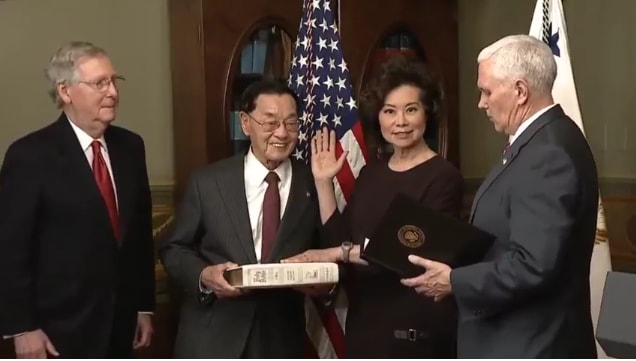
Elaine Chao being sworn in as secretary of transportation by Vice President Mike Pence. (Photo: U.S. DOT)
3 min to read
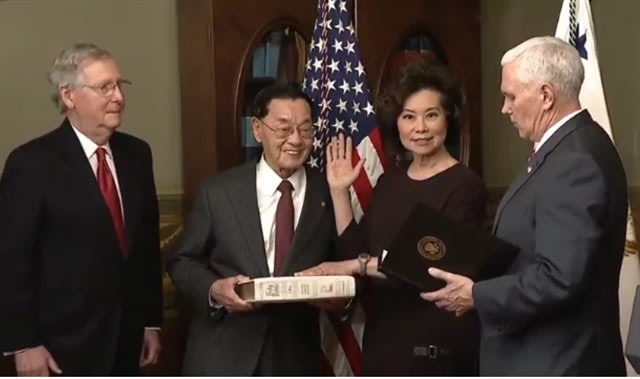
Elaine Chao being sworn in as secretary of transportation by Vice President Mike Pence.(Photo: U.S. DOT)
As expected, Elaine Chao was easily confirmed in largely bipartisan fashion on Jan. 31 as Secretary of Transportation by the U.S. Senate. The final roll call tally was 93 for and 6 against. In addition, Senate Majority Leader Mitch McConnell (R-KY), who is married to Chao, voted "present."
Secretary Chao has stated that one of her top priorities will be cooperating with Congress to enact the trillion-dollar infrastructure investment plan that has been floated by President-elect Trump since right after the election.
Speaking at her Senate confirmation hearing earlier in January, Chao emphasized the “significant difference between traditional program funding and other innovative financing tools, such as public-private partnerships.” She said getting private capital flowing into infrastructure projects will require “incentivizing” equity firms, pension funds, and endowments to invest in “a bold new vision” for building highways and other infrastructure.
In addition, Chao pledged in that hearing to keep safety a “primary objective” for DOT on her watch. She has also asserted that regulatory decisions should be “based on sound science with solid underlying data.”
Chao is no stranger to the power elite in Washington. She served as secretary of labor throughout both terms of President George W. Bush. Her first major executive appointment was deputy secretary of transportation under President George H.W. Bush.
“Secretary Chao has a long and distinguished track record, from her time as Secretary of Labor where I got to know her best and her service as Deputy Transportation Secretary as well as with the United Way and Peace Corps,” said Chris Spear, president and CEO of the American Trucking Associations, after the confirmation vote.
“Wherever she has gone,” he added, “Secretary Chao has demonstrated the kind of leadership and vision we need to address our nation’s pressing transportation issues and we look forward to quickly getting to work with her.”
ATA Chairman Kevin Burch, president of Jet Express Inc. added that trucking is "excited to begin working with Secretary Chao and eager to join with her in pushing to improve the safety and efficiency of our nation’s highways."
House Transportation and Infrastructure Committee Chairman Bill Shuster (R-PA) also congratulated the newest member of the Trump cabinet.
“I look forward to getting to work with her, the new administration, and my colleagues in Congress on the many issues before the Committee this year,” Shuster said. “We have a tremendous opportunity to improve our transportation systems, reduce regulatory burdens, encourage innovation and private-public partnerships, strengthen our competitiveness, and build a 21st century infrastructure for America.”
Offering well wishes as well was the Intelligent Transportation Society of America, which emphasized in a congratulatory letter that it “stands ready to work with Secretary Chao and her department to accelerate the widespread deployment of intelligent, transformational transportation systems.”
In the letter, ITS America President and CEO Regina Hopper told Chao that “Our members would like to work closely with you to build a transportation infrastructure that is the technological envy of the world—a national system that drives economic growth, enhances global competitiveness, advances safety, and improves mobility.”
More Operations

Here's When You Should Make an Exception to Fleet Policy
Fleet policies are designed to create consistency, but not every driver or situation fits neatly within standard rules.
Read More →
AI-Native or AI-Acquired: What Should Fleet Managers Look for in an AI Platform?
Six questions can help fleet managers look beyond AI marketing claims to evaluate integration, data access, and real-world operational performance.
Read More →
Sponsored•October 14, 2026
A buyer's guide to fleet management software in 2027
Buying fleet management software in 2027 means looking beyond features and price. As fleet operations, technology and expectations evolve, this guide explores what today’s fleet professionals should consider when choosing a system that can deliver value now and adapt to what comes next.
Read More →

What Will Shape the Next Era of Fleet Management?
EVs, AI, and autonomous vehicles are reshaping fleet management. Discover what’s ahead—and how fleet leaders can prepare for the next era.
Read More →
How Fleets Can Recruit and Train Veterans for Technician Roles
Here's how the technician shortage has affected uptime for fleets, and what to do about it.
Read More →
Avis Budget Group Deploys Neology Toll Management Technology Across Major Brands
Neology’s neoFleet platform will manage toll transactions and toll-authority operations for vehicles across Avis, Budget, Payless, Budget Truck and Zipcar.
Read More →
Fleet Personal-Use Charges Edge Higher in 2026
Nearly eight in 10 surveyed fleets allow personal use of company vehicles, while just over half of respondents report charging employees for the privilege.
Read More →
The Future of Fleet + What’s Changing Right Now | AF News Recap
Could developments overseas offer a preview of what’s coming for U.S. fleets? This week, we’re looking at the future of AI, autonomy, and electrification, plus Ford Pro’s new certified pre-owned program, smarter vehicle offboarding, and a new way for fleets to manage toll expenses.
Read More →
How to Handle Vehicle Offboarding
What do fleet managers need to do when a driver leaves?
Read More →
Sponsored•October 1, 2026
Fleet Manager’s Ultimate Playbook: Navigating the New Standard in OEM Connectivity
Rising operating costs, driver safety concerns, and unplanned downtime are putting unprecedented pressure on modern fleets. Discover how fleet managers use embedded OEM connectivity and real-time vehicle data to cut TCO, prevent downtime, and protect drivers without aftermarket telematics hardware.
Read More →