




2018 Chevrolet Equinox Adds Turbo, Diesel Engines
Chevrolet's 2018 Equinox will add a pair of turbo-charged four-cylinder engines and an optional turbo-diesel as the compact SUV enters its third generation.
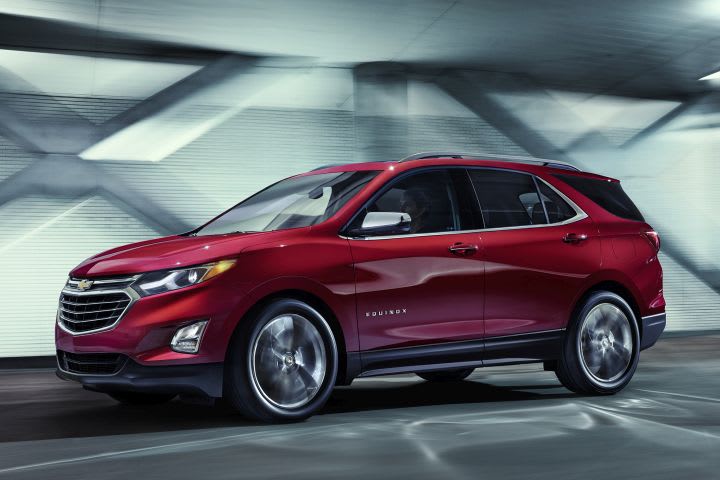
Photo of 2018 Chevrolet Equinox courtesy of GM.
Photo of 2018 Chevrolet Equinox courtesy of GM.
Chevrolet's 2018 Equinox will add a pair of turbo-charged four-cylinder engines and an optional turbo-diesel as the compact SUV enters its third generation.
Chevrolet introduced the vehicle on the autumnal equinox (Sept. 22) as the start of an initiative to refresh its entire SUV lineup.
The 2018 Equinox also improves connectivity, safety technology, and adaptive crash avoidance features. The vehicle also sheds 400 pounds over the outgoing model and a switchable all-wheel-drive system.
The new engine lineup includes two turbo-charged four cylinders that replace the Ecotec 2.4L direct-injected four-cylinder and optional 3.6L V-6. A 1.5L direct-injected DOHC that makes 170 hp and 203 lb.-ft. of torque serves as the base engine. The Equinox powered by this engine with a 6-speed automatic transmission (Hydra-Matic 6T40) should achieve 31 mpg on the highway, according to GM.
A 2.0L direct-injected DOHC should produce 252 hp and 260 lb.-ft.. It's paired with a 9-speed automatic (Hydra-Matic 9T50) and should achieve 28 mpg on the highway.
The 2018 Equinox will also offer a 1.6L turbo-diesel that makes 136 hp and 236 lb.-ft. It will be paired with a 6-speed automatic (Hydra-Matic 6T45) and should achieve 40 mpg on the highway.
"The Chevrolet Equinox is one of the top-selling compact crossovers for commercial fleets, and we look forward to continuing that success with the 2018 Equinox," said Jason Simcoke, General Motors Fleet, commercial product manager, crossovers. "The all-new Equinox gives commercial customers more choices and customization options than ever before with three available turbocharged engines, including two gas engines and the segment’s first turbo-diesel."
Chevrolet has refreshed the exterior design of the Equinox with styling inspired by the 2016 Chevrolet Malibu. In the interior, designers have lowered the windshield base and added a new “kneeling” rear seat with bottom cushions that tilt forward when the split-folding seatbacks are lowered, allowing a flat floor for easier loading.
As for technology, the 2018 Equinox will offer 7- or 8-inch displays for MyLink infotainment systems that will now support Apply CarPlay and Android Auto, as well as an available OnStar 4G LTE Wi-Fi hotspot.
New safety features include a Safety Alert Seat, Surround Vision, a forward collision alert, low-speed forward automatic braking, lane keep assist, blind zone alert, and rear cross traffic alert.
The 2018 Equinox is expected to go on sale in early 2017.
General Motors received more than 26,000 Equinox orders from commercial and government fleet users for the 2015 model year Equinox, Simcoke said.
"The 2018 Equinox is lighter and shorter than the previous model, but has more interior space and a tighter turning radius making it easier to maneuver in urban settings," Simcoke said. "The Equinox also delivers on safety with an extensive list of standard and a broad range of available safety features to help prevent accidents and keep drivers safe on the road."
More Operations

Company Vehicle or Reimbursement? How Fleets Are Rethinking Assignments
As fleet costs and insurance pressures rise, fleet managers are taking a closer look at which employees need company-provided vehicles and when a reimbursement program may make more sense.

Fleetio, ASE Launch Scholarship Program for Automotive Technicians
The second annual program will award 15 scholarships totaling $35,000 to support ASE certification, testing fees, and equipment costs.

Reading the Global Signals: What AI and the Energy Transition Mean for Fleets Now
In this opening keynote of the 2026 Fleet Forward Conference, John Rossant, founder of CoMotion, How can fleet managers navigate a never-ending, changing industry landscape?

90% Use Telematics. Are Fleets Getting Safer? | AF News Recap
This week, we're breaking down which industries have the highest rates, how Jamie McKay manages 2,400 vehicles, what's happening with the 2027 fleet awards, and why software-defined vehicles could introduce new costs.

What's Best Handled by an FMC, and What's Better Done Directly?
Fleet managers continue to rely on FMCs for essential services but are taking a closer look at where working directly with suppliers can improve efficiency and responsiveness.

Fleet Meets: Erin Gilchrist
Meet Erin Gilchrist, the inaugural Mike Antich Spirit of Fleet Award winner, as she shares insights on leadership, mentorship, the power of industry connections, and why people remain at the heart of fleet's future.

How 2026 Fleet Visionary Jamie McKay Manages 2,400 Vehicles Across 37 States
How do you keep 2,400 vehicles running across 37 states? Fleet Visionary Award winner Jamie McKay shares how collaboration, flexibility, and a few simple strategies help her tackle fleet management challenges at Aptive Pest Control.

Managing Fleet Costs in an Era of Permanent Volatility
Fleet operating costs have risen more than 20% since 2020, raising a key question: When does extending a vehicle's service life stop making financial sense?

The Next Evolution of Fleet Management: Autonomous Operations
This opening keynote session at the Fleet Forward Conference highlights the future of autonomous driving for fleets.

How to Reduce the Total Cost of Risk From Catalytic Converter Theft
A stolen catalytic converter can cost fleets far more in downtime and lost productivity than in repairs. A total-cost-of-risk approach can help fleet managers quantify their exposure and prioritize theft prevention.