




Ford Updates F-150's 3.5L Turbo, Adds 10-Speed
The 2017 F-150 will arrive with a more powerful twin-turbo V-6 and 10-speed transmission to deliver improved acceleration and performance than the prior model, Ford has announced.
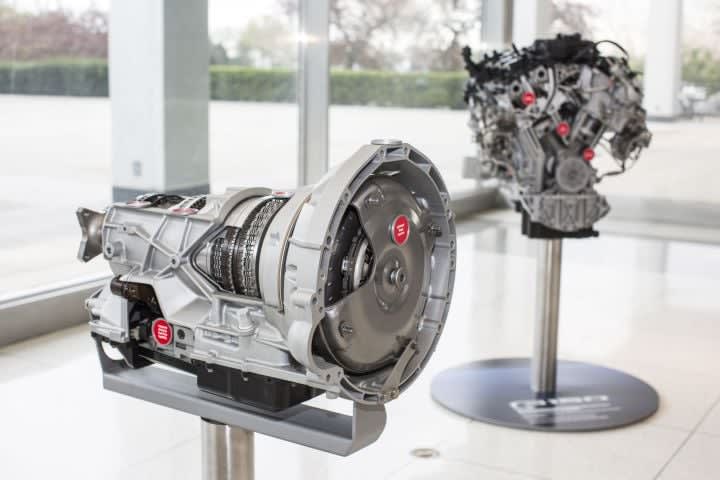
Photo of 10-speed transmission and 3.5L EcoBoost engine courtesy of Ford.
Photo of 10-speed transmission and 3.5L EcoBoost engine courtesy of Ford.
The 2017 F-150 will arrive with a more powerful twin-turbo V-6 and 10-speed transmission to deliver improved acceleration and performance than the prior model, Ford has announced.
Ford's second-generation 3.5L EcoBoost is rated at 450 lb.-ft. of torque, an improvement of 30 lb.-ft. Ford will continue to offer the 2.7L V-6 EcoBoost.
The new engine provides better low-end and peak engine performance for hauling heavy payloads and towing heavy trailers, according to Ford.
The engine features a new dual-direct and port fuel-injection system. Two injectors per cylinder — one mounted in the intake port where air enters the cylinder and one positioned inside the cylinder — work together to improve power output, efficiency, and emissions.
New turbochargers deliver more boost thanks to improved twin turbos and a lighter turbine wheel. The new turbos work with electrically activated wastegates to enhance operating efficiency. Ford added a lighter-weight turbine wheel made out of high-temperature super alloy Mar-M-247 that was developed by the aerospace industry.
The 10-speed automatic transmission replaces the existing 6-speed for the 3.5L V-6.
The new transmission uses optimized wide-span gear spacing and drag-reduction actions. Three overdrive gears and a wider ratio span enable lower-numerical rear-axle ratios to help improve fuel efficiency at highway speeds, according to Ford.
The 10-speed uses advanced materials and alloys to save weight, and it is the first Ford gearbox without cast-iron components. An integrated torque converter/turbine clutch also helps shave more than 2 pounds of weight.
Smarter shift logic assists while the truck is in tow/haul mode. New real-time-adaptive shift-scheduling algorithms monitor more than a dozen powertrain- and driver-control signals to ensure the right gear at the right time.
An integrated electric pump works with the standard automatic start-stop system for seamless restarts and improved driving efficiency, according to Ford.
More Operations

How Fleets Can Recruit and Train Veterans for Technician Roles
Here's how the technician shortage has affected uptime for fleets, and what to do about it.
Read More →
Avis Budget Group Deploys Neology Toll Management Technology Across Major Brands
Neology’s neoFleet platform will manage toll transactions and toll-authority operations for vehicles across Avis, Budget, Payless, Budget Truck and Zipcar.
Read More →
Fleet Personal-Use Charges Edge Higher in 2026
Nearly eight in 10 surveyed fleets allow personal use of company vehicles, while just over half of respondents report charging employees for the privilege.
Read More →
The Future of Fleet + What’s Changing Right Now | AF News Recap
Could developments overseas offer a preview of what’s coming for U.S. fleets? This week, we’re looking at the future of AI, autonomy, and electrification, plus Ford Pro’s new certified pre-owned program, smarter vehicle offboarding, and a new way for fleets to manage toll expenses.
Read More →
How to Handle Vehicle Offboarding
What do fleet managers need to do when a driver leaves?
Read More →
Fleet Manager’s Ultimate Playbook: Navigating the New Standard in OEM Connectivity
Rising operating costs, driver safety concerns, and unplanned downtime are putting unprecedented pressure on modern fleets. Discover how fleet managers use embedded OEM connectivity and real-time vehicle data to cut TCO, prevent downtime, and protect drivers without aftermarket telematics hardware.
Read More →
U.S. Bank Adds Verra Mobility Toll Management to Voyager Fleet Platform
The integration allows U.S. Bank Voyager fleet customers to manage toll payments and violations alongside fuel, EV charging and maintenance expenses.
Read More →
ADAS Prevents Crashes. But Repairs Cost More | AF News Recap
ADAS-equipped vehicles may crash less often, but they can cost more when they do. This week, we’re breaking down what that tradeoff means for fleets, plus Subaru’s first Forester Wilderness Hybrid, Nissan’s new e-POWER Rogue, and why Calstart has become Catalyst Mobility.
Read More →
Moventum Fleet Management Names Mark Iorillo Head of Sales
Iorillo brings nearly 20 years of fleet management and sales experience to the role, including previous positions at Element Fleet Management, CEI, Donlen and Ryder.
Read More →
Fleet Has a Talent Pipeline Problem. What Comes Next? | AF News Recap
Where will fleet’s next generation of leaders come from? This week, we’re looking at the industry’s talent pipeline, what certification can add to a fleet career, how to build an award-worthy track record, and the return of Automotive Fleet’s Personal Use Survey.
Read More →