




Safety Tip: Dealing With Headlight Glare
In the view of some drivers, this problem has grown much worse. Here's some advice from AAA as well as news about upcoming technology that might help.
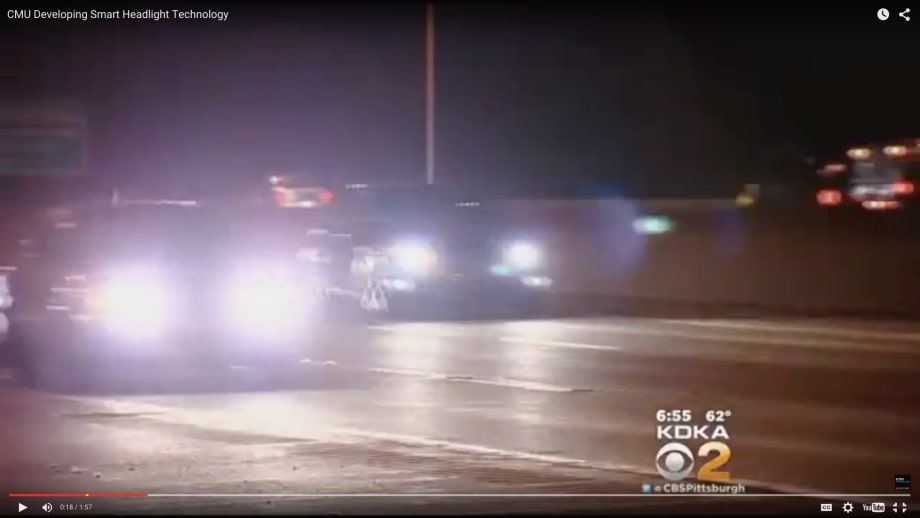
VIDEO: Future Smart Headlight Technology
Headlight glare has drawn the ire of drivers for more than a century, but the problem seems to have grown worse in recent years for a number of reasons.
More and more pickup trucks and SUVs ride higher off the ground and, as a result, their headlights are more likely to shine directly into the eyes of other drivers. Secondly, more vehicle models are using high-intensity discharge (HID) lights, which emit twice the light of halogen headlamps but produce a blue-white light. Also, more vehicle models have fog or other auxiliary lights in front – and unfortunately, these lights often become misaligned over time.
In fact, misalignment is a problem that affects more than just fog and auxiliary lights. Studies suggest that nearly half of vehicles in states that require inspections have at least one off-kilter headlight, according to the AAA Foundation for Traffic Safety. Vehicles more than five years old are two times as likely to have misaimed headlights compared to new vehicles. Misaligned lights are a major contributor to the headlight glare problem.
Another factor is driver distraction. A driver preoccupied with a phone conversation, for example, is more likely to absentmindedly forget to turn off high beams.
Demographics also play a role in how the problem is perceived. Middle-aged and older drivers are more sensitive to headlight glare because their eyes adjust more slowly to changing light levels. Also, drivers who have light-colored eyes or who have had LASIK eye surgery often find headlight glare more troublesome. Further, hypersensitivity to headlight glare can be an early warning sign of a vision problem such as cataracts or macular degeneration – conditions that require medical attention.
What about those tinted night-driving glasses and visors you see advertised online and on TV? Do they help?
They’re a bit controversial and have drawn mixed reviews. AAA has advised against their use, asserting that these products reduce night vision overall – not just glare.
On the other hand, many ophthalmologists and optometrists recommend eyeglasses with an anti-reflective (AR) coating to reduce nighttime glare.
The good news is that technology figures to address at least some of the causes of headlight glare in the not-so-distant future. To view a video about smart headlight development at Carnegie Mellon University, click on the photo or link below the headline.
To help diminish nighttime glare, drivers need to make sure their windshield (both sides), mirrors and their own headlights are kept clean. It’s also a good idea to periodically clean wiper blades, and worn-out blades should be replaced.
Here are a few more AAA tips you might want to share with fleet drivers:
Adjust Both Outside Mirrors
Properly aligned mirrors not only reduce blind spots, they also reduce glare from vehicles behind you. While sitting in the driver's seat, lean to the left and tilt your head until it rests against the window. From that position, adjust the driver's side mirror so you can just see the left rear corner of the vehicle.
Avert Your Eyes
When oncoming vehicles shine light directly into your eyes, turn your gaze to the white line on the right side of the road, or to where the pavement meets the shoulder, until the vehicle goes by.
Use the Rearview Mirror's "Night" Setting
All cars have day/night interior mirrors to reduce glare from cars directly behind you. You can usually change the mirror to its "night" setting by flipping the small lever at the bottom of the mirror.
Proactively Use Your Headlights
Headlights should be on at least one hour after sunrise and one hour before sunset. Lights should be turned on during a cloudy or rainy day. Make sure that all lights are functioning properly.
To minimize the challenges of driving at night, AAA also recommends these measures:
Adjust your speed to the reach of your headlights. Don’t “overdrive” your headlights by driving at a speed that wouldn’t allow you to stop for an obstacle at the far reaches of your headlights. Compensate for reduced visibility by decreasing your speed and increasing following distance to four or more seconds behind the car in front of you.
Keep your eyes moving. Don’t focus on the middle of the area illuminated by your headlights. Watch for sudden flashes of light at hilltops, around curves or at intersections. These may indicate the presence of oncoming vehicles.
Look at the sides of objects. In dim light during reduced visibility, focus on the edges or outlines of objects. Your eyes can pick up images more sharply this way than by looking directly at the object.
Protect your eyes from glare. Prolonged exposure to glare from sunlight or headlights can temporarily affect your visibility at night. It can also lead to eyestrain and drowsiness. Wear good sunglasses on bright days and take them off as soon as the sun goes down. After steady daytime driving, rest awhile before you begin driving at night. At night, look to the center of your pathway and use the painted edge lines to guide your vehicle.
Avoid being blinded by oncoming high beams. If the driver of an oncoming vehicle fails to dim the lights, look down toward the right side of the road to avoid being blinded. You should be able to see the edge of the lane or the painted edge line and stay on course until the vehicle passes.
More Safety

The Safest Fleets Aren’t the Ones with the Most Technology
You’ve made the telematics investment. Here’s how to capture the other half of its value and build the safest fleet on the road.
Read More →
Hidden in Plain Sight: Fleet Compliance Risks
Fleet compliance isn't just about having policies — it's about consistently enforcing them. This practical guide reveals six hidden compliance risks common in public sector and shared fleet operations and outlines proven strategies to improve visibility, accountability, and audit readiness
Read More →
NETS Sets 2026 Fleet Safety Benchmark Conference for Indianapolis
The Sept. 15–17 program will feature fleet benchmarking data, case studies, emerging technologies, and implementation strategies while running alongside the NSC Safety Congress & Expo.
Read More →

Off-the-Job Crashes Account for 43% of Employers’ $61.7 Billion Crash Burden
NETS quantifies costs dispersed across fleet, risk, HR, and other departments while providing new per-crash benchmarks for employers.
Read More →
Ram Recalls More Than 1.27 Million 1500 Pickups for Seat Belt Anchor Issue
The recall affects certain 2019-2026 Ram 1500 pickups that may have improperly attached second-row seat belt buckle anchors.
Read More →
How Better Visibility Cut Speeding Violations by 48%
Fleet leaders don't need more data, they need clearer visibility into what the data is saying. This case study explores how one utility replaced speeding-event counts with a single metric — miles driven in violation — to strengthen safety and significantly reduce speeding violations.
Read More →
Operation Safe Driver Week: Why the Industry's Oldest Safety Campaign Still Matters to Fleets
A look at how a 2007 enforcement initiative became one of the most consequential weeks on the fleet safety calendar, and what it means for your drivers in 2026.
Read More →
Nexar-Nauto Merger Aims to Give Fleets Better Safety Intelligence Through Larger Driving Dataset
Stefan Heck tells Automotive Fleet that combining more than 10 billion miles of driving history with Nexar's AI models will give fleets deeper insights into driver risk and roadway conditions than either company could provide independently.
Read More →
From Silos to Solutions: Relationship Management for Safer Fleets
From telematics adoption and driver accountability to policy consistency and risk mitigation, this episode breaks down what it really takes to build a safer fleet culture without slowing business down.
Read More →
IIHS Launches First Commercial Vehicle Safety Evaluations
The Insurance Institute for Highway Safety has begun evaluating heavy-duty pickups and cargo vans for driver protection. Which models earned top marks?
Read More →