Trucking and package delivery giant FedEx Corp. on Wednesday reported a big jump in profit for its fiscal year second quarter.
by Staff
December 17, 2014
3 min to read
Trucking and package delivery giant FedEx Corp. on Wednesday reported a big jump in profit for its fiscal year second quarter.
The Tennessee-based operation reported net income of $616 million, up 23% from last year’s $500 million, with earnings of $2.14 per diluted share for the second quarter ended November 30, up 36% from last year’s $1.57 per share.
Ad Loading...
Revenue during the period totaled $11.9 billion, up 5% from $11.4 billion the previous year, while operating income was $1.01 billion, up 22% from $827 million last year.
“FedEx posted strong results and a higher operating margin in the second quarter, with continued growth in volumes and base yields in each of our transportation segments,” said Frederick W. Smith, FedEx Corp. chairman, president and chief executive officer.
Operating income and margin increased primarily due to higher volumes and base yields in all three transportation segments, according to FedEx. Results in the second quarter also included benefits from the company’s profit improvement programs, lower pension expense and a slightly positive net impact from fuel. These benefits were partially offset by higher aircraft maintenance expense due to the timing of aircraft maintenance events.
FedEx also reaffirmed its 2015 earnings forecast of $8.50 to $9.00 per diluted share. The outlook assumes continued moderate economic growth and a modest net benefit from fuel.
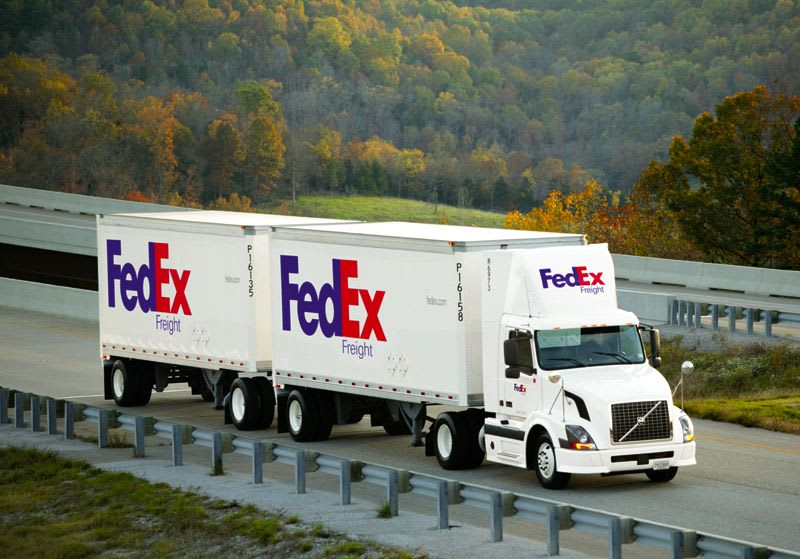
For the second quarter of the fiscal year, the company’s trucking operation FedEx Freight segment reported:
Ad Loading...
Revenue of $1.59 billion, up 11% from last year’s $1.43 billion,
Operating income of $112 million, up 35% from $83 million a year ago an
Operating margin of 7.1%, up from 5.8% the previous year.
Less-than-truckload average daily shipments increased 8%, including a 10% increase in demand for priority service, according to FedEx. LTL revenue per shipment grew 3% due to higher weight per shipment, higher rates and increased fuel surcharges. Operating results improved due to increased LTL revenue per shipment and higher average daily LTL shipments.
The FedEx Express segment reported for the second fiscal year quarter:
Revenue of $7.02 billion, up 3% from last year’s $6.84 billion,
Operating income of $484 million, up 36% from $357 million a year ago and
Operating margin of 6.9%, up from 5.2% the previous year.
Revenue increased due to higher U.S. domestic package volume and international export package base revenue, partially offset by lower fuel surcharges and exchange rates, FedEx said. U.S. domestic package volume grew by 7%, including a 10% increase in U.S. overnight box shipments. U.S. domestic revenue per package declined 2% due to decreased fuel surcharges and lower weight.
Ad Loading...
For the second fiscal year quarter, the FedEx Ground segment reported:
Revenue of $3.06 billion, up 8% from last year’s $2.85 billion,
Operating income of $465 million, up 6% from $439 million a year ago and
Operating margin of 15.2%, down from 15.4% the previous year.
FedEx Ground average daily volume grew 5% in the second quarter, driven by growth in both business-to-business and FedEx Home Delivery services, according to FedEx. Revenue per package increased 3% due to rate increases and higher residential surcharges.
Operating income increased due to higher revenue per package and volume, partially offset by higher network expansion costs.
For fleet managers, fuel is one of the biggest line items in the budget — and it's one hybrids can shrink without changing how your people work. Download the eBook to see the numbers, understand the technology, and get a step-by-step guide to making the switch.
James Victory of NOV discusses how the company manages fleet safety, maintenance, and telematics across more than 150 locations supporting oilfield operations throughout the U.S.
Departmentally assigned vehicles often create hidden costs through underutilization, poor visibility, and increased administrative burden. This white paper explores how shared motor pool strategies help fleets reduce costs, improve accountability, and optimize vehicle utilization.
BBL Fleet expanded its footprint in the fleet management industry with the acquisition of Velcor Leasing Corporation of Madison through a stock purchase agreement finalized Feb. 27, 2026.
Fleet leaders are under pressure to reduce costs, adapt to economic uncertainty, and make smarter decisions. See how peers across North America are responding with real data, proven strategies, and forward-looking insights. Download the 2026 Market Pulse Report to benchmark your strategy and uncover where you can gain an edge.
AI is no longer a future concept for fleets—it’s already embedded in the tools, data, and decisions that operators rely on every day. In this episode of the Fleet Forward Podcast, recorded live at Fleet Forward, industry leaders take the conversation beyond hype to examine what responsible AI adoption really looks like in fleet operations.