




Nissan Shows 2013 NV200 Cargo Van in Chicago, Reveals Fuel Economy and MSRP
Nissan says its all-new 2013 NV200 Cargo Van is designed for business owners and fleet operators that want a smaller work van. It goes on sale in April.
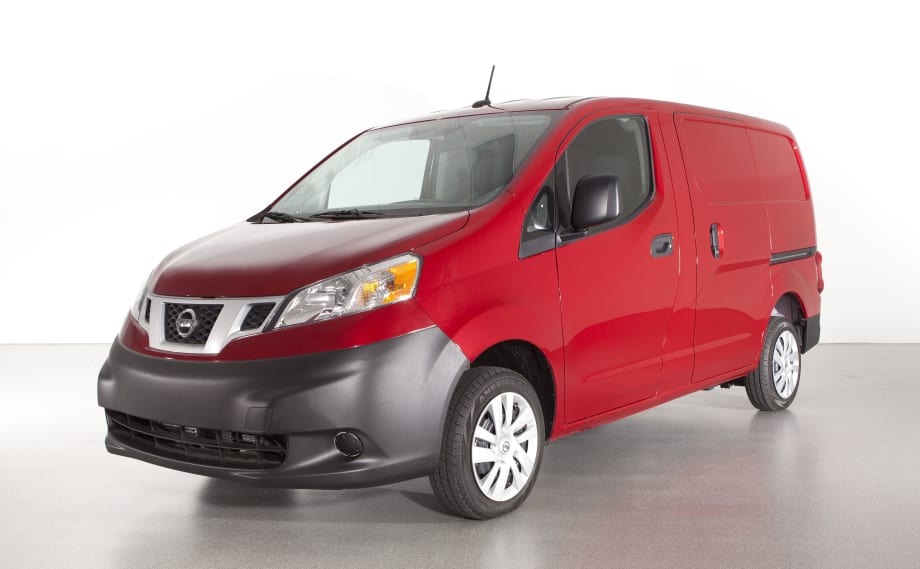
The Nissan NV200 Compact Cargo Van comes in two models, S and SV, in five exterior colors, and offers a range of option packages.
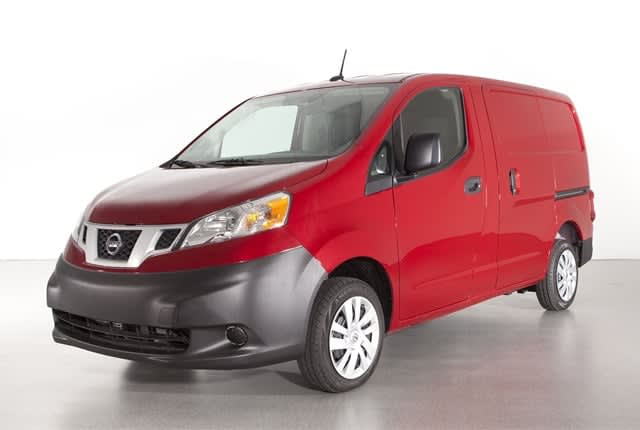
The Nissan NV200 Compact Cargo Van comes in two models, S and SV, in five exterior colors, and offers a range of option packages.
Nissan showed its all-new 2013-MY NV200 Compact Cargo Van at the 2013 Chicago Auto Show and revealed more details about the vehicle, which the company originally announced at the 2012 Chicago Auto Show. The company said the all-new vehicle is designed for business owners and fleet operators that want a smaller work van. According to Nissan, the all-new cargo van goes on sale in April.
You can view additional photos of the vehicle here.
The NV200 comes in two models, S and SV. MSRP for the S is $19,990 and $20,980 for the SV. These prices exclude the $845 destination and handling charge. Both models are equipped with a 2.0L DOHC four-cylinder engine rated at 131 hp and 139 lb. ft. of torque. Nissan said the vehicle is rated at 24 mpg city, 25 mpg highway, 24 mpg combined. The engine is matched with an Xtronic CVT transmission.
Exterior color choices for the all-new NV200 include Blue Onyx, Brilliant Silver, Super Black, Red Brick, and Fresh Powder. A gray cloth interior is standard. The vehicle has a 115.2-inch wheelbase, is 186.3 inches long, has 82.8 inches of cargo space length, 54.8 inches of cargo width, and 53 inches of cargo area height. Cargo width between the wheel wells is 48 inches. Total cargo capacity is 122.7 inches, and estimated maximum payload is 1,500 lbs.
The vehicle offers a range of “mobile office” features, such as an under-seat storage tray, a center console with laptop and hanging file folder storage, recessed storage areas, and a passenger seat that folds down to act as a work surface.
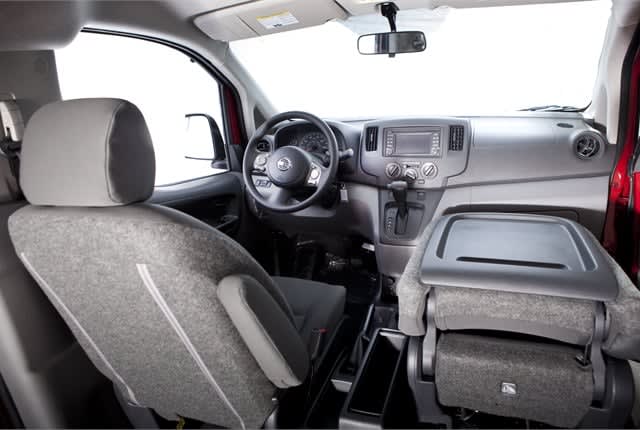
The Nissan NV200 Compact Cargo Van's interior is designed to function as a "mobile office."
Technology-wise, Nissan offers its NissanConnect system, which comes with a 5.8-inch touch screen display, Nissan Voice Recognition technology for controlling audio system functions and navigation, NavTraffic and NavWeather functions (these features require a SiriusXM Satellite Radio subscription), points of interest from Google, Google’s Send-to-Car feature (this allows a user to send navigation directions from a smartphone to the vehicle’s navigation system), Pandora (via an iPhone), Bluetooth streaming audio, and a Hands-Free Text Messaging Assistant feature.
The automaker offers five option packages, including Cruise Control, Back Door Glass, Bluetooth Hands-Free, Exterior Appearance, and Technology. The Exterior Appearance package includes body-color bumpers, door handles, and outside mirrors and a chrome grille. The Technology Package comes with NissanConnect, a navigation system, a rear-view monitor, and SiriusXM Satellite Radio (which requires a subscription).
More Operations

Fleet Has a Talent Pipeline Problem. What Comes Next? | AF News Recap
Where will fleet’s next generation of leaders come from? This week, we’re looking at the industry’s talent pipeline, what certification can add to a fleet career, how to build an award-worthy track record, and the return of Automotive Fleet’s Personal Use Survey.
Read More →
Smith System Launches Driver Risk Management Program
Fleets have more driver data than ever, but identifying risky behavior doesn't necessarily correct it. Smith System's new Driver Risk Management program combines monitoring, training, and follow-up coaching to help fleets connect risk signals with driver intervention.
Read More →
Automotive Fleet Opens 2026 Personal Use Survey for Commercial Fleet Managers
Less than two weeks left! Commercial and corporate fleet managers are invited to share how their organizations handle company vehicle personal-use policies, charges, and driver eligibility.
Read More →
From AI Prompts to AI-Generated Safety Songs | AF News Recap
Can better prompts make AI more useful for fleet managers? This week, we’re breaking down smarter fleet analysis, an AI-assisted experiment that turned safety training into music, and what happened to fuel prices in August.
Read More →
How to Write Better AI Prompts for Fleet Analysis
Include these six elements in your fleet prompts to generate more relevant analysis and accurate answers.
Read More →
Fleet Meets: Eric Kilgore
This edition of the Fleet Meets series features one of the industry's best leaders driving multi-market and national operations.
Read More →
Why Reactive Fleet Management Is Becoming Too Expensive to Sustain
Research highlights a growing need for proactive management strategies to address rising costs in fleet operations effectively.
Read More →
What Your Fleet KPIs Aren’t Telling You
Tracking fleet metrics is only useful when the data leads to better decisions. This guide helps fleet leaders assess cost, utilization, and downtime more accurately, identify performance gaps, and prioritize the actions that can improve operational results.
Read More →
Hidden in Plain Sight: Fleet Compliance Risks
Fleet compliance isn't just about having policies — it's about consistently enforcing them. This practical guide reveals six hidden compliance risks common in public sector and shared fleet operations and outlines proven strategies to improve visibility, accountability, and audit readiness
Read More →
Turning Fleet Payment Data into Executive Insights
Does data alone drive results in operations?
Read More →