




Keep Reading! Fleet Registration Trends: Will Light-Duty Keep Outpacing Medium- and Heavy-Duty?
Inside AI and Automation in Fleet Transport: A Technology Perspective Building the Next Generation of Intelligent Fleet Transport
Fleet transport is evolving beyond execution into intelligence, where data, automation, and AI are reshaping how vehicles move, how decisions are made, and how readiness is defined.
by Erik Rasmussen, Vice President of Strategic Operations, PARS
April 2, 2026
As fleet transport evolves, data and connectivity are reshaping how vehicles move—from physical logistics to intelligent, insight-driven operations.
Credit: Automotive Fleet
5 min to read
For decades, vehicle relocation providers have focused on a core commitment: helping fleets move vehicles accurately, transparently, and without surprises.
What is changing today is not the mission, but the infrastructure supporting it. Technology is increasingly becoming the operational backbone of fleet transport.
Following broader consolidation and platform integration trends across logistics, investments in data architecture, automation, and artificial intelligence are accelerating.
Across the industry, digital systems are evolving from support tools into foundational frameworks that shape execution, reporting, and decision-making. The objective is not technology deployment for its own sake, but strengthening driveaway, storage coordination, carrier transport, and condition management while improving visibility into vehicle readiness and lifecycle status.
From a technology strategy perspective, digital systems now influence nearly every operational workflow in fleet transport.
Business Intelligence That Turns Data into Decisions
Fleet managers have never lacked reports. What they increasingly need is structured insight.
Transport providers capture detailed operational data at nearly every step of a vehicle move—pickup attempts, delivery timing, storage dwell time, exception handling, and customer feedback.
The industry challenge is not data availability but data normalization and usability. Transforming operational data into structured dashboards enables fleets to analyze root causes rather than isolated events.
Instead of simply documenting late deliveries, modern systems can identify contributing factors: repeated contact attempts with specific dealers, geographic clusters of delays, lane performance variability, or storage bottlenecks. Benchmarking across portfolios is becoming more common as fleets demand comparative transparency.
However, performance metrics remain inconsistently defined across providers. Industry-wide standardization of timeliness, dwell time, and inspection metrics remains limited, making cross-provider evaluation difficult. As transparency expectations rise, standardization will become increasingly important.
Automating the Details That Matter
Fleet transport operations rarely operate under uniform rules. Individual fleets maintain unique compliance requirements, service expectations, and handling instructions.
Rules-based automation engines are increasingly being deployed to apply those parameters systematically at the order level. Detail allowances, fuel requirements, telematics instructions, and key verification protocols can be embedded into workflows and delivered directly to drivers through digital tools.
This is not artificial intelligence; it is structured automation. Yet its impact is significant: reduced variability, lower risk of manual input, and more consistent execution.
As redeployment cycles accelerate and fleet sizes fluctuate, automation will likely become a baseline operational requirement rather than a competitive differentiator. Manual exception handling is increasingly a point of vulnerability in scaled transport operations.
Vehicle 360: A VIN-Centric Model
One emerging structural shift within fleet logistics is the movement toward VIN-centric data models.
Historically, transport requests, storage activities, repair claims, and title processes have been handled in separate systems. A VIN-centered architecture consolidates these elements into a unified record, creating lifecycle visibility around a single vehicle rather than around isolated transactions.
This approach addresses a common operational friction point: vehicle assignment decisions made without full visibility into repair status, registration timing, or service readiness.
By consolidating transportation requests, repair claims, service needs, title activity, and dwell time in one structured record, fleets gain improved assignment intelligence and location-based vehicle search capability.
While VIN-centric frameworks are gaining traction, interoperability between fleet management companies, telematics providers, transport partners, and remarketing platforms remains fragmented. True lifecycle transparency across systems is still an industry objective rather than a fully realized standard.
AI-Powered Vehicle Inspections: Raising the Standard
One of the most visible advancements in fleet transport technology is AI-assisted condition reporting.
Vehicle 360 integrates advanced driver condition reporting with transport, repair, and service status to give fleet managers a complete, real-time picture of vehicle readiness—before assignments are made.
AI-enabled driver condition reporting within Vehicle 360 delivers consistent, objective documentation of exterior and interior vehicle condition, helping fleets reduce surprises and accelerate redeployment decisions.
By combining VIN-level intelligence with advanced condition reporting, Vehicle 360 allows fleet teams to quickly identify which vehicles are truly ready for service and which require attention first.
Standardized digital condition reports enhanced through AI feed directly into Vehicle 360, supporting smarter repair prioritization and more confident vehicle assignments.
Traditional inspections rely on human documentation—VIN verification, panel-by-panel damage mapping, interior photo capture, and documentation checks. While effective, human inspections introduce variability.
AI inspection technologies have matured considerably over the past several years. Early deployments struggled with false positives and false negatives. Improvements in image training datasets, lighting compensation, and surface detection algorithms have improved reliability.
Even so, challenges remain: reflective surfaces, interior shadowing, inconsistent capture angles, and workflow integration with claims systems continue to present technical hurdles. Widespread industry adoption will depend on continued consistency in performance and integration maturity.
Looking ahead, condition intelligence is likely to evolve beyond documentation into predictive modeling. Damage pattern data, redeployment frequency, and resale outcomes may eventually feed algorithms that anticipate repair thresholds and lifecycle optimization points.
AI Inside the Organization
AI adoption is not limited to customer-facing applications.
Generative tools are increasingly used to analyze driver density, network placement, and the distribution of storage capacity. Heat mapping, geographic clustering, and scenario modeling support network optimization and capacity planning decisions.
Industry-wide, AI integration remains uneven. Many logistics providers are piloting tools, but deep operational embedding—where AI informs real-time dispatch, predictive routing, and lifecycle forecasting—is still developing. Over the next several years, AI’s impact will be determined by workflow integration depth rather than isolated pilot projects.
Platform Consolidation and Scale
Consolidation within fleet logistics is also shaping the technology landscape.
Scale enables stronger data aggregation, broader AI training sets, and more resilient transport networks. Platform integration reduces dependency on external brokerage layers and can improve operational consistency.
Across the industry, consolidation may accelerate technology standardization and shared infrastructure, though it also raises questions around interoperability and platform neutrality.
What This Means for Fleet Managers
Technology adoption in fleet transport is increasingly tied to practical outcomes: reduced variability, clearer visibility into vehicle readiness, more consistent condition reporting, and stronger policy compliance enforcement.
Automation, AI-driven condition intelligence, and VIN-centered data models are shaping the next phase of fleet logistics infrastructure.
The industry’s next evolution will likely center on standardized performance metrics, cross-platform interoperability, predictive lifecycle analytics, and AI-supported exception management. While progress is measurable, full integration across the ecosystem remains a work in progress.
Fleet managers evaluating transport partners may increasingly assess not only service coverage and pricing, but also data transparency, inspection consistency, and system interoperability.
The direction is clear: fleet transport is becoming less transactional and more data-driven. Providers who embed intelligence into operational workflows will be positioned to support increasingly complex fleet environments.
Subscribe to Our Newsletter
More Vehicle Research
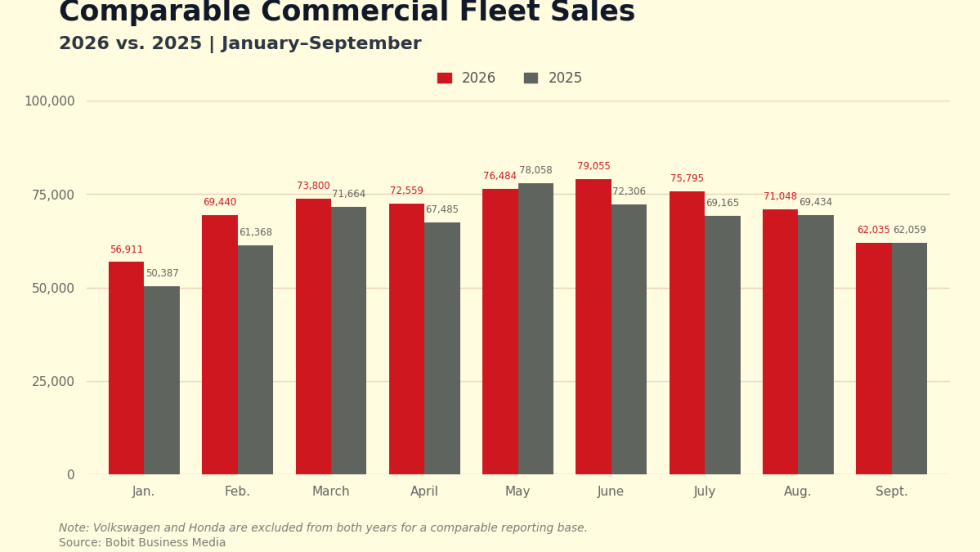
Commercial Fleet Sales Rise 5.8% Through September 2026
September commercial fleet sales were essentially unchanged from a year earlier, slowing year-to-date growth while keeping volume ahead of 2025.
Read More →
Hall of Fame Inductee: John Dmochowsky
The longtime Mondelēz International fleet executive joins the Automotive Fleet Hall of Fame.
Read More →
Hall of Fame Inductee: Lee Miller
After more than four decades at Boehringer Ingelheim, Lee Miller leaves a legacy built on fleet expertise.
Read More →
Hall of Fame Inductee: Mark F. Petersen
From managing fleets of thousands of vehicles to advancing safety and mentoring fellow professionals, Mark F. Petersen made his mark across both the corporate and supplier sides of fleet.
Read More →
When Charger Downtime Becomes a Fleet Availability Problem
As EV deployments move beyond pilot programs, charger reliability can directly affect vehicle readiness, driver productivity and route scheduling.
Read More →
2027 Nissan Rogue Hybrid Adds e-POWER, Standard AWD
The new Rogue Hybrid uses Nissan’s e-POWER system with dual electric motors, offers an estimated 40 mpg and starts at $35,490.
Read More →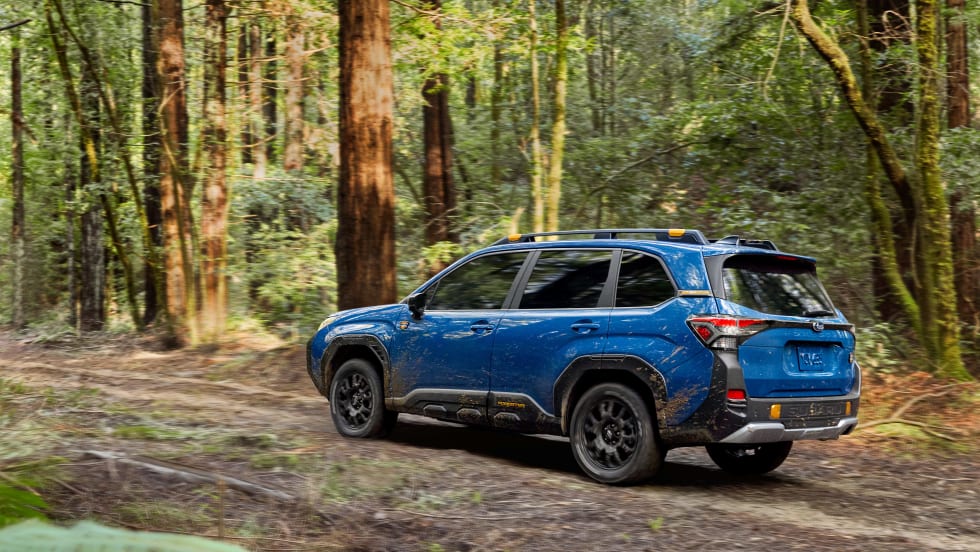
2027 Subaru Forester Adds First Wilderness Hybrid
The 2027 Forester lineup starts at $29,995 and adds a Wilderness Hybrid with 194 combined horsepower and 9.3 inches of ground clearance.
Read More →
EV Realty Names Henrik Holland President as Charging Platform Expands
The former Prologis Mobility and Shell executive will help expand EV Realty’s truck charging business and move its power-first infrastructure model into autonomous vehicle depots and other fleet sectors.
Read More →
Mercedes-Benz Introduces Electric GLC With Up to 350 Miles of Range
The GLC 400 4MATIC Electric features an 800-volt architecture, 330-kW DC fast charging and a 94-kWh battery, along with Mercedes-Benz's new MB.OS operating system.
Read More →
Fleet Has a Talent Pipeline Problem, not a Talent Problem
Where will the next generation of fleet leaders come from, and what does the industry need to do differently to find them?
Read More →