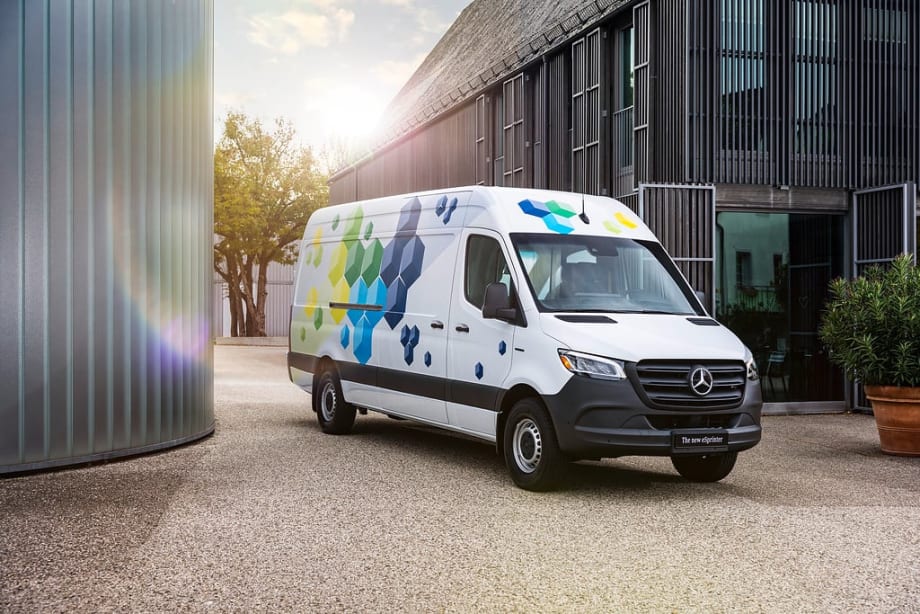
Making its debut in North America, the Mercedes-Benz eSprinter will have three battery choices, the largest delivering an estimated range of 248.5 miles highway and 311 city.
The all-electric version of the Sprinter van will be available in North America in the second half of 2023. From 2025, all new Mercedes-Benz Vans models will be fully electric.
Photo: Mercedes-Benz Group
3 min to read
The Mercedes eSprinter is finally coming to North America. The all-electric version of the Sprinter van will be available in North America and Europe in the second half of 2023, according to Mercedes-Benz.
Ad Loading...
The eSprinter will be available with three battery choices. The largest, a 113kWh battery will deliver an estimated range of 248.5 miles on highway and 311 miles in the city, based on Europe’s WLTP standard. (The U.S. EPA has yet to rate the vehicle.)
Ad Loading...
In addition to European production, the eSprinter will be produced at Mercedes’ Charleston, South Carolina plant. Pricing has not been released, though U.S. assembly should make the van eligible for the U.S. $7,500 EV tax credit.
The first version of eSprinter had been sold in Europe since 2020 as a delivery van, with Amazon as its largest buyer. That version came with a much smaller battery pack, a choice of either a 35- or 47-kWh.
The eSprinter will enter a van market that is just beginning to electrify in North America. The Ford E-Transit is available now; the Ram ProMaster EV will also debut in 2023. The larger Brightdrop Zevo 600, a walk-in (step) van, will begin deliveries to fleets (outside of FedEx) in the fourth quarter of 2023, along with the smaller Zevo 400. Other van models from independent OEMs Via Motors, Arrival, Cenntro, and Workhorse are available now or taking orders for future release.
What’s New
To streamline eSprinter production, Mercedes is introducing a modular concept: The front module includes all high-voltage components and can be combined unchanged with all vehicle variants, regardless of wheelbase and battery size. The second module is the integrated battery located in the underbody between the axles. The third, or rear module, is comprised of the electric motor that drives the rear axle.
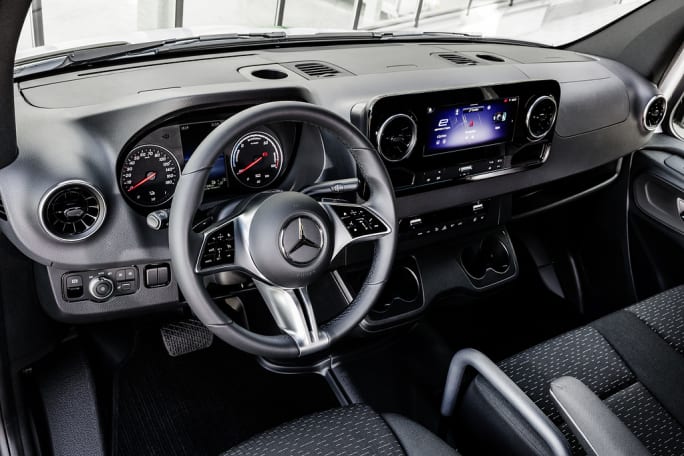
Mercedes-Benz is bringing digitization from the passenger car side to the eSprinter, including range updates in real time based on current conditions, calculations of best possible charging strategy, and "Hey Mercedes" voice control assistant. Payment at charging stations can be processed automatically.
From 2025, all new Mercedes-Benz Vans models will be all-electric.
The eSprinter will bring a user experience from the passenger car side in displays range updates in real time based on current conditions, calculations of best possible charging strategy, and "Hey Mercedes" voice control assistant.
Photo: Mercedes-Benz Group
Model Features
The eSprinter will be available in two body styles and two lengths. The North American version will first be a cargo van with a long wheelbase and high roof and a GVW of 8,500 lbs. Cargo volume is 494 cu. ft.
The eSprinter will come with three battery size choices, with a usable capacity of either 56, 81, or 113 kWh. (The Ford E-Transit has usable battery capacity of 68 kWh.)
The motor is available in two power levels, delivering 100 or 150 kilowatts of peak output and 295 ft.-lbs. of torque.
The electrically driven rear axle, a first in a Mercedes-Benz van, makes cab chassis variants possible in addition to cargo versions.
The new eSprinter can be charged with up to 115 kW at fast-charging stations, charging from 10% to 80% in about 28 minutes for the 56-kWh battery and 42 minutes for the 113-kWh battery.
Qualified commercial fleets can receive $7,500 per eligible propane autogas vehicle and up to $10,000 for new refueling site prep. Learn how the program works and see whether your fleet qualifies.
From millions in operating savings to hundreds of millions of EV miles, Merchants Fleet’s latest report reveals what’s working and what’s changing in fleet electrification.
A recent media and client event, studded with electric vehicles dressed up on platforms, planted a new position for the manufacturer in the wider EV market. Fleets will find cost-saving advantages.
Inspiration Mobility Group has acquired select assets of Electrada, adding the fleet electrification provider's team, technology, and charging infrastructure development capabilities to its energy management business.