




Wholesale Used Vehicle Prices Dip Further This Month
All eight major market segments saw seasonally adjusted prices that were lower year over year in the first half of October.

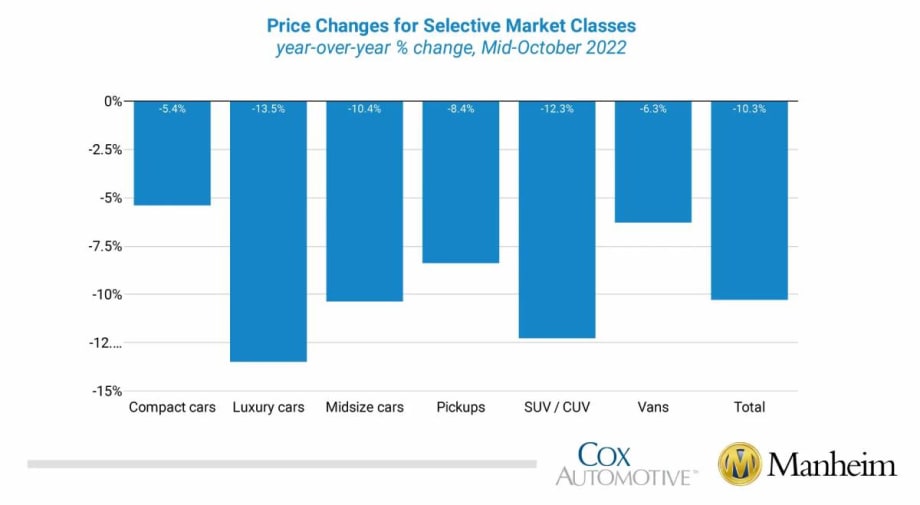
Compact cars had the lowest decline at -5.4%, while vans and pickups lost less than the overall industry in seasonally adjusted year-over-year changes.
Graphic: Cox Automotive / Manheim
Wholesale used-vehicle prices (on a mix-, mileage-, and seasonally adjusted basis) declined 2% from September in the first 15 days of October, according to the Manheim Used Vehicle Value Index, which fell to 200.5 and was down 10.3% from October 2021.
The non-adjusted price change in the first half of October was a decline of 1.8% compared to September, moving the unadjusted average price down 9% year over year.
During the last two weeks, Manheim Market Report (MMR) prices saw lower-than-normal and slowing declines resulting in a 1.1% cumulative decline in the Three-Year-Old MMR Index, which represents the largest model-year cohort at auction. Over the first 15 days of October, MMR Retention, which is the average difference in price relative to current MMR, averaged 98.2%, which indicates that valuation models are ahead of market prices. The average daily sales conversion rate of 60% in the first half of October increased relative to September’s daily average of 48.8%, and conversion rates typically decline in October. The latest trends in key indicators suggest wholesale used-vehicle values should decline less than normal in the second half of October.
All eight major market segments saw seasonally adjusted prices that were lower year over year in the first half of October. Compact cars had the lowest decline at -5.4%, while vans and pickups lost less than the overall industry in seasonally adjusted year-over-year changes. Six major segments saw price decreases compared to September, with full-size cars and vans showing gains of 10.2% and 0.2%, respectively. All major segments also saw unadjusted price declines in the first 15 days of October.
Retail and Wholesale Days’ Supply Tighter Than Normal in Mid-October
Using estimates based on vAuto data as of Oct. 10, used retail days’ supply was 49 days, which was down one day from the end of September. Days’ supply was up nine days year over year but down one day against the same week in 2019. Leveraging Manheim sales and inventory data, we estimate that wholesale supply ended September at 28 days, unchanged from the end of August but up nine days year over year. As of Oct. 15, wholesale supply was at 28 days, unchanged from the end of September but up 10 days year over year and four days lower than at the same time in 2019. Used supply measured in days’ supply and compared to 2019 suggests supply is tighter than normal for this time of year, which indicates that depreciation should be lower than normal for the time of year as well.
Rental Risk Prices Decreasing Along with Overall Wholesale Market
The average price for rental risk units sold at auction in the first 15 days of October was down 4.5% year over year. Rental risk prices were down 3.4% compared to the full month of September. Average mileage for rental risk units in the first half of October (at 57,000 miles) was down 6% compared to a year ago but up 5.3% month over month.
Consumer Sentiment Appears Stronger to Start October
The initial October reading on Consumer Sentiment from the University of Michigan increased by 2% to 59.8 from improving views of current conditions. Future expectations declined. Expected inflation rates increased in the October survey, which is a concern for the Fed and their campaign to reduce inflation. Consumers’ views of buying conditions for vehicles improved and were tied with March for the second-best reading this year. June was the all-time low in the reading. The daily index of consumer sentiment from Morning Consult reflects that sentiment may not be so strong. The timelier measure indicated consumer sentiment was down 1.4% in the first 15 days of October. This lower measure coincided with increasing average gas prices in early October and a turbulent stock market delivering new lows for the year on major indices.
Originally posted on Vehicle Remarketing
More Remarketing

Ford Pro Launches Certified Pre-Owned Program for Commercial Vehicles
Ford Pro Advantage will offer certified pre-owned Class 1-7 commercial vehicles through more than 700 Ford Pro Commercial Vehicle Centers.
Read More →
Copart to Acquire ACV in $1.9 Billion Deal
The acquisition would expand Copart beyond its traditional salvage business into dealer-to-dealer wholesale remarketing while adding ACV’s vehicle data, inspection, and valuation technology.
Read More →
Manheim Index Shows Used-Vehicle Wholesale Prices Up 2.1% in June
The market is seeing stronger appreciation in older used vehicles this year, and the most affordable segments have been among the year’s best performers.
Read More →
Commercial Fleet Sales Contribute To June, YTD Gains
The fleet sector has boosted its vehicle purchases at a reliable pace in the first half of this year compared with 1H 2025.
Read More →
Used Vehicle Prices Climb Higher As Sales Pace Slows
The higher prices at used retail reflect strong wholesale values earlier in the spring, particularly for older, more affordable vehicles.
Read More →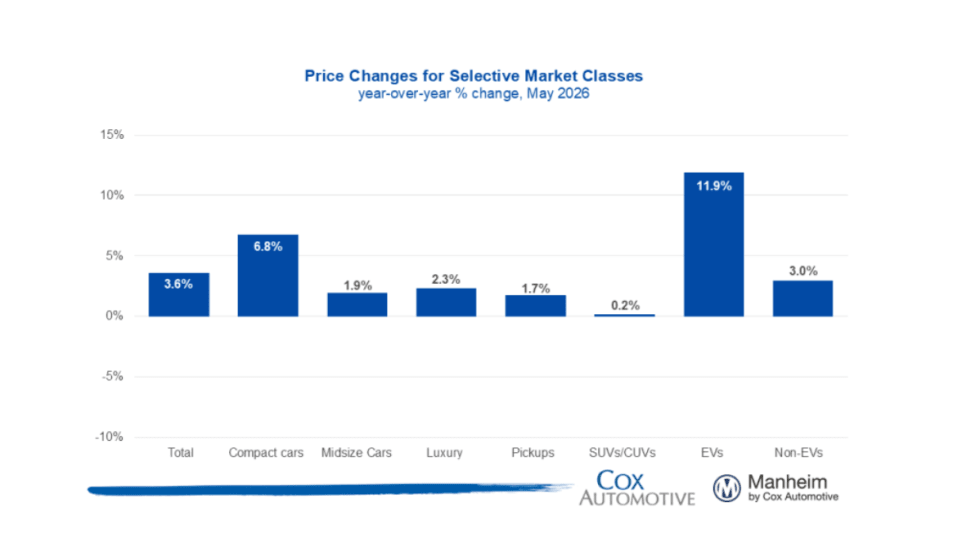
Wholesale Used Vehicle Market Sustains Moderate Rise In Values, Prices
Trends continue to normalize after a strong start to the year, as consumers contend with higher gas prices in the coming summer months.
Read More →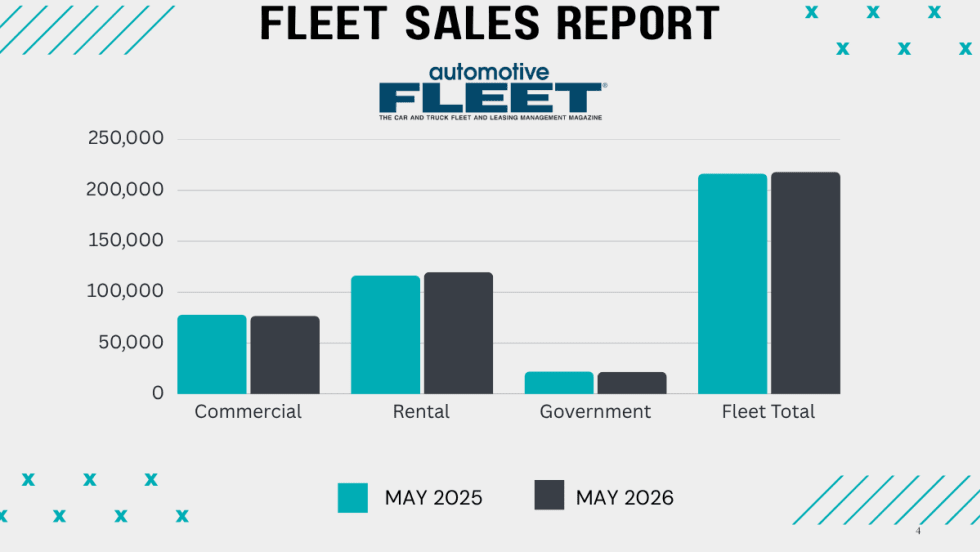
Commercial Fleet Sales Still Lead Sectors Despite May Mini Dip
The U.S. economy's continued growth and positive business investment are creating a favorable environment for fleet vehicle demand.
Read More →
How Connected Vehicle Data Is Lifting Fleet Resale Values
A vehicle health score could improve the value of fleet vehicles at remarketing. The path to a universal standard is forming, and fleets that understand the process early will be better positioned when it arrives.
Read More →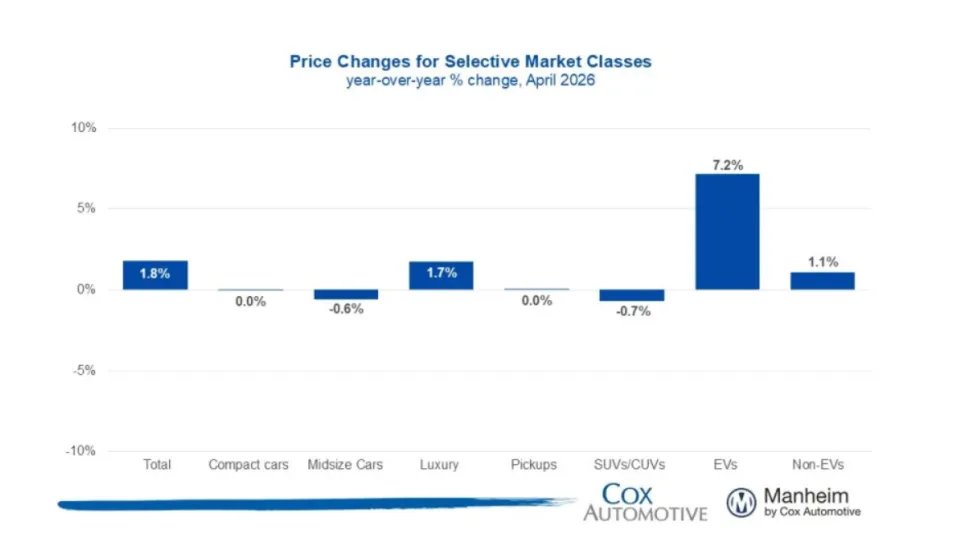
Wholesale Used Vehicle Prices Slightly Up In April
The Iranian conflict and rising gas prices inject much uncertainty into the future wholesale used vehicle markets, as higher gas prices soak up spendable income from vehicle buyers.
Read More →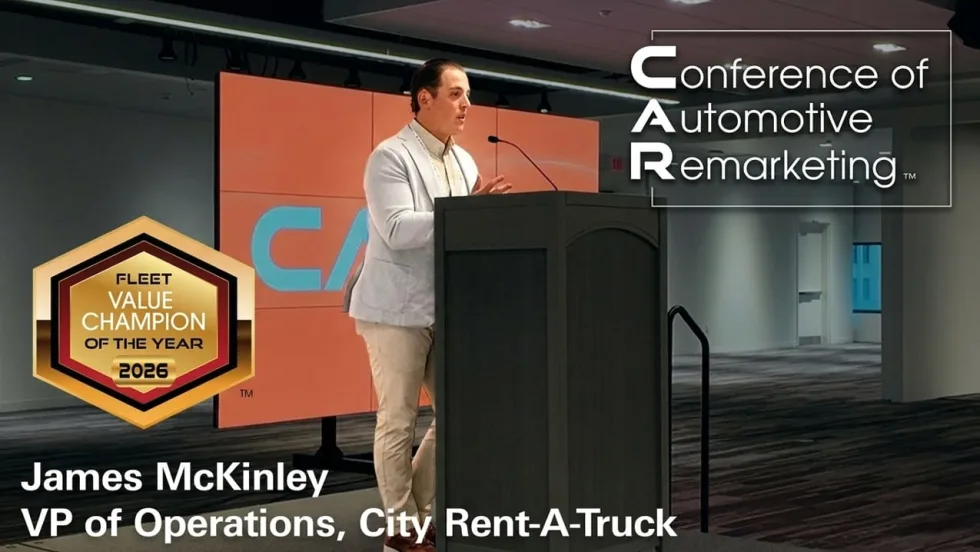
CAR2026: James McKinley Wins Value Champion of the Year
James McKinley of City Rent a Truck was named the inaugural Fleet Value Champion at the CAR Conference for his data-driven approach to fleet lifecycle management and vehicle remarketing.
Read More →