




Check This Out: Why There’s No Better Time for Fleet Electrification
Is Revel Poised to Push Electric Mobility to the Masses?
Users can rent an electric moped or e-bike and hail a Tesla all from a single app. They all get charged at a Revel charging hub, which can be monetized by opening the charge points to the public.
by Hari Sripathi
March 22, 20224 min to read
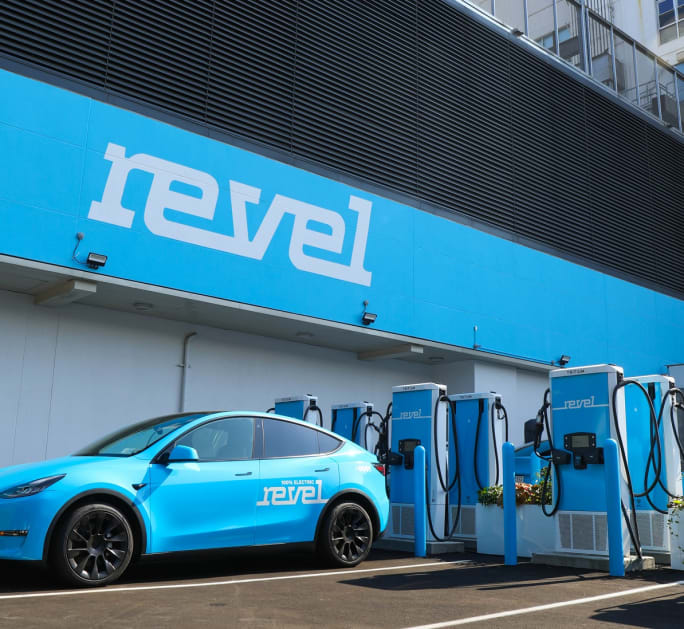
Photo: Revel
Vehicle electrification has felt a largely supply-driven innovation. There was no overarching customer desire it addressed beyond climate change. Rather, early adopters got on board as a response to celebrity endorsements from Elon Musk and the subsequent launch of Tesla. The rest continued to suffer from range and charge anxiety.
Electrification has since struggled with a chicken-and egg-problem. Customers would not take to it it en masse in the absence of adequate charger density. And fuel companies did not want to build a network unless customers were already there.
Brooklyn-based Revel has an interesting take on the problem that is truly commendable for an early-stage transportation startup.
What Revel Is
At its core, Revel is a network of charging stations situated in high-traffic urban areas. Its true value is its multimodal mobility ecosystem around it, each leveraging the other and drawing more customers into their charging infrastructure.
Users of Revel can rent electric mopeds and e-bikes or hail Teslas, which are owned by the company, through a single app. Revel is operational in three of New York City’s boroughs: Manhattan, Brooklyn, and Queens, as well as Miami, Washington, D.C., and the San Francisco Bay area.
The e-bike is a flexible rental service with maintenance included. It is delivered and picked up from customer doorsteps, making it highly convenient, easing adoption.
A high density of mopeds is maintained in high traffic areas. The mopeds are small enough to fit in between parked cars, thus minimally impacting traffic congestion. Customers can rent one way within the geofenced region, leaving the moped in any legal parking spot near their destination. They are charged for use by the minute, ensuring it is more affordable than comparable taxi rides.
With scale, mopeds circulate freely within a region. There are no subscription fees. Ease of adoption is enhanced with a digitally enabled license registration and identity verification process. With a few uploads of my driver's license and a selfie, I was set to ride.
The Tesla-only ride hail provides a luxury option to eco-conscious travelers. The cars are clean, new, company-owned, and strategically priced cheaper than an Uber to increase adoption. The drivers are full-time employees with benefits addressing a core criticism of the supposed exploitation of gig workers.
How It Works
Each of their offerings serves a unique occasion collectively broadening the appeal of electrification. Revel’s e-bike subscription serves for a morning spin around the block, particularly targeted at leisure riders or delivery workers. Its Tesla-only ride hail suits a busy professional’s 20-mile ride to the airport or a trip downtown on a Saturday evening. In between, the electric moped comes in handy when dropping off that package in the post office a couple of miles away or for the gig worker zipping through the city with frequent stops.
Throughout, the customer never interacts with the actual charging infrastructure but instead is getting habituated to the cleaner, more flexible, and possibly cheaper riding experience delivered by the electric vehicle.
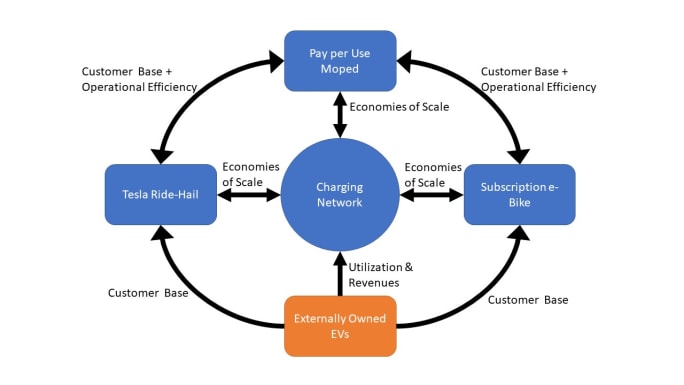
Source: Hari Sripathi
The bike and moped journeys capture most commonly trafficked routes, insights on parking regulations and driver behaviors including unsafe driving. The onboarding process captures customer identities and driver licenses. Meanwhile the connected Tesla feeds insights on high frequency pickup and drop-off spots which help ascertain high traffic areas to park the next moped. All the while, the very sight of the distinctive bright blue vehicles zipping through the street is free marketing, expanding the customer base.
Promise and Challenges
The manufacturer-agnostic charging network is largely hidden from the customer. However, it can easily be monetized by opening it up as service stations to the public (Revel does have one publicly accessible universal fast-charging Superhub in Bed-Stuy, Brooklyn). Revel’s true genius lies in unobtrusively creating customer adoption through its convenient transport options while achieving economies of scale — while building the operating infrastructure that underpins the electric vehicle industry.
To be clear, Revel has shortcomings as all startups do. Maintenance and cleaning particularly for its moped fleet is likely underestimated. Excellent customer service will be critical to build given the promise of best convenience. Given the reliance on full time employees, the margins are likely a lot worse than Uber. These problems will not go away with scale. But Revel is fairly young, with its electric mopeds in NYC launching in 2018. The all-electric rideshare service launched in August 2021. Given what they have already achieved, I have high confidence in their leadership to figure it out.
By creating a vertically integrated EV system, Revel has a unique ability to drive the customer experience, and hence adoption of electrification. By the by, they have come up with the first truly “Internet of Things” flywheel. This is likely the biggest innovation in business models since the ecommerce wheel popularized by Amazon. That, to me, is their biggest accomplishment.
About the Author: Hari Sripathi is a business operations and product strategy consultant. He served as senior director corporate strategy at Avis Budget Group, where he was responsible for driving innovation for the rental car provider in the face of market and fleet disruption. He lives in New York. Views expressed are his own and not of any company. He can be reached at harisripathi@outlook.com for comments or suggestions.
This article was authored and edited according to Fleet Forward editorial standards and style. Opinions expressed may not necessarily reflect that of FF.
Subscribe to Our Newsletter
More Fleet Forward


Erin Gilchrist Receives Mike Antich Spirit of Fleet Award
Last week at AFLA in Vegas, Erin Gilchrist received the inaugural, brand-new Spirit of Fleet Award.
Read More →
Dominika Leja Named the 2026 Fleet Manager of the Year
The AstraZeneca associate director of fleet was recognized for her leadership in fleet electrification, cost savings, and operational transformation.
Read More →
Jamie McKay Named the 2026 Fleet Visionary Award Winner
The Aptive Pest Control fleet manager was recognized for her approach to operations, data, lifecycle management, and driver needs.
Read More →
Fleet Forward Conference Introduces One-Day Passes for 2026
New one-day registration gives fleet professionals the flexibility to attend Tuesday, Wednesday, or Thursday, with passes available for $199 through Sept. 18.
Read More →
Vibe Coding: When Fleet Managers Become Software Builders
Five fleet professionals — none with programming skills — discuss how they’re using AI to build fleet solutions in-house and in a fraction of the time.
Read More →
Fleet Forward Conference Tackles Fleet Industry’s Growing Leadership Gap
This session will examine succession planning, knowledge transfer, and the skills the next generation of fleet leaders will need as veteran professionals leave the industry.
Read More →
2026 Fleet Manager of the Year Finalists Announced
Who are the 2026 Fleet Manager of the Year finalists?
Read More →
John Rossant to Deliver Opening Keynote at 2026 Fleet Forward Conference
The CoMotion founder will draw on developments across Europe, China, the Middle East, and other international markets to identify trends that could influence how U.S. fleets plan for the coming decade.
Read More →
How to Build Custom Fleet Tools With AI and Vibe Coding [Webinar]
A new Automotive Fleet webinar explores how fleet managers are using AI and vibe coding to automate routine work and create simple operational tools without traditional programming skills.
Read More →