





Related: Active Steering is There to Assist Drivers, Not Take Over
Consumer Reports Tested Active Driving Assistance Systems. Who Won?
Hint: It wasn’t Tesla’s Autopilot.
November 3, 2020
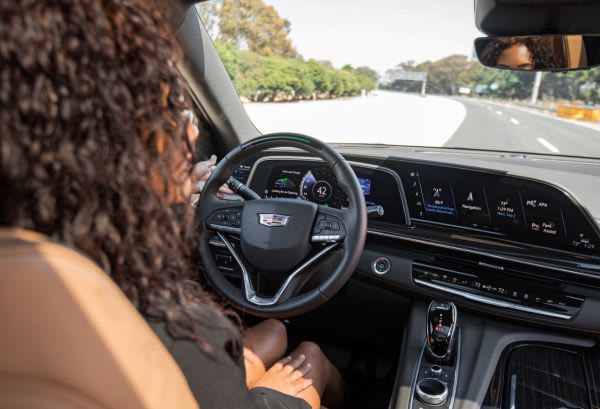
Cadillac’s Super Cruise uses direct driver monitoring to warn drivers that appear to have stopped paying attention to the road. The Super Cruise system uses a small camera that faces the driver’s eyes to determine whether the driver is watching the road.
Photo via Cadillac.
3 min to read
Cadillac’s Super Cruise remains the top-rated active driving assistance system, according to tests by Consumer Reports. Active driving assistance systems don’t help a car self-drive but help support the driver with features like lane keeping.
In 2018, Consumer Reports conducted the first ranking of driving assistance systems from Cadillac, Nissan, Tesla, and Volvo.
For this year’s testing, Consumer Reports looked at 17 systems, including the original four. Each of the 17 driving assistance systems was rated by its performance in 36 tests, such as steering the car, controlling the speed, and keeping the driver safe. CR’s testers looked at how each of the 17 systems performed in five categories: capability and performance, keeping the driver engaged, ease of use, clear when safe to use, and unresponsive driver.
Cadillac’s Super Cruise keeps the top spot because it uses direct driver monitoring to warn drivers that appear to have stopped paying attention to the road, according to Consumer Reports.
The Super Cruise system uses a small camera that faces the driver’s eyes to determine whether the driver is watching the road. If the system determines that the driver isn’t paying attention, it sends several warnings, including bright red lights on the upper rim of the steering wheel. If the driver doesn’t react to these warnings, the system will start to slow the car down on its own and eventually bring it to a stop. According to General Motors, the Super Cruise system will be available on 22 GM vehicles by 2023.
For lane keeping assist, Consumer Reports rated Tesla the best (7 out of 10). Systems from Audi, Cadillac, and Lincoln performed almost as well. A good system is classified as helping the driver keep the vehicle well within the lane boundaries. Buick and Mazda didn’t perform well. Those systems don’t consistently keep the vehicle between the lane lines; they assist the driver only when a lane departure occurs.
For ease of use, CR’s testers looked at how easy it was for drivers to interact with the systems and make adjustments to settings. Tesla performed the best with a 7 out of 10 with Porsche, Land Rover, and Volkswagen not far behind with 6 out of 10.
“The best systems allow drivers to activate the steering and speed control independently so that drivers can decide exactly how much assistance they want to use, and only have a single lane keeping system that performs consistently,” said Kelly Funkhouser, CR’s head of connected and automated vehicle testing.
Consumer Reports also evaluated the systems in how they communicated in real time about when drivers should (and shouldn’t) be using the technology. Most systems restrict their use in less-than-ideal situations, according to Consumer Reports. Cadillac’s Super Cruise topped this category (8 out of 10) because it will warn drivers in advance when there is an upcoming lane merge or situation that might require more attention.
For the unresponsive driver category, Consumer Reports evaluated systems for their escalation process for warnings, steering control, and speed control. Most of the systems will send an alert if the car judges the driver to be inattentive for a period of time and then bring the vehicle to a stop with the hazard lights on. Cadillac topped this category with a 9 out of 10 and Nissan’s system took second place with a 7 out of 10.
“We’d like to see developers of these systems consider the additional step of steering the vehicle onto the shoulder of the road when a driver becomes unresponsive, and providing this feature even if the driver wasn’t using the system,” said Funkhouser.
More Fleet Forward
Matt Dyer to Deliver Closing Keynote at Fleet Forward Conference
The Merchants Fleet CEO will discuss the changing expectations and strategic role of today’s fleet leaders.
Read More →
IIHS Brings Commercial Vehicle Safety Analysis to 2026 Fleet Forward Conference Stage
IIHS President David Harkey will share early findings from new testing of delivery vans, pickups, and work trucks — and what the data means for fleet safety decisions.
Read More →
Fleet Manager or Data Strategist? You’re Both
The job hasn’t changed, but the expectations have. Do you have a plan on how to use AI to thrive?
Read More →
Nominations Are Open for the 2026 Awards!
The Hall of Fame, Visionary, and Fleet Manager of the Year award nominations are officially live. Don't miss your chance to recognize someone deserving.
Read More →
Fleet Manager of the Year Winners Over the Years
The Edward J. Bobit Fleet Manager of the Year award honors commercial fleet managers whose leadership, innovation, and business acumen have advanced the profession.
Read More →
Vehicle Management Systems Introduces Virtual Fleet Manager
VMS recently launched an AI-first fleet platform that streamlines system design, organizes data, and supports decision-making.
Read More →
LightMetrics Launches Cloud AI Layer to Reduce False Driver Safety Alerts
New FP platform filters dashcam alerts before they reach fleet managers, aiming to cut false positives, improve trust, and streamline safety coaching.
Read More →
Call for Nominations: 2026 Fleet Manager of the Year Award
Nominations are now open for one of the fleet industry’s most prestigious honors—the Edward J. Bobit Professional Fleet Manager of the Year Award. Recognizing leaders who drive innovation, safety, and measurable impact, this award celebrates the very best in fleet management.
Read More →
Is AI About to Change How Fleets Manage Vehicles? | AF News Recap
In this recap, host Faith Howell covers the top news released at Work Truck Week 2026.
Read More →
Women in Fleet Reflect on Leadership and Industry Change
Kathryn Schifferle and Lori Olson discuss how technology, mentorship, and collaboration are shaping today’s fleet landscape.
Read More →