




Pandemic's Disruption Keeps 2020 Fleet Operating Costs Flat
The COVID-19 pandemic divided the fleet market into essential and non-essential businesses, causing hundreds of thousands of company vehicles to sit idle from mid-March to mid-May. The economic shutdown caused miles-driven to plummet.


Calendar-year 2020 has the dubious distinction of being the most calamitous year in the history of fleet management. Although disruptive, the pandemic did have a positive impact that kept CY-2020 fleet operating costs flat compared to 2019.
The lockdowns, shelter-at-home mandates, and widespread adoption of remote working created a dramatic decline in business activity and, in turn, business mileage, which caused fuel consumption to decline, tires to last longer, and maintenance costs to remain flat.
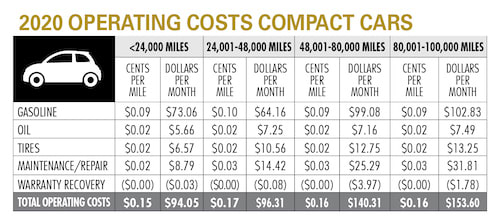
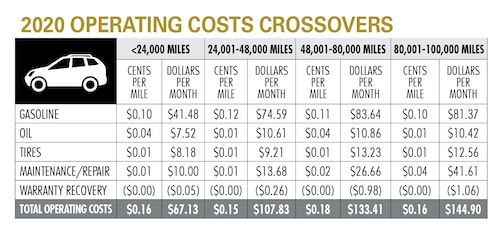
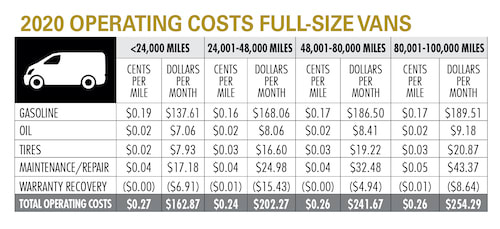
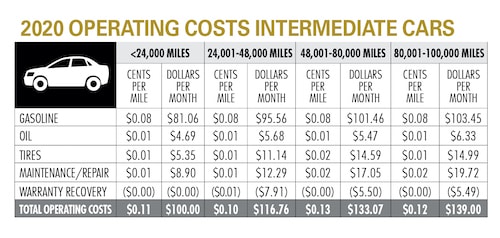
These, along with other findings, were revealed in Automotive Fleet’s 28th annual operating cost survey, and are based on data provided by eight survey partners:
ARI
Donlen
Element Fleet Management.
Emkay
Enterprise Fleet Management
LeasePlan USA
Merchants Fleet
Wheels Inc.
This year’s survey is based on the analysis of actual operating costs incurred by 961,702 vehicles operated by commercial fleets, which are managed by these eight fleet management companies.
Data: Automotive Fleet
The below analysis of fuel pricing trends is the first of a five-part assessment of fleet operating costs, which will feature four additional in-depth articles each focused on a specific fleet operating cost segment:
Fleet maintenance
Replacement tires
PM trends
Warranty recovery
Low Demand Flattens Fuel Prices
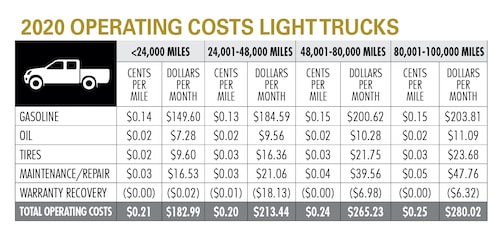
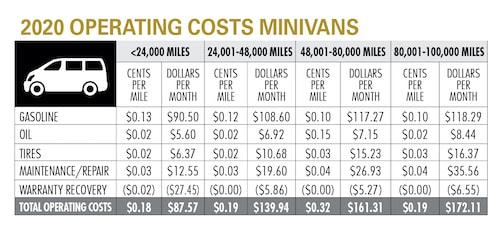
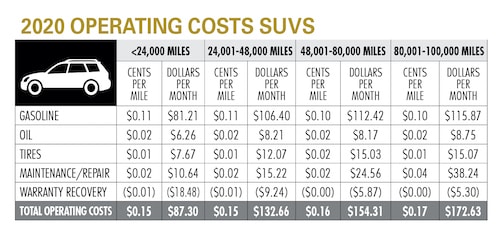
The largest fleet operating expense is fuel, which traditionally represents approximately 60% of all operating costs. However, the decreased miles driven by fleets during the pandemic was the No. 1 factor contributing to keeping fuel costs flat in 2020.

[EMPTY CREDIT]
“The 2020 calendar-year began with oil prices remaining steady with late 2019 levels; however, when COVID-19 hit, prices dramatically decreased. To protect the safety of the public, many states went into lockdown, which had a direct impact on many fleets and the overall economy,” said Lindsay Wood, product manager for Wheels. “When states began to open back up, we saw a steady increase in demand, which helped drive prices back up to near pre-pandemic levels but they have not fully recovered. The Energy Information Administration (EIA) expects that gasoline prices will decrease through the rest of the year.”
Data: Automotive Fleet
One key factor driving down fuel prices at the pump was the overall decline in fuel consumption in both the retail and fleet markets.
“Overall, the cost per gallon is down nearly 15% year-over-year and fuel consumption is down nearly 18%. We see a larger impact to our customers that are in the retail sales sectors versus the manufacturing industry being more directly impacted,” said Justin Dudeck, product director, analytics, consulting and transformation for LeasePlan USA.

[EMPTY CREDIT]
Despite the initial lower price of fuel at the pump, overall fleet fuel economy (mpg) decreased based on data captured by onboard vehicle telematic devices.
“Interestingly, and counter-productive to a cost mitigation strategy, we have found that the pandemic has resulted in overall lower fuel economy. There are two reasons for this,” said John Wuich, vice president of strategic consulting services for Donlen. “First, the mix of vehicles on the road since March shifted toward more service-type vehicles. These vans and trucks tend to have lower fuel economy than passenger fleet vehicles, more of which were grounded. Also, engine idle percent has actually risen within many fleets, as more workers are using the vehicle as an office and means of social distancing. With some new vehicles equipped with a hot spot, we are finding that the vehicle engine must be on in order for the vehicle’s network to be used, working to further increase idle percent.”
Data: Automotive Fleet
In many ways the declining price of fuel coincided with the economic shutdown to “bend the curve” of the spread of COVID-19 and subsequent rising prices coincided with the increased business activity as the lockdowns were lifted.

[EMPTY CREDIT]
“Fuel prices were a parallel indicator for the economy during this pandemic year. That is, prices fell quickly as COVID spread and businesses shut down. And price volatility closely followed a volatile economic recovery,” said Wuich of Donlen.
Making a similar observation was Enterprise Fleet Management. “Prior to COVID-19, fuel pricing was relatively flat as expected before dropping to historic lows. The balance of 2020 has allowed fuel prices to return to stable levels and experience modest growth,” said Mark Atchley, senior supply chain manager for Enterprise Fleet Management.
Data: Automotive Fleet
In reaction to the lockdowns and people’s concern about contagion, virtual meetings arose as an alternative to in-person meetings, eliminating the need to drive to these meetings, contributing to the decline in overall fuel consumption.

[EMPTY CREDIT]
The overwhelming majority of companies were pleasantly surprised that corporate productivity did not suffer when the majority of their employees started working from home. In addition, most employees embraced the idea of working at home.
“Stay-at-home orders have had an impact on fuel consumption and thus fuel prices. As people conduct business from home with virtual meetings and events, their vehicles are moving considerably less,” said Steven Donckers, director, service center for LeasePlan USA.
Data: Automotive Fleet
Lower fuel consumption and decreased user demand were the catalysts triggering lower prices at the pump.

[EMPTY CREDIT]
“Demand was driven down by stay-at-home orders rolling out across the nation in February-March, especially concerning was fleets typically roll into peak season of demand around April. Fleets have benefited from the lower at-the-pump costs in 2020, but with lower utilization, profit loss within fleets have no doubt had a larger impact where fleets were not able to operate at full or anticipated capacity,” said Emily Candib, director – fleet products for Merchants Fleet. “Also, more frequently this year, some fleets are also reviewing options for fuel hedging than in prior years and additionally more are seriously reviewing opportunities to house fuel in bulk on-site to dispense for vehicles that operate out of a single yard location.”
While fuel consumption declined for many fleets, it increased for other fleets, in particular those designated as essential businesses.

[EMPTY CREDIT]
“The pandemic forced many businesses to suspend operations and as you can imagine, with most fleet vehicles parked for some period of time, fuel consumption certainly dropped,” said Andy Hall, manager, fuel & GMS products for ARI. “Conversely, for some organizations, particularly essential service and last-mile delivery fleets, miles driven jumped to near record highs and their fuel costs likely increased significantly. So, while the cost of fuel itself remained fairly consistent throughout the year, how the pandemic impacted an organization certainly influenced its overall fuel spend.”
While fuel prices have been relatively stable for the past several years after earlier years of ongoing price volatility, some saw a reemergence of volatility as fuel prices reacted to the pandemic.
Data: Automotive Fleet
“A big difference in 2020 as compared to 2019 is simply the volatile nature of fuel costs, largely impacted by the global oil pact negotiations early in the year and followed immediately by the pandemic. This volatility, coupled by equally volatile shifts in fleet mileage and vehicle use put fleet planning in some industries on hold and made forecasting fuel spend especially challenging,” said Wuich of Donlen.
Forecast of Fuel Prices in 2021
The price of fuel is impacted by many variables making predictions difficult. However, there are certain variables that are in play today, which allows us to extrapolate and extend those trend lines into the next calendar-year and interpret possible outcomes.

[EMPTY CREDIT]
“With demand still significantly lower than historical averages and continued supply to carry through to 2021, prices will continue to remain relatively flat throughout the rest of 2020 and into 2021,” said Candib of Merchants Fleet. “Traditional demand expected to pick up in May-June and raise prices along with pressure on refineries to keep pace.”
The price of fuel is very much influenced by supply-and-demand dynamics, which are forecast to improve in CY-2021.
However, entire segments of the macro-economy continue to be hobbled, in particular the aviation and vehicle rental industries, this reduced consumption will put downward pressure on crude oil prices.
Data: Automotive Fleet
“We expect oil markets to remain volatile due to slow economic recovery. We are still seeing constraints in travel from consumers and many businesses are keeping employees remote. This has led to a decreased demand in fuel and will continue if the pandemic worsens this winter,” said Wood of Wheels.
[EMPTY CREDIT]
Another reason why it is difficult to forecast fuel prices is because pricing dynamics are often dictated at a much larger geopolitical level.
“Geopolitical tensions are currently low; however, that could change quickly and negatively impact fuel supply and demand,” said Atchley of Enterprise Fleet Management. “The Organization of the Petroleum Exporting Countries (OPEC) will likely continue attempts to sharply increase fuel prices through production cuts. However, we expect fuel prices to continue experiencing modest growth in 2021 and remain below 2018 and 2019 levels.”
More Operations

A buyer's guide to fleet management software in 2027
Buying fleet management software in 2027 means looking beyond features and price. As fleet operations, technology and expectations evolve, this guide explores what today’s fleet professionals should consider when choosing a system that can deliver value now and adapt to what comes next.
Read More →
What Will Shape the Next Era of Fleet Management?
EVs, AI, and autonomous vehicles are reshaping fleet management. Discover what’s ahead—and how fleet leaders can prepare for the next era.
Read More →
How Fleets Can Recruit and Train Veterans for Technician Roles
Here's how the technician shortage has affected uptime for fleets, and what to do about it.
Read More →

Avis Budget Group Deploys Neology Toll Management Technology Across Major Brands
Neology’s neoFleet platform will manage toll transactions and toll-authority operations for vehicles across Avis, Budget, Payless, Budget Truck and Zipcar.
Read More →
Fleet Personal-Use Charges Edge Higher in 2026
Nearly eight in 10 surveyed fleets allow personal use of company vehicles, while just over half of respondents report charging employees for the privilege.
Read More →
The Future of Fleet + What’s Changing Right Now | AF News Recap
Could developments overseas offer a preview of what’s coming for U.S. fleets? This week, we’re looking at the future of AI, autonomy, and electrification, plus Ford Pro’s new certified pre-owned program, smarter vehicle offboarding, and a new way for fleets to manage toll expenses.
Read More →
How to Handle Vehicle Offboarding
What do fleet managers need to do when a driver leaves?
Read More →
Fleet Manager’s Ultimate Playbook: Navigating the New Standard in OEM Connectivity
Rising operating costs, driver safety concerns, and unplanned downtime are putting unprecedented pressure on modern fleets. Discover how fleet managers use embedded OEM connectivity and real-time vehicle data to cut TCO, prevent downtime, and protect drivers without aftermarket telematics hardware.
Read More →
U.S. Bank Adds Verra Mobility Toll Management to Voyager Fleet Platform
The integration allows U.S. Bank Voyager fleet customers to manage toll payments and violations alongside fuel, EV charging and maintenance expenses.
Read More →
ADAS Prevents Crashes. But Repairs Cost More | AF News Recap
ADAS-equipped vehicles may crash less often, but they can cost more when they do. This week, we’re breaking down what that tradeoff means for fleets, plus Subaru’s first Forester Wilderness Hybrid, Nissan’s new e-POWER Rogue, and why Calstart has become Catalyst Mobility.
Read More →