





Related: The COVID-19 Pandemic Creates the Greatest Disruption in the History of Fleet
Survey: How COVID-19 has Impacted Fleet Operations
Highlights of the survey include analysis on the impact of acquisition volume, total cost of ownership (TCO), impact on fleet budget and expenses, and other key areas essential to fleet.
July 2, 2020
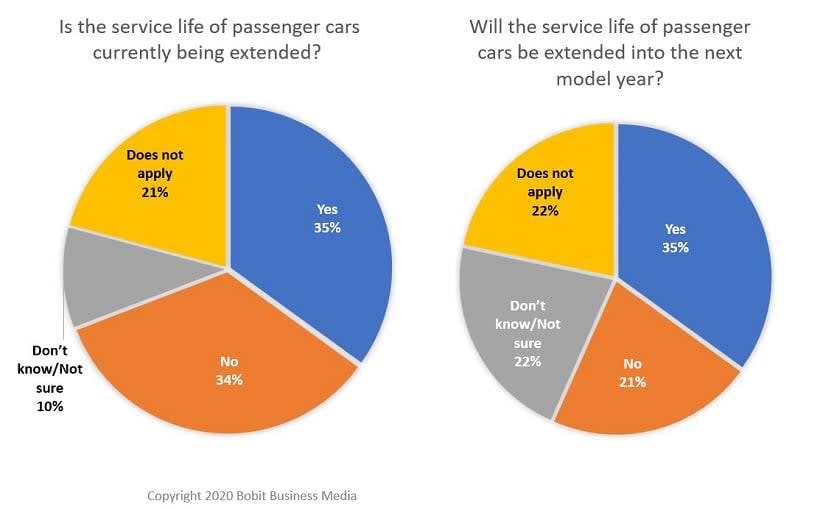
The survey found that 35% of fleets are extending the service life of passenger cars into the next model year.
Graphic: Bobit Business Media
3 min to read
Approximately one-third or more of fleets will extend the service life for their passenger cars and light-duty trucks, following the impact COVID-19 has had on their operations, according to Automotive Fleet’s latest Coronavirus Pulse Survey.
Other highlights of the survey include analysis on the impact of acquisition volume, total cost of ownership (TCO), impact on fleet budget and expenses, and other key areas essential to fleet.
The survey found that 35% of fleets are extending the service life of passenger cars into the next model year. A somewhat larger majority (41%) said that the service life of light-duty trucks is currently being extended, and that 37% will extend the service life of trucks into the next model year.
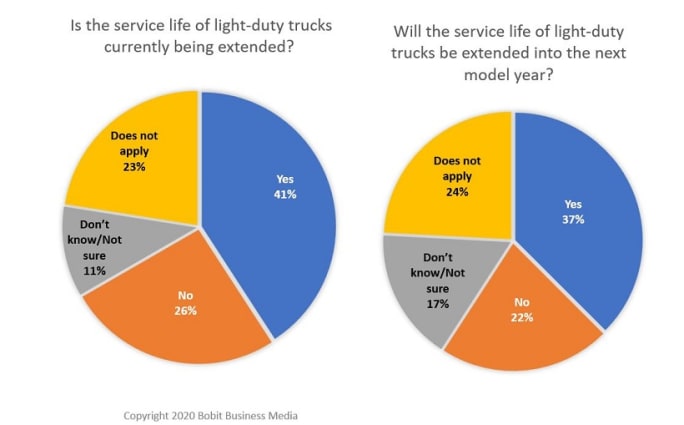
Approximately 41% said that the service life of light-duty trucks is currently being extended, and that 37% will extend the service life of trucks into the next model year.
Graphic: Bobit Business Media
Trends on vehicle acquisition volumes were also tracked in the survey, which found that a majority of respondents (40%) said that vehicle acquisition volumes would remain unchanged over the next three months. However, 27% in the survey reported they would be acquiring fewer vehicles. Another 15% said it was too early to tell, and much smaller percentage (7%) said they would be acquiring more vehicles.
On overall fleet budget predictions for the next three months, 42% of fleets said they were concerned budges would be reduced, and another 37% said they were unconcerned. Those who were concerned about budget reductions guesstimated that reductions seen could be anywhere from 6% - 10%
A majority of respondents (37%) also noted that TCO has remained the same amid the pandemic. However, 24% said that TCO was lower, and another 15% said it was too early to tell. Meanwhile, 17% reported TCO was higher.
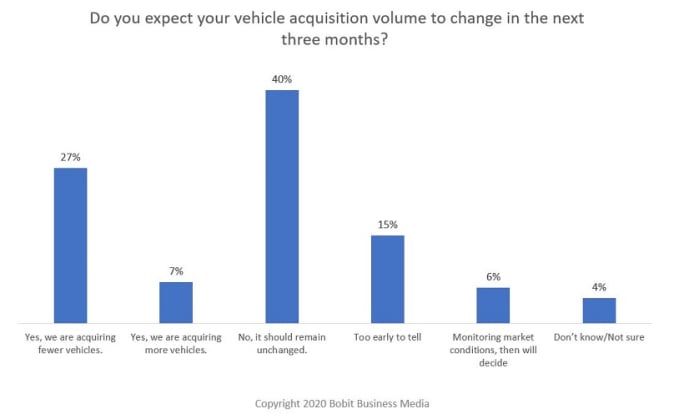
Trends on vehicle acquisition volumes were also tracked in the survey, which found that a majority of respondents said that vehicle acquisition volumes would remain unchanged over the next three months.
Graphic: Bobit Business Media
When asked if COVID-19 had stimulated interest in the adoption of new technology productivity solutions, more than half (68%) said no and another 21% said it was too early to tell.’
Meanwhile, a smaller percentage (13%) said yes, it did stimulate interest in adopting these technologies. Technologies that generated the most interest as a result of the pandemic were driver safety/monitoring technology and telematics/fleet tracking capabilities.
Impact on Fleet Policy
A large portion of respondents, over 80%, were taking actions to protect the health of employees during the pandemic. The survey found that fleets were providing masks (89%), providing hand sanitizer (88%), providing cleaning solutions (87%), enforcing social distancing practices (84%), and providing gloves (81%).
Other fleet policy changes that were observed individually in the survey included only allowing one person per vehicle; adding no-contact delivery and new disinfecting steps; daily vehicle cleanings; and more. Additionally, 64% said that they were limiting or completely eliminating business travel, and 58% said that meetings would be now be conducted over the internet or via phone.
Most fleets in the survey (66%) said that work-from-home capabilities were optional for some of their employees, though 31% said that this was not feasible. A much smaller percentage (2%) said that work-from-home solutions could apply for all employees, and another 1% were unsure.
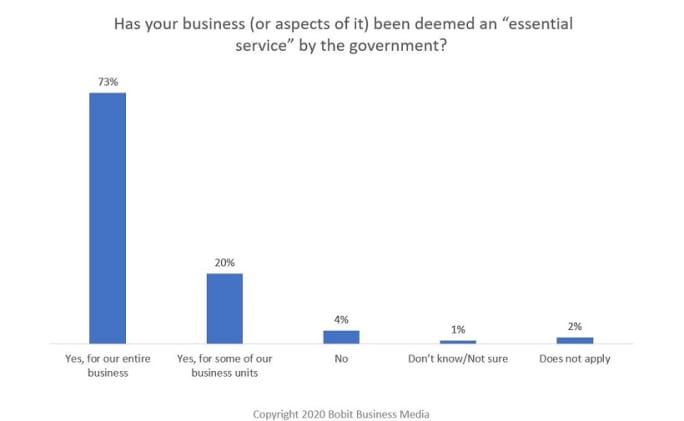
A large percentage of respondents in the survey were deemed an essential service by the government to some capacity.
Graphic: Bobit Business Media
Additional Operational Impact
A large percentage of respondents in the survey were deemed an essential service by the government to some capacity; 73% said that they were deemed essential for their entire business and 20% were deemed essential for some business units. Only 4% were not deemed essential.
Most fleets (64%) also said they had not experienced any lay offs or furloughs in their workforce as a result of the pandemic, while 32% said that they had.
A majority of fleets also reported a decrease in fuel spend, during the month of April 2020, with most noting a decrease of fuel expenses of more than 20%.
With regards to maintenance spend during the month of April, 39% said expenses had decreased, and another 37% said that maintenance expenses had not changed at all. Similarly, a portion of fleets observed replacement tire expenses had seen decreases in April (33%) and 38% said that these expenses had not changed at all.
More Operations

Personal-Use Charges Rise as Vehicle Values Fall | AF News Recap
Personal-use charges are climbing, wholesale used-vehicle values are declining, and commercial fleet sales growth is slowing. This week, we're breaking down the latest fleet data, plus how Element Fleet Management is helping Waymo prepare for its first Canadian robotaxi market.
Read More →
Here's When You Should Make an Exception to Fleet Policy
Fleet policies are designed to create consistency, but not every driver or situation fits neatly within standard rules.
Read More →
AI-Native or AI-Acquired: What Should Fleet Managers Look for in an AI Platform?
Six questions can help fleet managers look beyond AI marketing claims to evaluate integration, data access, and real-world operational performance.
Read More →

Sponsored•October 14, 2026
A buyer's guide to fleet management software in 2027
Buying fleet management software in 2027 means looking beyond features and price. As fleet operations, technology and expectations evolve, this guide explores what today’s fleet professionals should consider when choosing a system that can deliver value now and adapt to what comes next.
Read More →
What Will Shape the Next Era of Fleet Management?
EVs, AI, and autonomous vehicles are reshaping fleet management. Discover what’s ahead—and how fleet leaders can prepare for the next era.
Read More →
How Fleets Can Recruit and Train Veterans for Technician Roles
Here's how the technician shortage has affected uptime for fleets, and what to do about it.
Read More →
Avis Budget Group Deploys Neology Toll Management Technology Across Major Brands
Neology’s neoFleet platform will manage toll transactions and toll-authority operations for vehicles across Avis, Budget, Payless, Budget Truck and Zipcar.
Read More →
Fleet Personal-Use Charges Edge Higher in 2026
Nearly eight in 10 surveyed fleets allow personal use of company vehicles, while just over half of respondents report charging employees for the privilege.
Read More →
The Future of Fleet + What’s Changing Right Now | AF News Recap
Could developments overseas offer a preview of what’s coming for U.S. fleets? This week, we’re looking at the future of AI, autonomy, and electrification, plus Ford Pro’s new certified pre-owned program, smarter vehicle offboarding, and a new way for fleets to manage toll expenses.
Read More →
How to Handle Vehicle Offboarding
What do fleet managers need to do when a driver leaves?
Read More →