




Effective Metrics for Rewarding Positive Driving
The use of incentives may be a productive part of a well-rounded and well-executed fleet driver safety program, but it should never be used as a shortcut to deliver results when underlying practices may be incomplete.

Photo courtesy of iStockphoto.com.

Photo courtesy of iStockphoto.com.
The growing frequency and severity of fleet crashes, difficulty in finding qualified drivers, and constant enforcement of safe driving policies can be frustrating for driver safety teams to deal with.
This is where enhanced candidate screening, performance coaching, solid driver communication plans, goal alignment initiatives and use of feedback mechanisms can help.
However, in addition to these practices, many fleets have been pursuing bonus/reward programs as an incentive to motivate drivers to self-enforce proper driving techniques.
The use of incentives may be a productive part of a well-rounded and well-executed driver safety program, but it should never be used as a shortcut to deliver results when underlying practices aren’t effectively utilized. For example:
If critical policies are poorly constructed or inadequately communicated to all drivers, this can create frustration when trying to reward compliance.
Managers who are desperate for a way to get results quickly (often to reverse worsening results) will pay bonuses for the employees to self-regulate their own behavior in lieu of proper performance monitoring and coaching.
Without all of the relevant safety fundamentals in place as a foundation, incentives can only motivate a temporary movement in the right direction — the results won’t be long-lasting.
Typically, an incentive rewards the performance of a positive behavior. However, many fleet safety teams fall into a trap of devising a long list of negative behaviors or outcomes that, when discovered, lead to the removal of the bonus (i.e., “sanctions” in lieu of “incentives”). It’s often very hard to identify how we can reward positive behavior rather than reward the lack of, or, decline in bad behaviors.
Other ways to incentivize
There must be stronger examples of rewarding positive driver of fleet safety behaviors related to how the behaviors are measured. I’ve come up with some ideas that look to reward positive behavior.
One such way is through online training assignment completion. It is one thing to assign driver training modules and another to have the test taker have 100% buy-in to review and complete those assignments in an urgent and timely fashion and also be able to retain the information. Perhaps metrics around the timely and functional completion of safety awareness online training modules would fairly reward a positive activity. If someone taking the test were to ignore the assignment or fail the quiz, then he or she wouldn’t earn the bonus. So we are measuring and rewarding positive completion, but failing to reward noncompliance?
Further, a bonus could be increased if assignments are completed in a timely manner, and an additional bonus provided for those who score 100% correct on the quiz.
Seatbelt usage, which safety teams could observe by noting vehicles leaving from a dispatch location, could be another way to monitor positive driving behavior. Reward a gold star for those with seatbelts on (bonus), coaching session for those without one (no bonus). Perhaps those who failed to wear their seatbelt could pursue optional training on their own time to learn about the urgency of belts to reduce injuries and prevent ejection from the vehicle in the event of a crash. If the optional training gets completed, then award half of the original bonus amount. This says, “Even though you goofed by not wearing the seatbelt, you stepped up for the optional training and we value that attitude.” Here, we are still rewarding the dedication to improve safety performance and results.
Behavior scoring from telematics units is another possible way to measure a safe driving. If the system provides daily, weekly, and monthly scorecards to each driver, as well as in-cab feedback through lights or audio warnings when they exceed nominal threshold behaviors, then the safety team could devise a plan to reward the driver who is modifying his or her driving to be more like the ideal condition. While this is rewarding for “stopping” certain behaviors, it’s also rewarding the adoption of new, positive behaviors. This could include driving gently, shutting off the engine instead of idling when at a long duration stop, and increasing following distance by curbing harsh braking.
Perhaps repackaging the reward metrics would make a difference — decreased speed alerts by GPS can be packaged as greater instances driving at or below speed limit (positive behavior result), instead of “speeding less” (reduction in negative behavior).
Along this same line, some fleets have taken to developing advanced driver safety scorecards — and rewarding drivers who reduce or maintain “good” MVR records. Drivers earn bonuses for “avoiding” further tickets by following their company policies and adhering to recommended practices in refresher training or coaching sessions.
Finally, monitoring days driven safely without incident, with an increasing bonus available based on targeted/bracketed time frames.
I still encourage fleets to self-audit their current plans against a standard like ANSI Z15 prior to investing in bonus programs (to shore up their essential policies, communication plan, core program, etc.). However, if they feel that they have mastered the fundamentals and have a good communication plan in place to work with their drivers, then they should have less difficulty in identifying and implementing several “best fit” metrics to reward the right behaviors.
About the author: Paul Farrell, CDS, is a senior technical consultant at Nationwide Insurance. This article was prepared by Farrell in his personal capacity. The opinions expressed in this article are his own and do not reflect the view of his employer. This article is offered as an opinion or informational piece and should not be confused as any sort of professional advice.
Editor's note: This article first appeared in the October 2016 issue of Automotive Fleet.
More Safety

Nexar-Nauto Merger Aims to Give Fleets Better Safety Intelligence Through Larger Driving Dataset
Stefan Heck tells Automotive Fleet that combining more than 10 billion miles of driving history with Nexar's AI models will give fleets deeper insights into driver risk and roadway conditions than either company could provide independently.
Read More →
Don't Wait for a Crisis: 5 Ways to Build Mental Health Into Your Fleet Safety Program
For Suicide Prevention Month, fleet and safety leaders have an opportunity to put mental health where it belongs: at the center of workplace safety.
Read More →
How Camera Data Can Strengthen a Fleet’s Insurance Renewal
Insights from a commercial insurance carrier and a broker show how fleets can turn video telematic data, driver coaching, and improved claims results into a stronger case at insurance renewal.
Read More →
The Safest Fleets Aren’t the Ones with the Most Technology
You’ve made the telematics investment. Here’s how to capture the other half of its value and build the safest fleet on the road.
Read More →
Hidden in Plain Sight: Fleet Compliance Risks
Fleet compliance isn't just about having policies — it's about consistently enforcing them. This practical guide reveals six hidden compliance risks common in public sector and shared fleet operations and outlines proven strategies to improve visibility, accountability, and audit readiness
Read More →
NETS Sets 2026 Fleet Safety Benchmark Conference for Indianapolis
The Sept. 15–17 program will feature fleet benchmarking data, case studies, emerging technologies, and implementation strategies while running alongside the NSC Safety Congress & Expo.
Read More →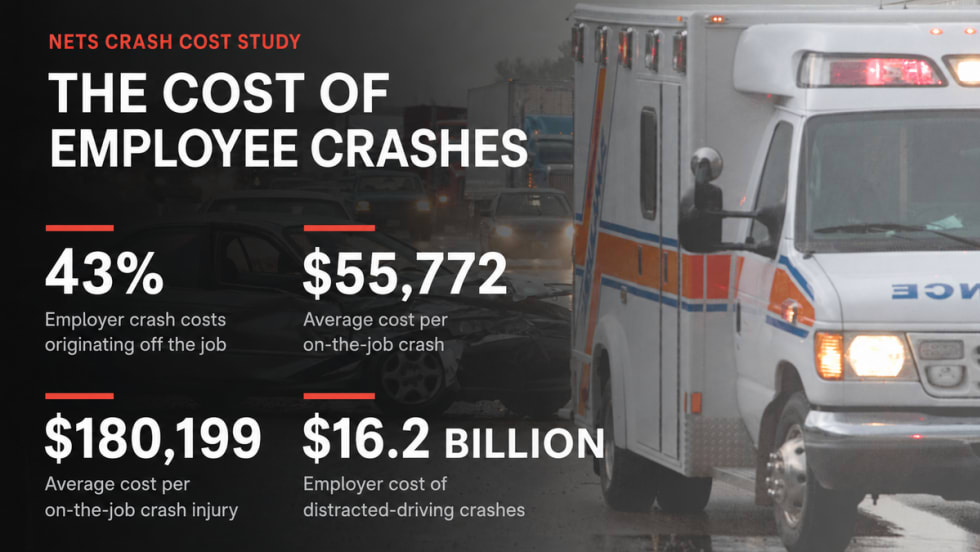
Off-the-Job Crashes Account for 43% of Employers’ $61.7 Billion Crash Burden
NETS quantifies costs dispersed across fleet, risk, HR, and other departments while providing new per-crash benchmarks for employers.
Read More →
Ram Recalls More Than 1.27 Million 1500 Pickups for Seat Belt Anchor Issue
The recall affects certain 2019-2026 Ram 1500 pickups that may have improperly attached second-row seat belt buckle anchors.
Read More →
How Better Visibility Cut Speeding Violations by 48%
Fleet leaders don't need more data, they need clearer visibility into what the data is saying. This case study explores how one utility replaced speeding-event counts with a single metric — miles driven in violation — to strengthen safety and significantly reduce speeding violations.
Read More →
Operation Safe Driver Week: Why the Industry's Oldest Safety Campaign Still Matters to Fleets
A look at how a 2007 enforcement initiative became one of the most consequential weeks on the fleet safety calendar, and what it means for your drivers in 2026.
Read More →