




Volvo Takes Part in European Platooning Challenge
Volvo Group is participating in the European Truck Platooning Challenge, which involves three Volvo trucks communicating wirelessly and driving closely behind one another, in a method known as platooning.
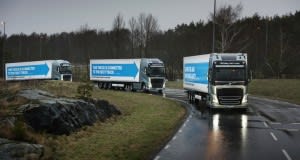
Photo: Volvo
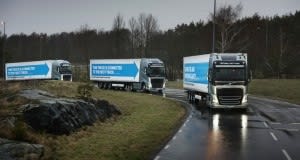
Photo: Volvo
Volvo Group is participating in the European Truck Platooning Challenge, which involves three Volvo trucks communicating wirelessly and driving closely behind one another, in a method known as platooning. The aim is to move a step closer to the introduction of platooning in Europe, according to the company.
When trucks can drive closely behind one another, fuel economy is improved as a result of the reduction in drag. Drag accounts for up to 25% of a truck’s total fuel consumption, and the closer the trucks drive to each other, the greater the fuel-saving potential. Using wireless technology, the trucks can drive with only about a one-second gap between the vehicles in a platoon. By communicating with each other, the trucks automatically match each other’s speed and braking, according to the automaker.
“Essentially, this means that the reaction time for breaking is reduced to zero, which in turn improves safety and minimizes the ‘accordion effect’ in connection with traffic congestion,” says Anders Kellström, project manager for Volvo’s participation in the EU Truck Platooning Challenge.
It is currently not possible to utilize the advantages of platooning on Europe’s roads, since legislation in the various countries governing the safe driving distance between trucks differs. The Netherlands has initiated the European Truck Platooning Challenge in an effort to discuss and highlight the changes required in European transportation legislation that would facilitate the introduction of platooning. All truck manufacturers in Europe have been invited to drive truck convoys from their respective countries to a final event in Rotterdam in April, according to the automaker.
The Volvo Group said it will participate by driving three trucks in a platoon from Gothenburg, Sweden, to Rotterdam in the Netherlands via Denmark, Germany, and Belgium. Volvo, in cooperation with the Swedish Transport Administration and the City of Gothenburg, will arrange a seminar in Gothenburg in conjunction with the start of the journey to address the potential to enhance the efficiency of transportation through platooning and autonomous driving. A similar seminar will be arranged by Volvo Trucks in Brussels on April 5, 2016.
“We believe that platooning offers major advantages, mainly for our customers, but also for society in the form of fuel savings, reduced emissions and enhanced transportation efficiency. Together with the rest of society, the transportation industry needs to tackle such challenges as the harmonization of legislation, and in so doing promote the introduction of platooning in Europe,” said Kellström.
More Global Fleet
Holman Takes Full Ownership of ARIZA in Mexico
Holman is bringing its Mexican fleet management operation fully under its own brand after more than 30 years as a joint venture. The change gives multinational fleet customers a single Holman operation across the U.S., Canada, and Mexico.
Read More →
Proven Ways to Reduce Work Truck Downtime
The age-old problem of downtime will always be a reality, but with new strategies at hand, fleets have more ways to keep trucks on the road longer.
Read More →
The Top 300 Commercial Fleets
The Top 300 Commercial Fleets: See the List
Read More →

Cameras, Safety and Insurance: From Reactive Claims to Real-Time Prevention (Part 2 of 2)
Part Two: Commercial auto remains one of the most challenging and costly lines of coverage for fleet operators and insurers alike. Continue learning more about how to effectively address these issues from Onur Aksan, Enterprise Business Development Executive, Geotab
Read More →
Cameras, Safety and Insurance: From Reactive Claims to Real-time Prevention
Commercial auto remains one of the most challenging and costly lines of coverage for fleet operators and insurers alike. Learn more about how to effectively address these issues from Onur Aksan, Enterprise Business Development Executive, Geotab.
Read More →
Fleet Costs Are Rising: Here’s How Leaders Are Responding
Fleet leaders are under pressure to reduce costs, adapt to economic uncertainty, and make smarter decisions. See how peers across North America are responding with real data, proven strategies, and forward-looking insights. Download the 2026 Market Pulse Report to benchmark your strategy and uncover where you can gain an edge.
Read More →
Enterprise Fleet Management Surpasses 900,000 Vehicles in U.S. & Canada
Enterprise Mobility connects with mobility solutions around the globe
Read More →
Automotive Fleet's Guide to Fleet Electrification
Unlock the secrets to a successful transition to electric fleets with Automotive Fleet's comprehensive Fleet Electrification Guide!
Read More →
Sumitomo Rubber Industries to Acquire Viaduct
Viaduct will join Sumitomo as an independent subsidiary. Partnership strengthens global reach and accelerates AI-driven innovation for fleets and manufacturing.
Read More →