




Volvo Improves Performance for 2012 S60 R-Design and XC60 R-Design
NEW YORK - Volvo announced the 2012 S60 R-Design sport sedan and XC60 R-Design crossover will get significant horsepower and torque increases when they go on sale late this summer.
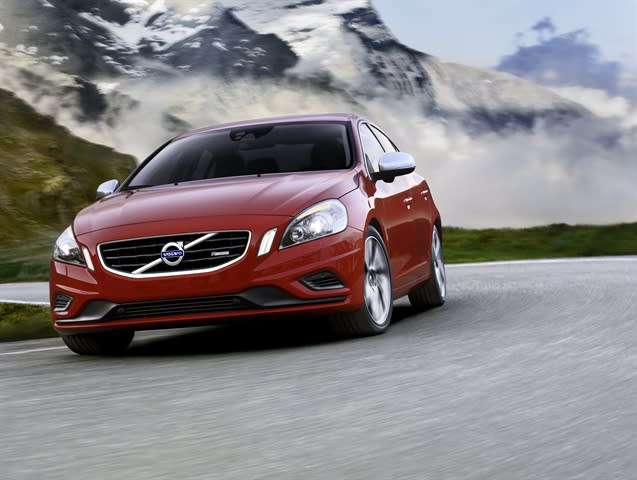

NEW YORK - The 2012 Volvo S60 R-Design sport sedan and XC60 R-Design crossover will get significant horsepower and torque increases when they go on sale late this summer, the company announced at the New York International Auto Show. The S60 R-Design will have a starting price of $42,275 and the XC60 R-Design will start at $43,150.
Under the Hood
Both models will be powered by Volvo's T6 engine, a turbocharged, inline six-cylinder that will now produce 325 horsepower and 354 lb.-ft. of torque. The standard T6 engine in both models produces 300 horsepower and 325 lb.-ft. of torque.
"The jump in performance will re-define these two R-Design models," said Doug Speck, president and CEO of Volvo Cars of North America. "Along with styling and suspension features that set them apart from other versions, our two newest R-Design models will have a higher 'fun-to-drive' quotient. I see that as a positive thing, and so will car buyers."
The S60 R-Design features the turbocharged 3.0L T6, what the company said is its most powerful six-cylinder engine currently offered. The company said the S60 R-Design achieves maximum torque from just 3,000 rpm and that it remains available throughout the rev range. Power is transmitted to the wheels via Volvo's second-generation six-speed automatic Geartronic transmission with sport mode. New valves and lower friction mean faster gear changes than before.
Suspension and Chassis
After developing the all-new S60, the company said its chassis team focused on further refining a number of details.
"The challenge was to boost the dynamics without making the chassis feel raw," says Stefan Sallqvist, manager of vehicle dynamics. The chassis team fitted a strut brace under the hood that ties together the suspension strut towers to stiffen the body structure and improve steering response. At the rear, the S60 R-Design features monotube dampers. Unlike the twin-tube dampers used in the S60 T6, the monotube system features compression and return damping via the same valve. This gives shorter, faster fluid flow, which in turn means the damper responds more quickly.
The front and rear springs have been shortened by 15 mm and spring stiffness is 15 percent higher compared to the chassis in the S60 T6. The bushings with which the rear dampers are attached to the body are 20 percent stiffer compared with the Dynamic chassis found in the standard S60 T6. The front tie-blade bushing, the attachment in the rear of the car, is 400-percent stiffer than before to counteract wheel bouncing and shaking.
Similar to the S60 T6, the S60 R-Design will be offered standard with Volvo's electronically controlled all-wheel-drive system with Instant Traction and Corner Traction Control with torque vectoring.
Corner Traction Control uses torque vectoring for smoother cornering. The company said this technology is a further refinement of its Dynamic Stability and Traction Control (DSTC). It helps reduce any tendency to understeer by applying more power to the outer driven wheel and braking the inner driven wheel.
Exterior Design
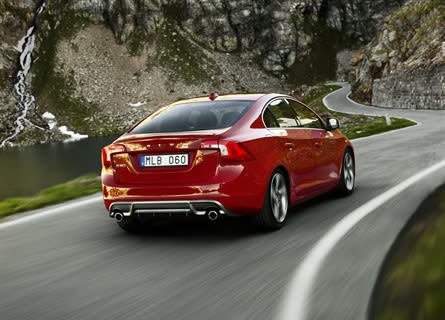
The S60 R-Design features a redesigned lower front fascia with a grille painted in glossy piano black. The vehicle features color-matched body components, details in matte finish and a hexagonal pattern repeated both front and rear. Incorporated within a sporty rear exhaust baffle are 90mm twin exhaust tailpipes and unique R-Design exclusive five-spoke 18-inch diamond cut wheels. The introductory, R-Design exclusive color is Passion Red but the Volvo S60 R-Design also will be available in four other colors. Additionally, the S60 R-Design features a rear trunk spoiler and standard Dual Xenons with Active Bending Lights.
Interior Design
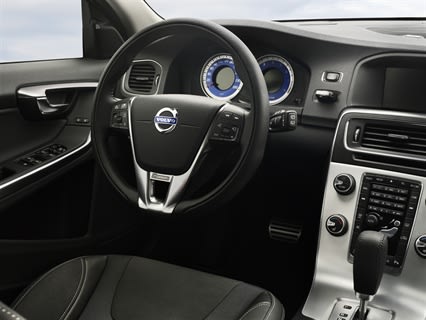
The driver and front passenger sit in sports seats where the backrest from the S60 is matched by an all-new seat cushion with deeper side bolsters. The upholstery will be offered in off-black leather with contrasting stitching and a sport-oriented textured leather accent with an embossed R-Design logo across the front-seat backrests. The interior also features a sport steering wheel with R-Design logo, gear selector, sports pedals, floor mats, and a blue watch-dial instrument cluster.
Safety Features
Safety features for the S60 R-Design include available Pedestrian Detection with Full Auto Brake. This driver assistance system consists of a newly developed radar unit integrated into the S60's grille, a camera fitted in front of the inside rearview mirror and a central control unit. The radar can detect any object in front of the car and to determine the distance to it while the camera determines the type of object. Up to 22 mph, the system helps the car avoid hitting a pedestrian. At higher speeds, the system helps mitigate the severity of an impact.
The function is also programmed to respond to vehicles in front of the S60 R-Design at a standstill or moving in the same direction as the car equipped with the system. The dual-mode radar’s wider field of vision allows early detection of pedestrians about to step into the road in front of the vehicle. The camera has higher resolution than the previous-generation unit, making it possible to detect a pedestrian’s movement pattern.
More Operations

How 2026 Fleet Visionary Jamie McKay Manages 2,400 Vehicles Across 37 States
How do you keep 2,400 vehicles running across 37 states? Fleet Visionary Award winner Jamie McKay shares how collaboration, flexibility, and a few simple strategies help her tackle fleet management challenges at Aptive Pest Control.
Read More →
Managing Fleet Costs in an Era of Permanent Volatility
Fleet operating costs have risen more than 20% since 2020, raising a key question: When does extending a vehicle's service life stop making financial sense?
Read More →
The Next Evolution of Fleet Management: Autonomous Operations
This opening keynote session at the Fleet Forward Conference highlights the future of autonomous driving for fleets.
Read More →

How to Reduce the Total Cost of Risk From Catalytic Converter Theft
A stolen catalytic converter can cost fleets far more in downtime and lost productivity than in repairs. A total-cost-of-risk approach can help fleet managers quantify their exposure and prioritize theft prevention.
Read More →
Personal-Use Charges Rise as Vehicle Values Fall | AF News Recap
Personal-use charges are climbing, wholesale used-vehicle values are declining, and commercial fleet sales growth is slowing. This week, we're breaking down the latest fleet data, plus how Element Fleet Management is helping Waymo prepare for its first Canadian robotaxi market.
Read More →
Here's When You Should Make an Exception to Fleet Policy
Fleet policies are designed to create consistency, but not every driver or situation fits neatly within standard rules.
Read More →
AI-Native or AI-Acquired: What Should Fleet Managers Look for in an AI Platform?
Six questions can help fleet managers look beyond AI marketing claims to evaluate integration, data access, and real-world operational performance.
Read More →
A buyer's guide to fleet management software in 2027
Buying fleet management software in 2027 means looking beyond features and price. As fleet operations, technology and expectations evolve, this guide explores what today’s fleet professionals should consider when choosing a system that can deliver value now and adapt to what comes next.
Read More →
What Will Shape the Next Era of Fleet Management?
EVs, AI, and autonomous vehicles are reshaping fleet management. Discover what’s ahead—and how fleet leaders can prepare for the next era.
Read More →
How Fleets Can Recruit and Train Veterans for Technician Roles
Here's how the technician shortage has affected uptime for fleets, and what to do about it.
Read More →