




Video: Volvo’s Self-Driving Cars Set for Pilot Project
In collaboration with Swedish government agencies, Volvo will examine future safety benefits and infrastructure needs of autonomous vehicles.

Self-driving vehicles will allow drivers to focus on other tasks, such as making phone calls to clients, without compromising safety. Photo: Volvo Cars.

Self-driving vehicles will allow drivers to focus on other tasks, such as making phone calls to clients, without compromising safety. Photo: Volvo Cars.
One hundred self-driving Volvo cars are slated to participate in an upcoming autonomous driving pilot project that will use public roads in and around Gothenburg, Sweden.
The project will get underway in 2014 with customer research and technology development, as well as creation of a user interface and cloud functionality. Project leaders expect the self-driving cars to hit public roads by 2017, Volvo Cars said. The vehicles – developed on the automaker’s upcoming Scalable Product Architecture -- will maneuver autonomously through everyday driving conditions.
The architecture is prepared for the continuous introduction of new support and safety systems all the way to technologies that enable highly autonomous drive, Volvo said. The first SPA model will be the Volvo XC90, set to debut in 2014.
The pilot project is a joint effort involving Volvo Car Group, the Swedish Transport Administration, the Swedish Transport Agency, Lindholmen Science Park and the City of Gothenburg. This initiative, dubbed “Drive Me – Self-driving Cars for Sustainability Mobility,” will focus on pinpointing the societal benefits of autonomous driving and on positioning Volvo and Sweden as leaders in developing the technology.
“Autonomous vehicles are an integrated part of Volvo Cars’ as well as the Swedish government’s vision of zero traffic fatalities,” said Håkan Samuelsson, president and CEO of Volvo Car Group. “This public pilot represents an important step towards this goal. It will give us an insight into the technological challenges at the same time as we get valuable feedback from real customers driving on public roads.”
The pilot will involve 50 kilometers (31 miles) of selected roads in and around Gothenburg. These roads are typical commuter arteries that can get congested during rush hour.
“Our aim is for the car to be able to handle all possible traffic scenarios by itself, including leaving the traffic flow and finding a safe harbor if the driver for any reason is unable to regain control,” explained Erik Coelingh, technical specialist at Volvo Car Group.
The project will focus on such topics as:
How autonomous vehicles bring societal and economic benefits by improving traffic efficiency, traffic environment and road safety
Infrastructure requirements for autonomous driving
Typical traffic conditions suitable for autonomous vehicles
Public confidence in autonomous vehicles
How surrounding drivers interact smoothly with a self-driving car.
The project’s vehicles will be capable of handling all driving functions at the driver's discretion. The driver will be available for occasional control -- but with a comfortable transition time.
The project also includes fully automated parking, without a driver in the car. This allows the driver to walk away from the car at the parking entrance while the vehicle finds a vacant spot and parks by itself.
“Our approach is based on the principle that autonomously driven cars must be able to move safely in environments with non-autonomous vehicles and unprotected road users,” Coelingh said.
More Safety

Nexar-Nauto Merger Aims to Give Fleets Better Safety Intelligence Through Larger Driving Dataset
Stefan Heck tells Automotive Fleet that combining more than 10 billion miles of driving history with Nexar's AI models will give fleets deeper insights into driver risk and roadway conditions than either company could provide independently.
Read More →
Don't Wait for a Crisis: 5 Ways to Build Mental Health Into Your Fleet Safety Program
For Suicide Prevention Month, fleet and safety leaders have an opportunity to put mental health where it belongs: at the center of workplace safety.
Read More →
How Camera Data Can Strengthen a Fleet’s Insurance Renewal
Insights from a commercial insurance carrier and a broker show how fleets can turn video telematic data, driver coaching, and improved claims results into a stronger case at insurance renewal.
Read More →
The Safest Fleets Aren’t the Ones with the Most Technology
You’ve made the telematics investment. Here’s how to capture the other half of its value and build the safest fleet on the road.
Read More →
Hidden in Plain Sight: Fleet Compliance Risks
Fleet compliance isn't just about having policies — it's about consistently enforcing them. This practical guide reveals six hidden compliance risks common in public sector and shared fleet operations and outlines proven strategies to improve visibility, accountability, and audit readiness
Read More →
NETS Sets 2026 Fleet Safety Benchmark Conference for Indianapolis
The Sept. 15–17 program will feature fleet benchmarking data, case studies, emerging technologies, and implementation strategies while running alongside the NSC Safety Congress & Expo.
Read More →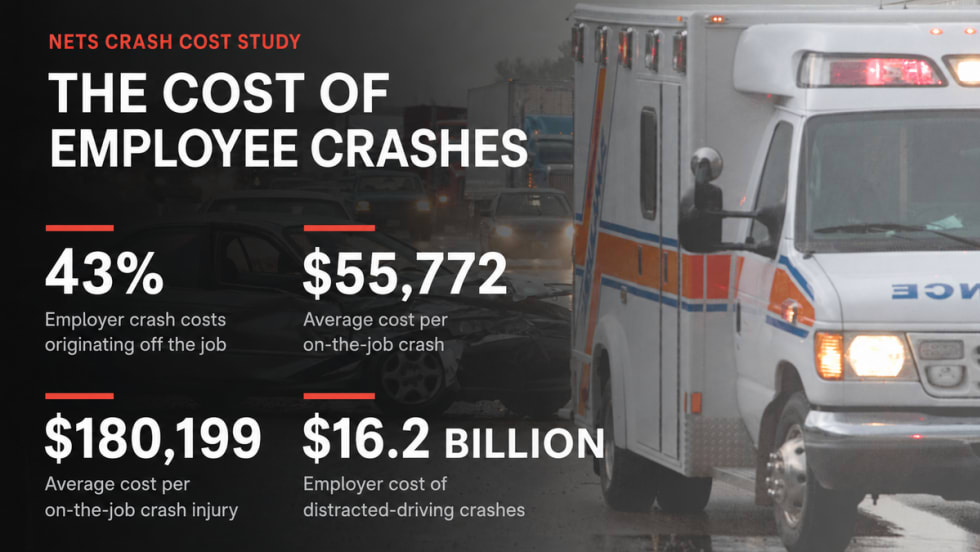
Off-the-Job Crashes Account for 43% of Employers’ $61.7 Billion Crash Burden
NETS quantifies costs dispersed across fleet, risk, HR, and other departments while providing new per-crash benchmarks for employers.
Read More →
Ram Recalls More Than 1.27 Million 1500 Pickups for Seat Belt Anchor Issue
The recall affects certain 2019-2026 Ram 1500 pickups that may have improperly attached second-row seat belt buckle anchors.
Read More →
How Better Visibility Cut Speeding Violations by 48%
Fleet leaders don't need more data, they need clearer visibility into what the data is saying. This case study explores how one utility replaced speeding-event counts with a single metric — miles driven in violation — to strengthen safety and significantly reduce speeding violations.
Read More →
Operation Safe Driver Week: Why the Industry's Oldest Safety Campaign Still Matters to Fleets
A look at how a 2007 enforcement initiative became one of the most consequential weeks on the fleet safety calendar, and what it means for your drivers in 2026.
Read More →