




Video: Ford F-150 Adds Pro Trailer Backup Assist
The technology allows drivers to steer a trailer instinctively by turning a knob left or right to indicate direction, and the truck controls the steering and limits vehicle speed.

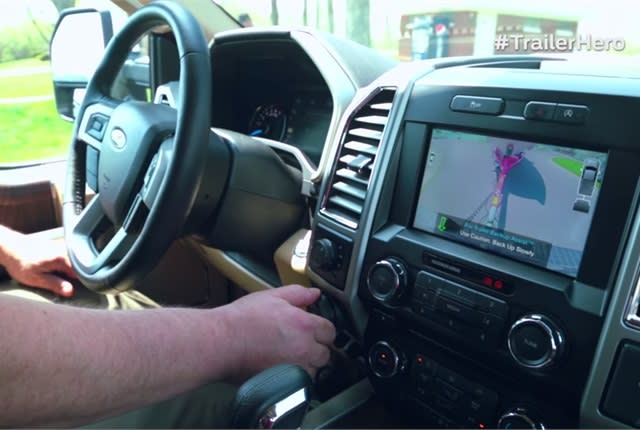
The 2016 model-year Ford F-150 pickup truck will introduce a new towing innovation, Pro Trailer Backup Assist, to make the challenge of backing up a trailer easier for drivers of all skill levels, Ford Motor Co. said.
Backing up a trailer can be tricky. The truck’s front wheels have to be turned the opposite direction the driver wants the trailer to go. Turn too hard and the trailer can hit the vehicle, or jackknife. Whether the driver works alone or with a spotter, backing up a trailer can be a nerve-racking experience.
Pro Trailer Backup Assist is designed to take the frustration out of backing up. The driver rotates a knob to indicate how much the system should turn the trailer. The technology automatically steers the truck to turn the trailer the desired amount.
“Pro Trailer Backup Assist is a smart solution to save time and increase productivity for our customers,” said Doug Scott, marketing manager for Ford Truck Group.
Using advanced camera technology, Ford engineers developed the trailer tracking system strategy and tested it for almost a decade. Along the way, Ford earned five patents for the technology, with 10 more pending.
To view a Ford video that demonstrates Pro Trailer Backup Assist, click on the photo or link below the headline.
Pro Trailer Backup Assist joins a suite of driver-assist technologies already available on the redesigned 2015 F-150. Among these features is Curve Control, which helps drivers maintain control of their vehicle by automatically reducing torque and applying four-wheel braking. This can reduce vehicle speed by up to 10 mph in approximately one second, assisting drivers in staying on their intended path.
The available lane-keeping system is designed to help prevent a driver from drifting outside of the intended driving lane. The system can detect the left- or right-hand road lane markings using a camera mounted between the windshield and rearview mirror. A vibration in the steering wheel alerts the driver. The system can also provide steering torque to help guide the vehicle back into the lane, if needed.
Adaptive cruise control and collision warning with brake support use radar in the front of the truck to measure the distance and speed of vehicles detected ahead. Taking this information into account, the F-150 can automatically maintain a consistent following distance set by the driver. The speed will be maintained if adaptive cruise control is activated and the vehicle is traveling at least 15 mph.
Collision warning triggers visual and audio alerts, if the system detects that the following distance is diminishing too quickly and a collision may occur. It also pre-charges the brakes if the driver needs to stop suddenly.
More Safety

Fleet Manager’s Ultimate Playbook: Navigating the New Standard in OEM Connectivity
Rising operating costs, driver safety concerns, and unplanned downtime are putting unprecedented pressure on modern fleets. Discover how fleet managers use embedded OEM connectivity and real-time vehicle data to cut TCO, prevent downtime, and protect drivers without aftermarket telematics hardware.
Read More →
From Driver Well-Being to EV Charging | AF News Recap
Mental health belongs in the fleet safety conversation. This week, we’re looking at five ways fleets can support employee well-being before a crisis, plus Holman’s expansion in Mexico, new one-day Fleet Forward passes, and why EV charging demand is outpacing infrastructure growth.
Read More →
Nexar-Nauto Merger Aims to Give Fleets Better Safety Intelligence Through Larger Driving Dataset
Stefan Heck tells Automotive Fleet that combining more than 10 billion miles of driving history with Nexar's AI models will give fleets deeper insights into driver risk and roadway conditions than either company could provide independently.
Read More →
Don't Wait for a Crisis: 5 Ways to Build Mental Health Into Your Fleet Safety Program
For Suicide Prevention Month, fleet and safety leaders have an opportunity to put mental health where it belongs: at the center of workplace safety.
Read More →
How Camera Data Can Strengthen a Fleet’s Insurance Renewal
Insights from a commercial insurance carrier and a broker show how fleets can turn video telematic data, driver coaching, and improved claims results into a stronger case at insurance renewal.
Read More →
The Safest Fleets Aren’t the Ones with the Most Technology
You’ve made the telematics investment. Here’s how to capture the other half of its value and build the safest fleet on the road.
Read More →
Hidden in Plain Sight: Fleet Compliance Risks
Fleet compliance isn't just about having policies — it's about consistently enforcing them. This practical guide reveals six hidden compliance risks common in public sector and shared fleet operations and outlines proven strategies to improve visibility, accountability, and audit readiness
Read More →
NETS Sets 2026 Fleet Safety Benchmark Conference for Indianapolis
The Sept. 15–17 program will feature fleet benchmarking data, case studies, emerging technologies, and implementation strategies while running alongside the NSC Safety Congress & Expo.
Read More →
Off-the-Job Crashes Account for 43% of Employers’ $61.7 Billion Crash Burden
NETS quantifies costs dispersed across fleet, risk, HR, and other departments while providing new per-crash benchmarks for employers.
Read More →
Ram Recalls More Than 1.27 Million 1500 Pickups for Seat Belt Anchor Issue
The recall affects certain 2019-2026 Ram 1500 pickups that may have improperly attached second-row seat belt buckle anchors.
Read More →