




U.S. Proposes V2V Mandate to Reduce Crashes
Separately, the U.S. DOT's Federal Highway Administration will soon issue guidelines for vehicle-to-infrastructure (V2I) communications.
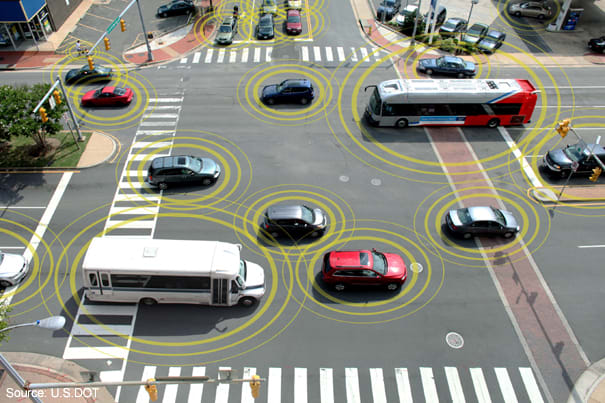
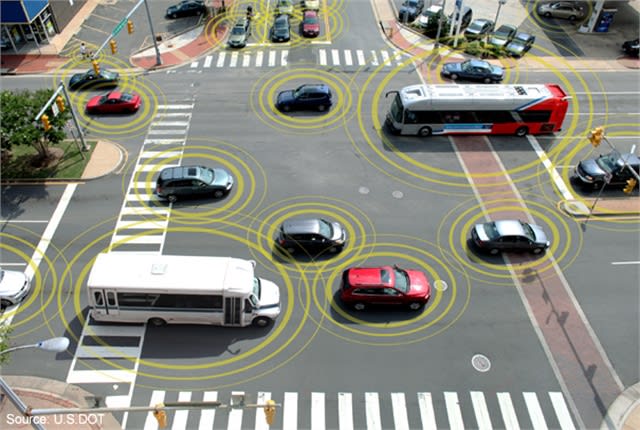
The U.S. Department of Transportation has proposed mandating vehicle-to-vehicle communication technology on all new light-duty vehicles to enable a wide range of new crash-avoidance applications.
Once fully deployed, these crash-avoidance features "could prevent hundreds of thousands of crashes every year by helping vehicles 'talk' to each other," the department said in a released statement about the proposed rule.
The action reflects the DOT's years-long efforts to accelerate development and deployment of connected vehicle communications and autonomous vehicles. The proposed rule would require vehicle-to-vehicle (V2V) communications devices to exchange information through standardized messaging developed with industry participation.
Automakers would need to fully comply with the mandate within four years after the final rule's implementation.
In a separate move, the department’s Federal Highway Administration plans to soon issue guidelines for vehicle-to-infrastructure (V2I) communications. V2I communications will help transportation planners "integrate the technologies to allow vehicles to 'talk' to roadway infrastructure such as traffic lights, stop signs and work zones to improve mobility, reduce congestion and improve safety," the DOT said.
The department's National Highway Traffic Safety Administration agency estimates that safety applications enabled by V2V and V2I could eliminate or mitigate the severity of up to 80% of crashes not involving impaired drivers. These include crashes occurring at intersections or while changing lanes.
V2V devices would use dedicated short-range communications (DSRC) to transmit data — such as location, direction, and speed — to nearby vehicles. That data would be updated and broadcast up to 10 times per second to nearby vehicles. Using that information, V2V-equipped vehicles could identify risks and provide warnings to drivers to avoid imminent crashes.
Vehicles equipped with automated driving functions — such as automatic emergency braking and adaptive cruise control — could also benefit from the use of V2V data to better avoid or reduce the consequences of crashes, according to NHTSA.
Additionally, V2V communications could provide the vehicle and driver with enhanced abilities to address additional crash situations. Examples include assisting the driver in deciding whether it’s safe to pass on a two-lane road or to make a left turn across the path of oncoming traffic. The technology can also determine whether a vehicle approaching an intersection appears to be on a collision course.
In those situations, V2V communications can detect developing threat situations hundreds of yards away — often in situations in which the driver and on-board sensors alone cannot detect the threat, NHTSA said.
Privacy is also protected in V2V safety transmissions, according to NHTSA.
"V2V technology does not involve the exchange of information linked to or, as a practical matter, linkable to an individual, and the rule would require extensive privacy and security controls in any V2V devices," the agency said.
The notice of proposed rulemaking will be open for public comment for 90 days, which carries the issue into the next administration. President-elect Donald Trump's nominee for Transportation secretary is Elaine Chao, who is expected to draw U.S. Senate confirmation without a problem.
"We are carrying the ball as far as we can to realize the potential of transportation technology to save lives," said current Transportation Secretary Anthony Foxx. "This long promised V2V rule is the next step in that progression. Once deployed, V2V will provide 360-degree situational awareness on the road and will help us enhance vehicle safety."
Back in February 2014, Foxx announced his intent to speed efforts to enable V2V communications. That's when he directed NHTSA to begin work on the rulemaking.
More Safety
IIHS Crash Avoidance Tests Reveal Safety Gaps in Cargo Vans and Work Trucks
New crash-avoidance ratings from the Insurance Institute for Highway Safety reveal inconsistent performance among commercial vehicles, with several popular cargo vans and heavy-duty pickups struggling to avoid collisions with other vehicles and pedestrians.
Read More →
What’s Next for Fleet? Safety, AI & Industry Recognition | AF News Recap
Could your company's culture be encouraging distracted driving? This week, we're exploring how workplace expectations affect driver safety, what AI, EVs, and autonomous vehicles could mean for the future of fleet management, and how fleet professionals can strengthen their award nominations.
Read More →
Does Your Fleet's Culture Encourage Distracted Driving?
What happens when the people responsible for enforcing safety rules are the ones setting the wrong example? The answer may reveal why some of the biggest risks to fleet drivers have little to do with what's written in the employee handbook.
Read More →
Fleet Manager’s Ultimate Playbook: Navigating the New Standard in OEM Connectivity
Rising operating costs, driver safety concerns, and unplanned downtime are putting unprecedented pressure on modern fleets. Discover how fleet managers use embedded OEM connectivity and real-time vehicle data to cut TCO, prevent downtime, and protect drivers without aftermarket telematics hardware.
Read More →
From Driver Well-Being to EV Charging | AF News Recap
Mental health belongs in the fleet safety conversation. This week, we’re looking at five ways fleets can support employee well-being before a crisis, plus Holman’s expansion in Mexico, new one-day Fleet Forward passes, and why EV charging demand is outpacing infrastructure growth.
Read More →
Nexar-Nauto Merger Aims to Give Fleets Better Safety Intelligence Through Larger Driving Dataset
Stefan Heck tells Automotive Fleet that combining more than 10 billion miles of driving history with Nexar's AI models will give fleets deeper insights into driver risk and roadway conditions than either company could provide independently.
Read More →
Don't Wait for a Crisis: 5 Ways to Build Mental Health Into Your Fleet Safety Program
For Suicide Prevention Month, fleet and safety leaders have an opportunity to put mental health where it belongs: at the center of workplace safety.
Read More →
How Camera Data Can Strengthen a Fleet’s Insurance Renewal
Insights from a commercial insurance carrier and a broker show how fleets can turn video telematic data, driver coaching, and improved claims results into a stronger case at insurance renewal.
Read More →
The Safest Fleets Aren’t the Ones with the Most Technology
You’ve made the telematics investment. Here’s how to capture the other half of its value and build the safest fleet on the road.
Read More →
Hidden in Plain Sight: Fleet Compliance Risks
Fleet compliance isn't just about having policies — it's about consistently enforcing them. This practical guide reveals six hidden compliance risks common in public sector and shared fleet operations and outlines proven strategies to improve visibility, accountability, and audit readiness
Read More →