




Subaru Announces Pricing on All-New 2009 Forester
CHERRY HILL, N.J. – Following its world debut at the NAIAS in January, Subaru of America, Inc. announced pricing on the all-new Subaru Forester.
CHERRY HILL, N.J. – Following its world debut at the NAIAS in January, Subaru of America, Inc. announced pricing on the all-new Subaru Forester. The 2009 Subaru Forester will arrive in dealer showrooms beginning in April with pricing starting at $19,995, a full $1,200 lower than the outgoing model.
“For 11 years, the Subaru Forester has been an icon of functionality, dependability and durability,” said Tim Colbeck, vice president of sales, Subaru of America, Inc. “The 2009 Forester now adds greater interior room, improved comfort and more amenities than before, yet with a starting price that is significantly lower than the outgoing model.”
The 2009 Subaru Forester is available in both 2.5 liter naturally aspirated and 2.5 liter turbo models. The naturally aspirated models are available with manual or automatic transmission, while the turbocharged models come with automatic transmission.
The naturally aspirated model is available in three trim levels; X, 2.5X Premium Package and 2.5X L.L. Bean (L.L. Bean equipped with automatic transmission only). The 2.5XT turbocharged model is available in standard X trim or as a Forester 2.5XT Limited model.
Model Highlights:
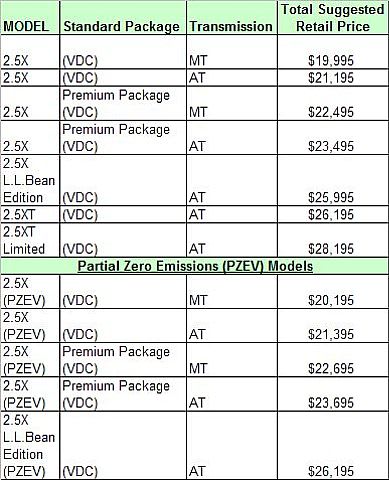
The 2.5X, equipped with manual transmission, will have a starting price of $19,995 (before D&D) - a $1,200 price decrease from the comparable 2008MY.
The 2.5X with Premium Package, equipped with manual transmission, has a starting price of $22,495 and includes; Power moonroof, 17-inch alloy wheels, rear seat center tray, roof rails, steering wheel audio controls, and reclining rear seat backs.
The 2.5X L.L.Bean Edition with standard automatic transmission starts at $25,995. The L.L.Bean Edition includes: perforated leather-trimmed upholstery, automatic climate control system, AM/FM stereo with 6-disc CD changer and 6 speakers, 10-way power driver’s seat, fog lights, all-weather package (heated front seats, windshield wiper de-icer and heated exterior mirrors), L.L.Bean embroidered floor mats and L.L.Bean embossed cargo tray.
The 2.5XT model starts at $26,195 and features a 2.5L, turbocharged engine that produces 224 HP. The 2.5XT comes with unique 17-inch alloy wheels.
An All Weather Package is an available option ($400) on the Premium Package, and is standard on the L.L.Bean & XT Limited. Satellite Navigation is optional ($1,800) on L.L. Bean and XT Limited models.
Destination and Delivery charge is $665 for all 2009-MY Forester models.
2009 FORESTER PRICING
The third-generation 2009 Forester is a total re-design of the award-winning crossover utility vehicle (CUV). The 2009 Forester builds upon its predecessor’s reputation as an icon of safety, dependability and versatility. The new-generation 2009 model projects a bolder, more SUV-like design and making a major leap in safety technology, comfort, refinement and driving dynamics.
As with all Subaru models, the 2009 Forester comes equipped as standard with Symmetrical All-Wheel Drive.
An all-new platform featuring a 3.6-inch longer wheelbase (now 103.0 inches) and double-wishbone rear suspension improves crash-worthiness and at the same time provides crisper handling, a quieter ride and increased interior space and cargo room. The 2009 Forester once again blends positive SUV attributes including a high seating point and interior versatility with passenger car comfort, handling and fuel efficiency.
All Forester models for 2009 feature standard side-curtain airbags with a rollover sensor, and the Vehicle Dynamics Control (VDC) stability and traction control system is standard on all models for the first time. With the Subaru Dynamic Chassis Control Concept (Subaru DC3), Subaru optimized all elements of the Forester’s chassis to deliver a better balance of ride, handling response, quietness and overall traction performance than offered by competitive vehicles. A comprehensive array of elements contributes to that goal, including the new, high-strength body structure, standard Symmetrical All-Wheel Drive, VDC and four-wheel disc ABS brakes with the Brake Assist safety system.
More Operations

Avis Budget Group Deploys Neology Toll Management Technology Across Major Brands
Neology’s neoFleet platform will manage toll transactions and toll-authority operations for vehicles across Avis, Budget, Payless, Budget Truck and Zipcar.
Read More →
Fleet Personal-Use Charges Edge Higher in 2026
Nearly eight in 10 surveyed fleets allow personal use of company vehicles, while just over half of respondents report charging employees for the privilege.
Read More →
The Future of Fleet + What’s Changing Right Now | AF News Recap
Could developments overseas offer a preview of what’s coming for U.S. fleets? This week, we’re looking at the future of AI, autonomy, and electrification, plus Ford Pro’s new certified pre-owned program, smarter vehicle offboarding, and a new way for fleets to manage toll expenses.
Read More →
How to Handle Vehicle Offboarding
What do fleet managers need to do when a driver leaves?
Read More →
Fleet Manager’s Ultimate Playbook: Navigating the New Standard in OEM Connectivity
Rising operating costs, driver safety concerns, and unplanned downtime are putting unprecedented pressure on modern fleets. Discover how fleet managers use embedded OEM connectivity and real-time vehicle data to cut TCO, prevent downtime, and protect drivers without aftermarket telematics hardware.
Read More →
U.S. Bank Adds Verra Mobility Toll Management to Voyager Fleet Platform
The integration allows U.S. Bank Voyager fleet customers to manage toll payments and violations alongside fuel, EV charging and maintenance expenses.
Read More →
ADAS Prevents Crashes. But Repairs Cost More | AF News Recap
ADAS-equipped vehicles may crash less often, but they can cost more when they do. This week, we’re breaking down what that tradeoff means for fleets, plus Subaru’s first Forester Wilderness Hybrid, Nissan’s new e-POWER Rogue, and why Calstart has become Catalyst Mobility.
Read More →
Moventum Fleet Management Names Mark Iorillo Head of Sales
Iorillo brings nearly 20 years of fleet management and sales experience to the role, including previous positions at Element Fleet Management, CEI, Donlen and Ryder.
Read More →
Fleet Has a Talent Pipeline Problem. What Comes Next? | AF News Recap
Where will fleet’s next generation of leaders come from? This week, we’re looking at the industry’s talent pipeline, what certification can add to a fleet career, how to build an award-worthy track record, and the return of Automotive Fleet’s Personal Use Survey.
Read More →
Smith System Launches Driver Risk Management Program
Fleets have more driver data than ever, but identifying risky behavior doesn't necessarily correct it. Smith System's new Driver Risk Management program combines monitoring, training, and follow-up coaching to help fleets connect risk signals with driver intervention.
Read More →