




Study: No Progress in Reducing Motorcyclist Deaths in 2011
WASHINGTON – A new study released by the Governors Highway Safety Association underscores the need for all motorists to take extra precautions so they can more safely share the road with motorcyclists. Here are details about the study, along with some safety tips you can share with your own fleet drivers.
WASHINGTON -- A report released May 22 by the Governors Highway Safety Association (GHSA) concludes that no progress was made in reducing motorcyclist deaths in 2011. Based upon preliminary data from 50 states and the District of Columbia, GHSA projects that motorcycle fatalities remained at about 4,500 in 2011, the same level as 2010.
Meanwhile, earlier this month, the National Highway Traffic Safety Administration projected that overall motor vehicle fatalities declined 1.7% in 2011, reaching their lowest level since 1949. But motorcycle deaths remain one of the few areas in highway safety where progress is not being made.
The new report -- the first state-by-state look at motorcycle fatalities occurring in 2011 -- was authored by Dr. James Hedlund of Highway Safety North. Most states have reasonably complete fatality counts for at least the first nine months of 2011, enabling GHSA to confidently project the full year. Hedlund completed similar projections for GHSA in 2009 and 2010, with both being very close to the final fatality numbers, GHSA said.
Comparing the first nine months of 2010 to 2011, motorcyclist fatalities decreased in 23 states, with notable declines in many. In Connecticut, for example, motorcycle deaths dropped 37%, while in New York and North Carolina they fell 16% and 21%, respectively. GHSA's member in New York State is the Governor's Traffic Safety Committee (GTSC). Barbara J. Fiala, commissioner of the New York State Department of Motor Vehicles and chair of GTSC, noted that the decrease in fatal motorcycle crashes in that state is due to a mix of countermeasures focusing on enforcement, education and engineering.
"In New York, we are educating motorists to watch for motorcycles, riders to wear bright protective gear to make themselves more visible, and law enforcement officers on conducting efficient and effective motorcycle checks," Fiala said. "It is encouraging to see that these efforts, which have been conducted with our state and local partners, are making a difference."
Twenty-six states and the District Columbia, on the other hand, reported an increase in motorcyclist deaths. In South Carolina and Texas, they rose 26% and 16%, respectively, while in California they increased 10%.
In light of the report’s findings, now is a good time for fleet managers to remind their drivers to be mindful of sharing the road safely with motorcyclists.
Here are some safety tips from the California DMV:
• When you change lanes or enter a major thoroughfare, make a visual check for motorcycles. Also use your mirrors. Motorcycles are small and they can easily disappear into a vehicle’s blind spots.
• Allow a four-second following distance. You will need this space to avoid hitting the motorcyclist if he or she brakes suddenly or falls off the motorcycle. Motorcycles generally can stop faster than passenger vehicles.
• Allow the motorcycle a full lane width. Although it is not illegal to share lanes with motorcycles, it is unsafe.
• Never try to pass a motorcycle in the same lane you are sharing with the motorcycle.
• When you make a turn, check for motorcyclists and gauge their speed before turning.
• Look carefully for motorcyclists before opening doors next to moving traffic or before turning right.
• Remember that motorcycles may travel faster than traffic during congested road conditions and can legally travel in the unused space between two lines of moving or stationary vehicles; this is commonly called "lane splitting."
• Remember that road conditions, which are minor annoyances to you, pose major hazards to motorcyclists. Potholes, gravel, wet or slippery surfaces, pavement seams, railroad crossings, and grooved pavement can cause motorcyclists to change speed or direction suddenly. If you are aware of the effect of these conditions and drive with care and attention, you can help reduce motorcyclist injuries and fatalities.
More Safety

Nexar-Nauto Merger Aims to Give Fleets Better Safety Intelligence Through Larger Driving Dataset
Stefan Heck tells Automotive Fleet that combining more than 10 billion miles of driving history with Nexar's AI models will give fleets deeper insights into driver risk and roadway conditions than either company could provide independently.
Read More →
Don't Wait for a Crisis: 5 Ways to Build Mental Health Into Your Fleet Safety Program
For Suicide Prevention Month, fleet and safety leaders have an opportunity to put mental health where it belongs: at the center of workplace safety.
Read More →
How Camera Data Can Strengthen a Fleet’s Insurance Renewal
Insights from a commercial insurance carrier and a broker show how fleets can turn video telematic data, driver coaching, and improved claims results into a stronger case at insurance renewal.
Read More →
The Safest Fleets Aren’t the Ones with the Most Technology
You’ve made the telematics investment. Here’s how to capture the other half of its value and build the safest fleet on the road.
Read More →
Hidden in Plain Sight: Fleet Compliance Risks
Fleet compliance isn't just about having policies — it's about consistently enforcing them. This practical guide reveals six hidden compliance risks common in public sector and shared fleet operations and outlines proven strategies to improve visibility, accountability, and audit readiness
Read More →
NETS Sets 2026 Fleet Safety Benchmark Conference for Indianapolis
The Sept. 15–17 program will feature fleet benchmarking data, case studies, emerging technologies, and implementation strategies while running alongside the NSC Safety Congress & Expo.
Read More →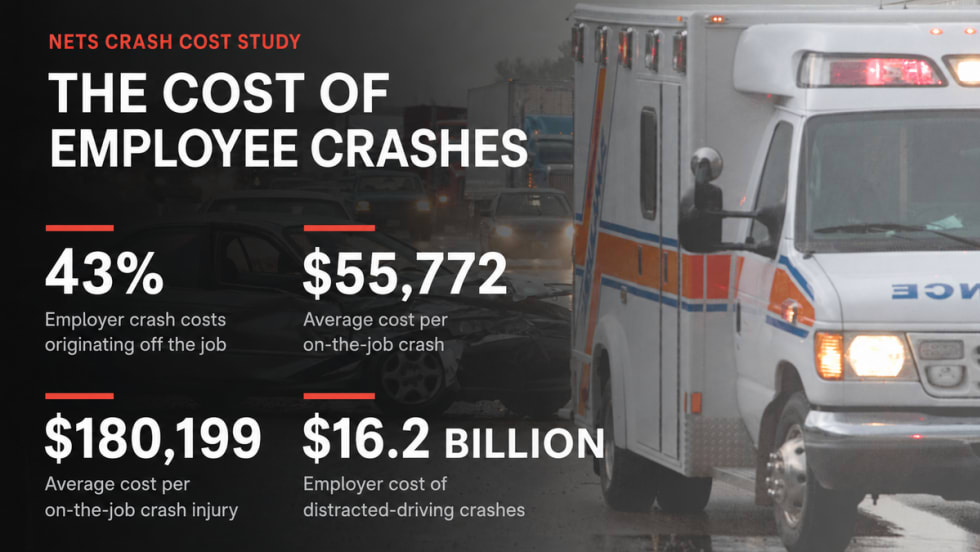
Off-the-Job Crashes Account for 43% of Employers’ $61.7 Billion Crash Burden
NETS quantifies costs dispersed across fleet, risk, HR, and other departments while providing new per-crash benchmarks for employers.
Read More →
Ram Recalls More Than 1.27 Million 1500 Pickups for Seat Belt Anchor Issue
The recall affects certain 2019-2026 Ram 1500 pickups that may have improperly attached second-row seat belt buckle anchors.
Read More →
How Better Visibility Cut Speeding Violations by 48%
Fleet leaders don't need more data, they need clearer visibility into what the data is saying. This case study explores how one utility replaced speeding-event counts with a single metric — miles driven in violation — to strengthen safety and significantly reduce speeding violations.
Read More →
Operation Safe Driver Week: Why the Industry's Oldest Safety Campaign Still Matters to Fleets
A look at how a 2007 enforcement initiative became one of the most consequential weeks on the fleet safety calendar, and what it means for your drivers in 2026.
Read More →