




Study Confirms Value of OnStar’s Injury Prediction
Emergency response agencies can use the additional information to fine-tune how they dispatch first responders to the scene of a crash.

OnStar’s “injury severity prediction” (ISP) service analyzes crash data, such as force of impact, to determine the probability of severe injury to the vehicle occupants. OnStar advisors then relay the ISP rating to 9-1-1 centers. Photo courtesy of GM.

OnStar’s “injury severity prediction” (ISP) service analyzes crash data, such as force of impact, to determine the probability of severe injury to the vehicle occupants. OnStar advisors then relay the ISP rating to 9-1-1 centers. Photo courtesy of GM.
OnStar’s “injury severity prediction” service is accurately predicting the severity of crash victims’ injuries, fostering better on-scene treatment, a new study has found.
Injury severity prediction (ISP) is an algorithm that OnStar uses in properly equipped Chevrolet, Buick, GMC and Cadillac vehicles in the U.S. and Canada to provide additional information to first responders following a vehicle crash. The algorithm analyzes crash information, such as force of impact and direction of impact, to determine the probability of severe injury to the vehicle occupants. OnStar advisors then relay the ISP rating to 9-1-1 centers, which may choose to adjust the level and priority of response dispatched to a crash scene.
“This past April we added injury severity prediction criteria to our trauma transport protocols,” said Cory Richter, battalion chief for Indian River County (Fla.) Fire Rescue. “It has been proven that crash victims with a severe injury have a better chance of survival when they’re transported to a trauma center instead of a local hospital. Resources like OnStar’s Injury Severity Prediction give us a better chance of identifying those victims early on.”
Over the past four years, General Motors, OnStar and the University of Michigan’s International Center for Automotive Medicine (ICAM) have studied how crash data can assist first responders. Dr. Stewart Wang has led the ICAM team. This was the first known study to match real-life injury outcomes with crash telemetry data.
“Only a subset of all people who have been involved in a crash require the most urgent attention,” Wang said. “This subset consists of those individuals who have sustained serious, life- or limb-threatening injuries. With this data, we are able to much more accurately predict which people might be in this critical subset so that the proper resources can be deployed to rescue them and transport them to the right level of care.”
As part of the research for each crash incident, Wang and his team matched each ISP rating with the corresponding police report, medical records, EMS data and computerized tomography (CT) scan data. The goal was to see if the predicted injury rating accurately matched the occupants’ confirmed injuries.
(The study’s data include no personal information that compromises medical confidentiality; injured occupants remain anonymous.)
This study confirmed that under real-world field conditions, occupant injury severity can be predicted using vehicle data.
“This service enables first responders to better treat injuries today, and in the long run, it will allow us to prevent certain injuries from occurring,” said Jeff Boyer, vice president of GM global vehicle safety. “With access to this information, our engineers can analyze today’s safety systems to identify those features most effective in preventing severe injuries in the future.”
Now that the algorithm for predicting severe injuries has been validated, the next step is educating the emergency response community so it can adjust training and protocols, OnStar said.
Recently, the National Highway Traffic Safety Administration (NHTSA), in conjunction with the American College of Emergency Physicians (ACEP) and National Association of EMS Physicians (NAEMSP), awarded a grant to develop online training to familiarize first responders and medical directors with crash data and the associated injury severity prediction. Pilot programs will be held in early summer.
Taking input from the pilot sessions, the training will be adjusted and rolled out to all first responders in the fall.
OnStar injury severity prediction is part of OnStar’s automatic crash response service, available as part of the OnStar protection, security and guidance plans. OnStar responds to more than 5,000 vehicle crashes every month. OnStar emergency advisors are certified by the International Academies of Emergency Dispatch, allowing them to provide medical guidance to vehicle occupants while they wait for first responders.
OnStar is a wholly owned subsidiary of GM Holdings.
More Safety

Fleet Manager’s Ultimate Playbook: Navigating the New Standard in OEM Connectivity
Rising operating costs, driver safety concerns, and unplanned downtime are putting unprecedented pressure on modern fleets. Discover how fleet managers use embedded OEM connectivity and real-time vehicle data to cut TCO, prevent downtime, and protect drivers without aftermarket telematics hardware.
Read More →
From Driver Well-Being to EV Charging | AF News Recap
Mental health belongs in the fleet safety conversation. This week, we’re looking at five ways fleets can support employee well-being before a crisis, plus Holman’s expansion in Mexico, new one-day Fleet Forward passes, and why EV charging demand is outpacing infrastructure growth.
Read More →
Nexar-Nauto Merger Aims to Give Fleets Better Safety Intelligence Through Larger Driving Dataset
Stefan Heck tells Automotive Fleet that combining more than 10 billion miles of driving history with Nexar's AI models will give fleets deeper insights into driver risk and roadway conditions than either company could provide independently.
Read More →
Don't Wait for a Crisis: 5 Ways to Build Mental Health Into Your Fleet Safety Program
For Suicide Prevention Month, fleet and safety leaders have an opportunity to put mental health where it belongs: at the center of workplace safety.
Read More →
How Camera Data Can Strengthen a Fleet’s Insurance Renewal
Insights from a commercial insurance carrier and a broker show how fleets can turn video telematic data, driver coaching, and improved claims results into a stronger case at insurance renewal.
Read More →
The Safest Fleets Aren’t the Ones with the Most Technology
You’ve made the telematics investment. Here’s how to capture the other half of its value and build the safest fleet on the road.
Read More →
Hidden in Plain Sight: Fleet Compliance Risks
Fleet compliance isn't just about having policies — it's about consistently enforcing them. This practical guide reveals six hidden compliance risks common in public sector and shared fleet operations and outlines proven strategies to improve visibility, accountability, and audit readiness
Read More →
NETS Sets 2026 Fleet Safety Benchmark Conference for Indianapolis
The Sept. 15–17 program will feature fleet benchmarking data, case studies, emerging technologies, and implementation strategies while running alongside the NSC Safety Congress & Expo.
Read More →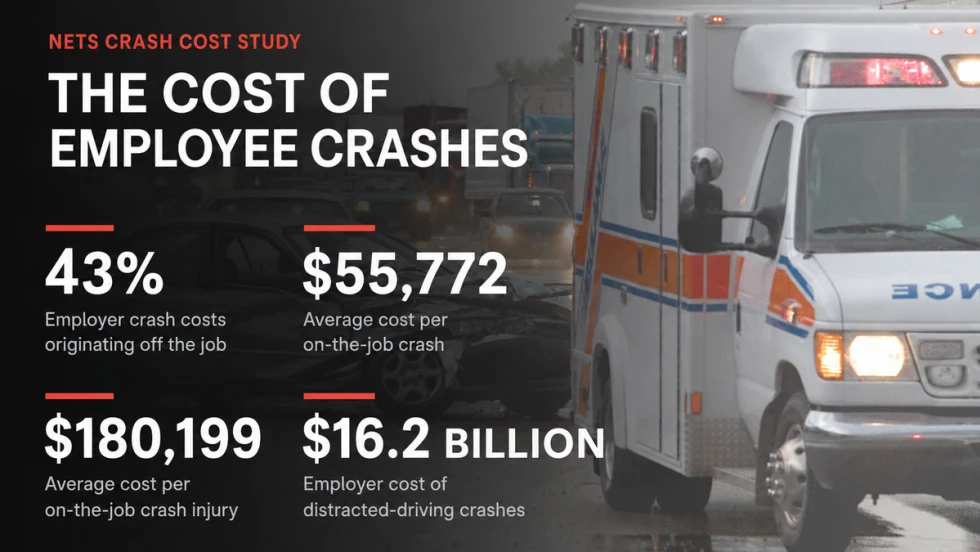
Off-the-Job Crashes Account for 43% of Employers’ $61.7 Billion Crash Burden
NETS quantifies costs dispersed across fleet, risk, HR, and other departments while providing new per-crash benchmarks for employers.
Read More →
Ram Recalls More Than 1.27 Million 1500 Pickups for Seat Belt Anchor Issue
The recall affects certain 2019-2026 Ram 1500 pickups that may have improperly attached second-row seat belt buckle anchors.
Read More →