




States Urged to Better Prepare for Autonomous Vehicles
A new report from the Governors Highway Safety Association offers recommendations to help state agencies get ready for the future impact of self-driving cars.
Graphic courtesy of GHSA.
Graphic courtesy of GHSA.
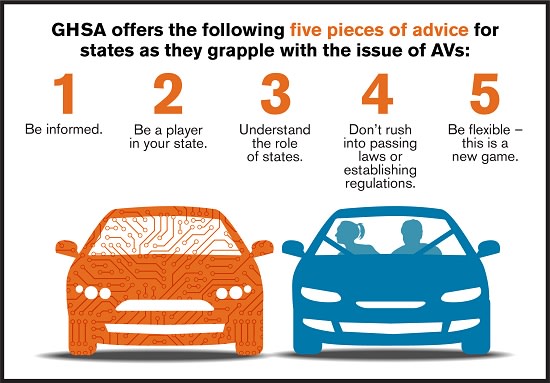
With more vehicle manufacturers and tech companies testing self-driving cars on public roads, the Governors Highway Safety Association has opted to release a report offering state governments advice on how to prepare for the future impact of autonomous vehicles. Among the GHSA recommendations: educate the public about the technology and don't rush into adopting regulations.
“The research and media attention given to autonomous vehicles often overlooks the safety implications that a mix of driver-operated and autonomous vehicles will bring,” said James Hedlund, the report’s author. “Unfortunately, ignoring the driver side of the equation may negate many of the expected safety benefits.”
Hedlund is a former senior official with the National Highway Traffic Safety Administration.
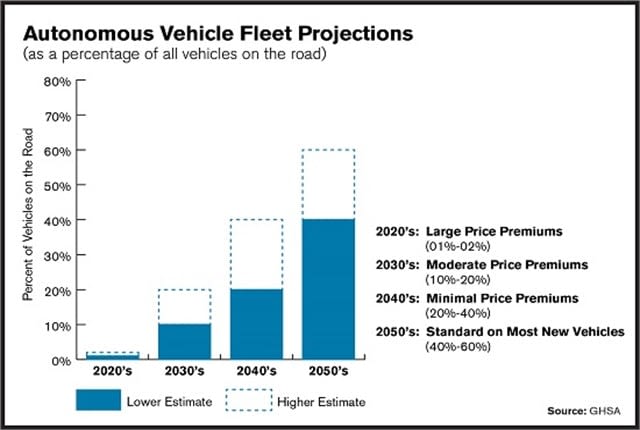
GHSA pointed out that autonomous vehicles will share the road with traditional driver-operated cars for many decades, perhaps forever. And the public remains skeptical. Polls suggest that only about one-fifth of drivers say they would buy an autonomous car as soon as one is available, and fewer than one-third say they would be comfortable riding in one. This presents a myriad of safety challenges for states, which are responsible for licensing drivers, educating the public about traffic safety, and establishing and enforcing traffic laws.
The newly released report, “Autonomous Vehicles Meet Human Drivers: Traffic Safety Issues for States,” provides an overview of the current autonomous vehicle landscape and outlines suggested priorities for state Departments of Motor Vehicles (DMVs) and Highway Safety Offices as autonomous vehicles become more widespread.
Key recommendations from the GHSA report include:
Educate the public — States should develop education campaigns on the benefits and risks of autonomous vehicles, how to operate vehicles with some autonomous features safely, and how to share the road with autonomous vehicles.
Don’t rush into passing laws — States should wait until model laws and regulations have been developed to encourage a common structure and prevent a patchwork of inconsistent laws and regulations that may delay autonomous vehicle implementation.
Capture the data — States should identify vehicle automation levels in their registration, driver licensing and crash information systems. Police crash reports should be designed to help facilitate comprehensive and accurate data collection.
Engage law enforcement — States should include law enforcement in their planning since autonomous vehicles raise a range of issues for law enforcement, including officer safety, enforcement procedures and vehicle identification.
Graphic courtesy of GHSA.
“Drivers are often forgotten as we discuss autonomous vehicles, but cars driven by humans will be on the road for at least another generation,” said Jonathan Adkins, GHSA executive director. “As human drivers begin to share the road with different levels of autonomous vehicles, states will need to stay informed, be patient and be flexible.”
To download the GHSA report, click here.
More Safety

Nexar-Nauto Merger Aims to Give Fleets Better Safety Intelligence Through Larger Driving Dataset
Stefan Heck tells Automotive Fleet that combining more than 10 billion miles of driving history with Nexar's AI models will give fleets deeper insights into driver risk and roadway conditions than either company could provide independently.
Read More →
Don't Wait for a Crisis: 5 Ways to Build Mental Health Into Your Fleet Safety Program
For Suicide Prevention Month, fleet and safety leaders have an opportunity to put mental health where it belongs: at the center of workplace safety.
Read More →
How Camera Data Can Strengthen a Fleet’s Insurance Renewal
Insights from a commercial insurance carrier and a broker show how fleets can turn video telematic data, driver coaching, and improved claims results into a stronger case at insurance renewal.
Read More →
The Safest Fleets Aren’t the Ones with the Most Technology
You’ve made the telematics investment. Here’s how to capture the other half of its value and build the safest fleet on the road.
Read More →
Hidden in Plain Sight: Fleet Compliance Risks
Fleet compliance isn't just about having policies — it's about consistently enforcing them. This practical guide reveals six hidden compliance risks common in public sector and shared fleet operations and outlines proven strategies to improve visibility, accountability, and audit readiness
Read More →
NETS Sets 2026 Fleet Safety Benchmark Conference for Indianapolis
The Sept. 15–17 program will feature fleet benchmarking data, case studies, emerging technologies, and implementation strategies while running alongside the NSC Safety Congress & Expo.
Read More →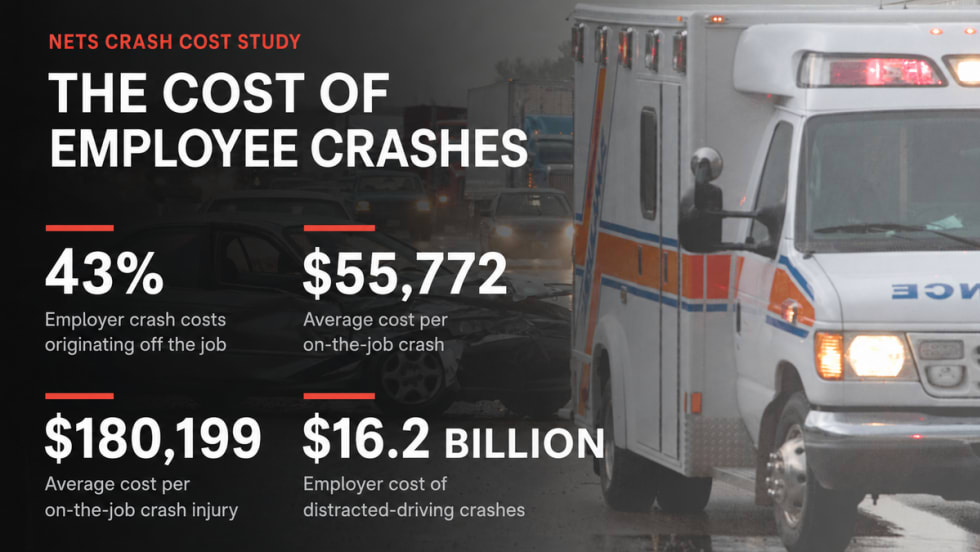
Off-the-Job Crashes Account for 43% of Employers’ $61.7 Billion Crash Burden
NETS quantifies costs dispersed across fleet, risk, HR, and other departments while providing new per-crash benchmarks for employers.
Read More →
Ram Recalls More Than 1.27 Million 1500 Pickups for Seat Belt Anchor Issue
The recall affects certain 2019-2026 Ram 1500 pickups that may have improperly attached second-row seat belt buckle anchors.
Read More →
How Better Visibility Cut Speeding Violations by 48%
Fleet leaders don't need more data, they need clearer visibility into what the data is saying. This case study explores how one utility replaced speeding-event counts with a single metric — miles driven in violation — to strengthen safety and significantly reduce speeding violations.
Read More →
Operation Safe Driver Week: Why the Industry's Oldest Safety Campaign Still Matters to Fleets
A look at how a 2007 enforcement initiative became one of the most consequential weeks on the fleet safety calendar, and what it means for your drivers in 2026.
Read More →