




Self-Driving Cars Capable of Extreme Evasive Moves
A team of Stanford engineers is developing autonomous driving algorithms to allow the kind of extreme crash-avoidance maneuvers normally associated with professional drivers.

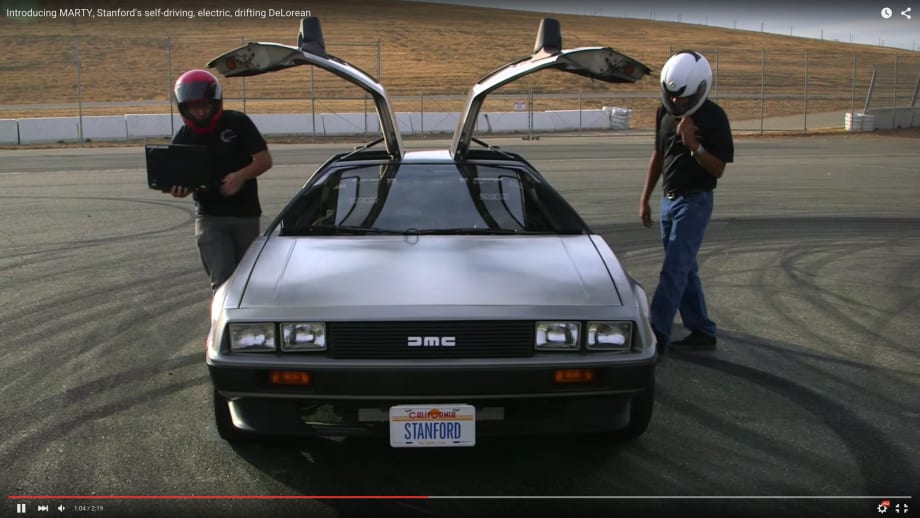
Photo: Stanford
Imagine riding in a self-driving car that's capable of the kind of extreme collision-avoidance maneuvers normally reserved for professional drivers who specialize in movie stunts or competitive racing.
That's a research mission taking shape at Stanford University. A team of engineers has transformed a vintage 1981 DeLorean into an electric vehicle fit to test the physical limits of autonomous driving. The latest addition to Stanford’s research fleet is nicknamed MARTY– short for Multiple Actuator Research Test bed for Yaw control. As you’ve probably guessed, the name pays homage to Michael J. Fox’s character in “Back to the Future.”
“We want to design automated vehicles that can take any action necessary to avoid an accident,” explained Chris Gerdes, a professor of mechanical engineering. “The laws of physics will limit what the car can do, but we think the software should be capable of any possible maneuver within those limits. MARTY is another step in this direction, thanks to the passion and hard work of our students.”
Playing a key role in the project is Jonathan Goh, a mechanical engineering graduate student in Gerdes’ Dynamic Design Lab (DDL). One of his challenges has been programming the car to handle all operating regimes, not just the simple one that electronic stability control imposes. The vehicle needs to be capable of determining when to sacrifice vehicle stability in order to execute a demanding evasive move.
“When you watch a pro driver drift a car, you think to yourself that this person really knows how to precisely control the path and angle of the car, despite how different it is from normal driving,” Goh said. “The wheels are pointed to the left even though the car is turning right, and you have to very quickly coordinate the throttle and steering in order to keep the car from spinning out or going the wrong way. Autonomous cars need to learn from this in order to truly be as good as the best drivers out there.”
Eventually, the test car will learn how to race around a track using this drifting technique to negotiate tight turns around obstacles when necessary. Already, the car can autonomously lock itself into a continuous, precisely circular doughnut at a large drift angle. The feat demonstrates Goh’s expertise in controls engineering.
Stanford researchers built MARTY in collaboration with Renovo Motors, a Silicon Valley company specializing in advanced electric vehicle technology. The partnership gave the Stanford team early access to a new platform derived from Renovo’s electric vehicle that delivers 4,000 pound-feet from on-motor gearboxes to the rear wheels in a fraction of a second. This permitted precise control of the forces required to drift. A central application programming interface (API) manages the systems, allowing a rapid integration process.
The collaboration has allowed Gerdes’ students to focus on the subsystems and algorithms most critical to the research project’s goals. On Oct. 20, the Revs Program at Stanford and the Center for Automotive Research at Stanford (CARS) hosted an event that introduced the vehicle to the public.
“In our work developing autonomous driving algorithms, we’ve found that sometimes you need to sacrifice stability to turn sharply and avoid accidents,” Gerdes said. “The very best rally car drivers do this all the time, sacrificing stability so they can use all of the car’s capabilities to avoid obstacles and negotiate tight turns at speed. Their confidence in their ability to control the car opens up new possibilities for the car’s motion. Current control systems designed to assist a human driver, however, don’t allow this sort of maneuvering. We think that it is important to open up this design space to develop fully automated cars that are as safe as possible.”
More Safety

Nexar-Nauto Merger Aims to Give Fleets Better Safety Intelligence Through Larger Driving Dataset
Stefan Heck tells Automotive Fleet that combining more than 10 billion miles of driving history with Nexar's AI models will give fleets deeper insights into driver risk and roadway conditions than either company could provide independently.
Read More →
Don't Wait for a Crisis: 5 Ways to Build Mental Health Into Your Fleet Safety Program
For Suicide Prevention Month, fleet and safety leaders have an opportunity to put mental health where it belongs: at the center of workplace safety.
Read More →
How Camera Data Can Strengthen a Fleet’s Insurance Renewal
Insights from a commercial insurance carrier and a broker show how fleets can turn video telematic data, driver coaching, and improved claims results into a stronger case at insurance renewal.
Read More →
The Safest Fleets Aren’t the Ones with the Most Technology
You’ve made the telematics investment. Here’s how to capture the other half of its value and build the safest fleet on the road.
Read More →
Hidden in Plain Sight: Fleet Compliance Risks
Fleet compliance isn't just about having policies — it's about consistently enforcing them. This practical guide reveals six hidden compliance risks common in public sector and shared fleet operations and outlines proven strategies to improve visibility, accountability, and audit readiness
Read More →
NETS Sets 2026 Fleet Safety Benchmark Conference for Indianapolis
The Sept. 15–17 program will feature fleet benchmarking data, case studies, emerging technologies, and implementation strategies while running alongside the NSC Safety Congress & Expo.
Read More →
Off-the-Job Crashes Account for 43% of Employers’ $61.7 Billion Crash Burden
NETS quantifies costs dispersed across fleet, risk, HR, and other departments while providing new per-crash benchmarks for employers.
Read More →
Ram Recalls More Than 1.27 Million 1500 Pickups for Seat Belt Anchor Issue
The recall affects certain 2019-2026 Ram 1500 pickups that may have improperly attached second-row seat belt buckle anchors.
Read More →
How Better Visibility Cut Speeding Violations by 48%
Fleet leaders don't need more data, they need clearer visibility into what the data is saying. This case study explores how one utility replaced speeding-event counts with a single metric — miles driven in violation — to strengthen safety and significantly reduce speeding violations.
Read More →
Operation Safe Driver Week: Why the Industry's Oldest Safety Campaign Still Matters to Fleets
A look at how a 2007 enforcement initiative became one of the most consequential weeks on the fleet safety calendar, and what it means for your drivers in 2026.
Read More →